Google has announced the rollout of major security upgrades for its Chrome browser designed to protect users against sophisticated "ClickFix" social engineering attacks, while Apple has simultaneously introduced robust new privacy features in Safari to combat cross-site tracking.
The security updates to Google Chrome, which are being deployed for users who have the Enhanced Protection setting enabled, target an increasingly popular method used by malicious actors to compromise computer systems. ClickFix attacks bypass traditional browser-based security controls by tricking unsuspecting users into executing malicious code directly within their operating systems.
Understanding the ClickFix Threat Vector
ClickFix is a social engineering technique where bad actors manipulate users into copying and pasting malicious code directly into their computer’s operating system. These attacks typically begin when a user lands on a legitimate-but-compromised website or encounters a malicious advertisement. The user is then redirected to a fraudulent phishing landing page that displays fake warnings, such as non-existent Cloudflare or Google reCAPTCHA verification failures or other system errors.
The deceptive pages instruct the user to resolve the issue by copying a specific command and pasting it into the Windows Run dialog or the Mac Terminal application. The moment the user presses the Enter key after executing the pasted command, a multi-stage infection chain is initiated. This process rapidly deploys malware, including information stealers or remote access trojans designed to harvest sensitive data.
To blend in with normal system activity and successfully evade detection, these malicious commands frequently leverage living-off-the-land tools, such as PowerShell or cmd.exe, to download subsequent payloads. ClickFix remains an exceptionally effective initial access vector because it fundamentally inverts traditional phishing paradigms. Rather than exploiting complex software vulnerabilities or convincing a user to click on suspicious web links, the technique induces the user to willingly open the front door themselves under the guise of troubleshooting an ordinary technical error.

Google noted that by shifting the download process entirely out of the browser environment and directly into the system terminal, malicious actors manage to completely bypass existing Chrome and Safe Browsing download protections. To combat this evolving tactic, Chrome has been updated to detect when a user with Enhanced Protection enabled has been manipulated into copying suspicious command strings.
Advanced Threat Detection and User Protection
Under the new security framework, if a user copies a potential ClickFix script, the payload held in the clipboard is first scrubbed of any personal information it might contain. It is then securely transmitted to Google Safe Browsing for deeper analysis. If the security infrastructure identifies the command as malicious, Chrome immediately issues a prominent warning to the user, effectively intercepting the attack before the hazardous command can be executed.
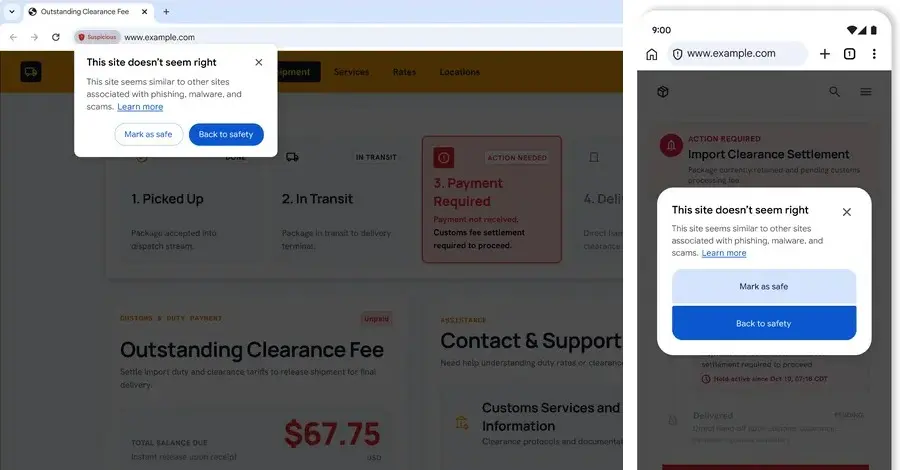
In addition to countering ClickFix campaigns, Google is introducing advanced scam-detection defenses in Chrome specifically tailored for users operating under Enhanced Protection. This evaluation model assesses page content by analyzing critical indicators, including the brand being represented, the primary intent of the web page, and a calculated scam-likeliness score. This yields comprehensive threat intelligence required to identify and isolate deceptive websites swiftly.
Google emphasized that Chrome minimizes data transmission during this evaluation process by analyzing page text exclusively when a website exhibits high-confidence scam indicators. Furthermore, whenever page content must be processed off the device, it is handled ephemerally. This ensures that the data is never permanently logged, retained, or utilized for training machine learning models.
Strengthening Financial Services Security
Parallel to its browser-level interventions, Google announced the expansion of its Financial Services Verification policy to the United States and Canada. This verification initiative aims to validate the credentials of digital advertisers and guarantee that financial advertisements originate strictly from authorized and legitimate providers. The program is already active across several global markets, including Australia, Brazil, India, Indonesia, Malaysia, New Zealand, Türkiye, and multiple European nations.

Under this regulatory policy, advertisers are required to demonstrate formal authorization from relevant government regulators or recognized industry registries before they are permitted to run specific financial advertisements. This measure is intended to prevent corporate brand impersonation and stop bad actors from reaching vulnerable consumers.
As part of this rollout, Google is collaborating closely with the American Bankers Association in the United States to utilize their dedicated registry to verify authorized banking institutions prior to ad publication. In Canada, similar collaborative preparations are underway with the Canadian Bankers Association as the policy launch approaches.
Apple Blocks Identity Resolution in Safari and WebKit
In a related development concerning user privacy, Apple has revealed new protective measures built directly into Safari and WebKit across upcoming software releases, including iOS, iPadOS, macOS, and visionOS. These updates take aim at an invasive practice known as identity resolution, which converts ordinary user email addresses into persistent tracking identifiers.
According to Apple’s WebKit team, identity resolution involves third-party entities—distinct from the actual website owner—invisibly harvesting a user’s email address when they log into a service or subscribe to a newsletter. These third parties transmit the email address to external servers, generate an opaque tracking identifier permanently linked to that email address, and return the tracking ID to the web page.
Once established, this tracking ID is stored on the website and can subsequently be repurposed for arbitrary tracking activities tied directly to the user’s email address, such as constructing detailed behavioral profiles or targeting advertisements across unrelated websites. Crucially, logging out of an account or unsubscribing from a newsletter fails to remove the tracking identifier or erase the email address stored by the third party.

Apple noted that these third-party entities aggregate extensive user data over time as individuals log in with their email addresses or complete forms containing personal information. This process enables the creation of comprehensive identity graphs encompassing names, residential addresses, phone numbers, and IP addresses.
To counteract cross-site tracking of this nature, Safari now blocks network access to identity resolution infrastructure embedded within web pages at the domain level, effectively preventing third parties from transmitting captured email addresses to their external servers. Apple stated that blocking cross-site cookies alone is no longer sufficient in the modern web ecosystem because the tracking industry continues to adapt in the post-cookie era, necessitating robust and comprehensive platform-level defenses.