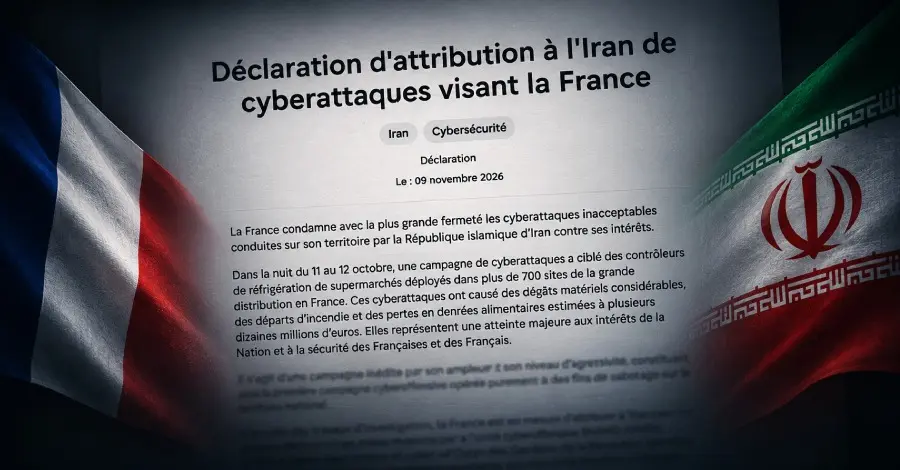
The French government has formally pointed the finger at a cyber unit operating within Iran’s Islamic Revolutionary Guard Corps (IRGC) for a sophisticated and destructive wave of cyberattacks that targeted refrigeration controllers across approximately 700 retail sites throughout France in October. The coordinated digital assault led to widespread food spoilage, significant financial losses, and a series of dangerous structural fires, marking what authorities describe as the first major offensive cyber sabotage campaign conducted on French soil solely aimed at causing physical disruption and economic damage.
According to French officials, the malicious activity took place on the night of October 11, when unauthorized actors managed to breach connected industrial controllers governing refrigeration equipment. Once inside, the perpetrators maliciously reconfigured the system defrost settings, driving temperatures up to unacceptably high levels. This sudden thermal shift compromised vast quantities of perishable goods, resulting in estimated food losses reaching tens of millions of euros. Furthermore, the tampering disabled essential safety alerts tied to temperature probes, which are normally programmed to sound alarms when thresholds are exceeded. The compounding technical failures triggered roughly twenty distinct fires across the affected facilities, putting workers and emergency responders at severe risk.
The state-backed hacking entity responsible for the operation has been identified by French authorities as Shahid Kaveh. While operating under the direct authority of the IRGC, the unit frequently utilizes public hacktivist personae, including CyberAveng3rs and Cyber Isnaad Front, to publicly claim credit for its disruptive actions. In response to the attribution, the French Foreign Ministry announced plans to summon the Iranian ambassador to Paris. Additionally, France intends to lobby its European Union partners to implement a new package of targeted sanctions against the specific Iranian organizations and individuals found to be complicit in the attacks.
Simultaneously, the Paris prosecutor’s office announced the opening of a formal judicial investigation targeting the head of the Shahid Kaveh unit, two of his primary deputies, and any other co-conspirators identified during the ongoing probe. French authorities have formally requested international arrest warrants for the key suspects. The legal charges under consideration include the unauthorized and malicious interference with automated data processing systems, as well as causing property and physical damage through means dangerous to human life—charges that carry heightened penalties due to the aggravating factor of acting on behalf of a foreign power, namely Iran.
Investigators from the Paris prosecutor’s office revealed that the attackers gained unauthorized remote access to Danfoss and Dixell refrigeration controllers through exposed web management interfaces. By initiating indefinite, abnormal defrost cycles and manually bypassing temperature safety alerts, the perpetrators engineered conditions designed to maximize physical destruction. The impact was felt heavily across major French retail chains, with a joint incident report issued by France’s cyber crisis coordination center—known as C4—confirming that prominent supermarket groups such as Casino, Leclerc, Coopérative U, Metro, Carrefour, and Intermarché were among the primary victims. Beyond large corporate grocery networks, the cyber intrusion also disrupted smaller independent businesses, including local butcher shops, a regional slaughterhouse, and several cooperative food manufacturing plants.

The cyber crisis coordination center, which unites France’s national cybersecurity agency ANSSI, the DGSE and DGSI intelligence services, the ministerial directorate for armaments, and the cyber defense command, noted that the refrigeration sabotage was not an isolated incident. Investigators discovered that the same digital infrastructure used in the supermarket breach was simultaneously leveraged to conduct reconnaissance against Schneider Electric equipment deployed at several small-scale hydroelectric installations across France. While the interference with the water and energy production facilities resulted in only moderate technical effects, it demonstrated a broader campaign strategy targeting critical industrial infrastructure.
How France Tied the Attack to Iran
The conclusive attribution delivered by the French government rests upon a robust foundation of technical indicators and intelligence gathered by the C4 collective, the national anti-cybercrime office OFAC, and the DGSI security service. Analysts identified four primary pillars connecting the October incidents directly to the IRGC and the Shahid Kaveh unit.
First, the network infrastructure utilized during the supermarket assault matched the infrastructure employed during the contemporaneous reconnaissance phase targeting Schneider Electric equipment at water and energy installations. This reconnaissance phase relied heavily on specific Tactics, Techniques, and Procedures (TTPs) that security researchers have tracked as hallmarks of Shahid Kaveh operations since at least April.
Second, the actors relied on FOFA, a specialized network scanning tool frequently employed by the Iranian unit in their preliminary intelligence-gathering phases. Third, digital footprints left behind on the command-and-control infrastructure included distinct references to the Persian language. Crucially, a propaganda outlet associated with the hacking group, known as CyberbanNews, published detailed reports concerning the sabotage operation as early as October 13, days before broader public awareness of the physical damage became widespread.
Further supporting the official attribution, criminal investigators traced the origin of the network connections back to internet protocol addresses leading directly to devices located within Iran. The operational methodologies mirrored patterns observed in previous international incidents linked to the same threat group. According to C4, Shahid Kaveh—operating via the CyberAveng3rs persona—previously claimed responsibility for a prominent November 2023 campaign targeting industrial programmable logic controllers manufactured by Unitronics, an Israeli company providing industrial control systems. Furthermore, the unit claimed credit for a sweeping series of digital sabotage operations directed against Israeli and American industrial interests throughout March and April, which similarly targeted industrial control technology, including international refrigeration machinery.

Despite the sweeping scope of the French investigation and subsequent diplomatic measures, French attribution statements did not explicitly address a separate, subsequent wave of cyberattacks targeting supermarket refrigeration systems that struck multiple other European countries in early November.
What Operators Should Disclose and Remediate
In the wake of the destructive campaign, France’s national computer emergency response team, CERT-FR, issued an urgent security advisory warning that ongoing scanning and exploitation attempts targeting vulnerable remote refrigeration management systems remain active. The alerts center on four major product families that were heavily compromised during the October attacks: the Danfoss AK-SM and AK-SC series, the Copeland Xweb systems, and the Dixell Xweb controllers.
Cybersecurity authorities emphasized that exposing administrative and management interfaces directly to the public internet violates basic security hardening practices. For devices that have managed to avoid compromise, operators have been strongly urged to isolate management portals behind secure virtual private networks, implement strict multi-factor authentication, and apply available firmware updates immediately.
For industrial controllers that have already suffered compromise, security experts warn that superficial remediation is entirely insufficient. Devices that have reached their end-of-life cycle and no longer receive vendor security patches face an extreme risk of reinfection if left accessible via the internet. In such scenarios, performing a simple factory reset merely removes the immediate persistence mechanisms established by the threat actors without closing the underlying vulnerabilities. Authorities caution that unpatched, internet-exposed legacy devices will almost certainly be re-compromised by state-sponsored actors seeking further disruption.