A coordinated wave of cyberattacks has struck supermarkets and food businesses across multiple European countries, leaving retailers scrambling to secure their facilities after attackers remotely tampered with refrigeration and freezer controls. The incidents, which unfolded overnight into Monday, November 2, impacted commercial operations in Belgium, Sweden, Estonia, Ireland, the Netherlands, Finland, Portugal, Italy, and Luxembourg.
The attacks involved unauthorized remote access to programmable controllers that regulate commercial refrigeration units. In many cases, the malicious actors shifted the equipment into defrost mode or drastically elevated temperature settings, causing fridges and freezers to heat up rather than maintain cold storage temperatures. While no single retail chain reported widespread devastation across its entire portfolio, several dozen stores across various companies were affected, forcing operators to discard spoiled inventory or remove chilled and frozen goods from shelves as a precautionary measure.
Danfoss, a prominent Danish manufacturer of refrigeration controls, confirmed that its products were involved in the intrusions. The security breach mirrors a similar large-scale campaign that struck hundreds of French supermarkets approximately three weeks prior. By Monday night, no group or individual had claimed responsibility for the cross-border operation, and authorities had not yet confirmed whether the latest incidents were directly linked to the earlier French cyberattacks.
Refrigeration controls act as the computerized nervous system for modern grocery stores, managing complex temperature networks for perishable goods. To facilitate maintenance and rapid troubleshooting, these systems are frequently connected to external networks, allowing third-party refrigeration contractors to monitor performance and rectify faults remotely. However, investigators and industry experts have pointed out that legacy equipment, outdated firmware, and inadequate network segregation have left these vital operational technology systems vulnerable to exploitation.
The scale of the disruption varied across jurisdictions and corporate networks. In Belgium, where multiple retail brands reported localized incidents, attackers systematically targeted individual store setups. Stephan Moelans, chief executive of the Belgian refrigeration contractor Sabcobel, explained that malicious actors switched cooling units into defrost mode. While defrost cycles are standard maintenance features designed to clear ice accumulation from coils, manipulating them remotely caused the units to actively heat up. Sabcobel, which manages refrigeration infrastructure for major chains including Delhaize, noted that attackers penetrated the localized networks of individual supermarkets rather than the central systems of the contractors themselves.
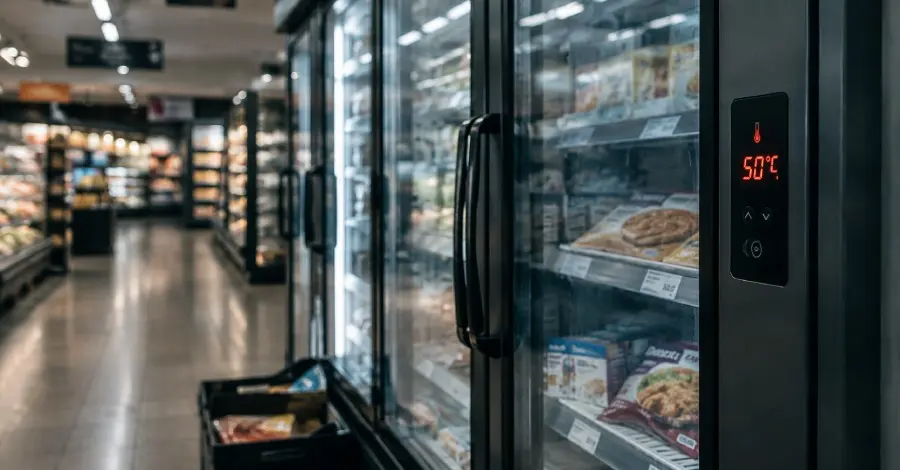
At a butcher shop operated by De Laet & Van Haver in Hove, south of Antwerp, internal temperatures soared as high as 18 degrees Celsius. Store owner Luc De Laet estimated that approximately 15,000 euros worth of high-grade meat was ruined by the sudden thermal spike. Similar extreme adjustments were documented elsewhere in Europe. In southern Sweden, an ICA supermarket in Sjöbo reported that its display units had been programmed to reach 50 degrees Celsius, prompting immediate disposal of affected merchandise. A parallel incident occurred at a Selver supermarket in Estonia, where a freezer control system was likewise pushed to 50 degrees Celsius. According to Jann Mutso, chief executive of refrigeration supplier Kitman Coldtech, the affected Selver location experienced a modest interior temperature rise of only two to three degrees due to rapid intervention. Store personnel resolved the issue within ten minutes, preventing any product damage.

Which Companies Say They Were Hit
Major European retail groups and independent merchants reported varying degrees of disruption, with corporate communications reflecting diverse assessments of the technological failures.
In Belgium and Luxembourg, the Delhaize chain reported that several dozen stores experienced an IT incident that impacted refrigeration systems, resulting in a temporary reduction of fresh and frozen food selections. Competitor Carrefour confirmed a cyberattack targeting the refrigeration controls of 15 locations out of its network of more than 700 stores, though it described the operational impact as very limited. Intermarché reported localized problems affecting 10 to 15 stores, while independent operators running five Spar locations under the Colruyt Group umbrella confirmed direct interference with their cooling infrastructure. A single IKEA store in Mons, Belgium, also reported a cyber incident affecting its refrigeration units, with no other Belgian locations impacted.
In Sweden, ICA confirmed that a limited number of its stores experienced temperature anomalies linked to an outside refrigeration control system supplied by Danfoss, though corporate leadership stopped short of formally classifying the event as a cyberattack. Meanwhile, Swedish rival Coop reported to media outlets that between six and seven of its approximately 800 stores were subjected to a cyber incident involving unauthorized tampering with refrigeration equipment.
Irish retailer Musgrave, owner of the SuperValu brand, disclosed that 13 of its 223 stores were impacted by a cyber incident restricted to a single model of refrigeration equipment. As a precautionary measure, the company pulled all chilled and frozen products from sale across those locations before resolving the issue and initiating restock procedures.
Operations in the Netherlands, Finland, Portugal, and Italy also registered disturbances. Danfoss reported that at least 17 businesses in the Netherlands, including local butcher shops and small independent merchants, suffered unauthorized temperature adjustments. In Finland, Kesko observed unusual temperature readings at a small number of smaller stores operating outside central corporate protections, prompting an ongoing internal investigation. In Portugal, the Mosqueteiros group reported that seven Intermarché stores were hit by a cyberattack that appeared to target an external management vendor. In Italy, at least four Coop supermarkets operated by the Radenza Group in Sicily reported malicious interference targeting remote control systems for frozen food sections.
What Companies Say About the Equipment and the Way In

Investigations into the intrusion vectors point heavily toward legacy hardware, default configurations, and unpatched software vulnerabilities in industrial control devices. Danfoss equipment was explicitly implicated across multiple territories, including Sweden and Estonia, where attackers gained access to the control computers of older operating platforms.
In the Netherlands, a Danfoss spokesperson revealed that the affected systems were operating without secure network perimeters and still relied on default factory passwords. While the majority of Dutch retailers had implemented defensive hardening measures following the earlier French attacks, a small subset of businesses had failed to update their security posture, leaving them exposed to the follow-up campaign. Danfoss representatives also indicated to broadcasters in Belgium that the core vulnerability stemmed from outdated software versions remaining unpatched on client premises.
Independent contractors corroborated these assessments. Sabcobel noted that while many of its Belgian retail clients heeded warnings to secure their internet connections following the French incidents, those that delayed implementation remained vulnerable. Kitman Coldtech reported that in Estonia, the targeted facility was the final location within its client base that had yet to be migrated to a modernized system. Representatives for ICA emphasized that the compromised Swedish stores utilized an external supplier network entirely segregated from ICA’s primary corporate infrastructure.
Official cybersecurity bodies have previously issued targeted warnings regarding vulnerable industrial controllers. Advisory notices from France’s national cybersecurity agency, CERT-FR, highlighted specific risks associated with Danfoss AK-SM and AK-SC series controllers, alongside Copeland and Dixell xweb devices. Security alerts emphasized that end-of-life hardware no longer receiving vendor patches remains highly susceptible to compromise if exposed directly to the internet without multi-layered network protections or proper credential management. National cybersecurity centers across Sweden, Belgium, and other European jurisdictions have reiterated calls for organizations to conduct comprehensive asset inventories, disconnect unnecessary remote management interfaces from public networks, and apply necessary firmware updates or hardware replacements.
Who Is Behind It
While industry observers and cybersecurity experts have pointed out clear operational similarities between the overnight tampering in Belgium, Sweden, Estonia, and the earlier large-scale incidents in France, authorities have cautioned that shared technical methods do not definitively confirm a common perpetrator.
Belgium’s Centre for Cybersecurity stated that the identity of the threat actors remains unknown, noting that attribution may ultimately prove difficult or impossible to establish. In response to the growing operational disruptions, the Belgian federal prosecutor’s office confirmed that a formal criminal investigation has been initiated. Concurrently, Sweden’s National Cybersecurity Centre announced it is actively monitoring the situation and sharing intelligence with regional and European partners to mitigate further risk and trace the origins of the unauthorized access.