Decentralized exchange Hyperliquid and memecoin launchpad Pump.fun have emerged as the primary drivers behind a historic wave of capital deployment in the digital asset sector, reportedly accounting for nearly 90% of a record $638 million in token buybacks carried out by cryptocurrency projects so far in 2026.
According to data compiled by Allium Labs and cited in a recent Financial Times report, crypto projects have collectively spent a record $638 million year-to-date to repurchase their native cryptocurrencies. This figure marks a significant acceleration from previous years, up sharply from the $545 million recorded during the same period in 2025 and a minuscule $366,000 spent across the entire sector in 2024. Of the staggering $638 million total registered leading up to late August, decentralized derivatives platform Hyperliquid alone accounted for roughly $370 million, while prominent memecoin deployment platform Pump.fun drove nearly $200 million in repurchases.
The mechanism of token buybacks functions much like traditional share buybacks executed by publicly listed corporations on conventional stock exchanges. In traditional equity markets, companies repurchase their own shares to reduce circulating supply, support market prices, and increase intrinsic returns for existing shareholders. While token buybacks have historically been relatively rare within the nascent cryptocurrency industry—where projects more frequently relied on inflationary token emissions, staking rewards, or direct treasury distributions—a growing number of decentralized finance protocols and infrastructure providers are adopting corporate-style capital management strategies.

This shift toward capital return mechanisms gained further momentum when the Ethena Foundation opened a vote on a major fee-switch proposal. Under the terms of the proposal, 95% of the net revenue paid directly to the foundation from Ethena’s core business lines would be systematically utilized to repurchase Ethena (ENA) tokens from the open market. The market reaction was swift and positive, with the ENA token rising 10.7% on the day following the announcement, illustrating how sensitive investor sentiment has become to protocol-level value accrual models.
HYPE, PUMP Outperform Crypto Market as Buybacks Boost Token Valuations
The aggressive capital allocation strategies pursued by leading platforms have translated directly into tangible market strength. The native tokens of Hyperliquid (HYPE) and Pump.fun (PUMP) have notably outperformed the broader cryptocurrency market downturn observed during the first eight months of 2026.
TradingView market data indicates that HYPE surged 145% and PUMP climbed 109% year-to-date. These impressive gains contrast sharply with the macro environment characterized by a 10% price decline for Bitcoin (BTC) and an 11.9% contraction in total cryptocurrency market capitalization over the same timeframe. Industry analysts attribute this relative outperformance largely to the continuous demand pressure and reduced circulating supply generated by systematic token buybacks.
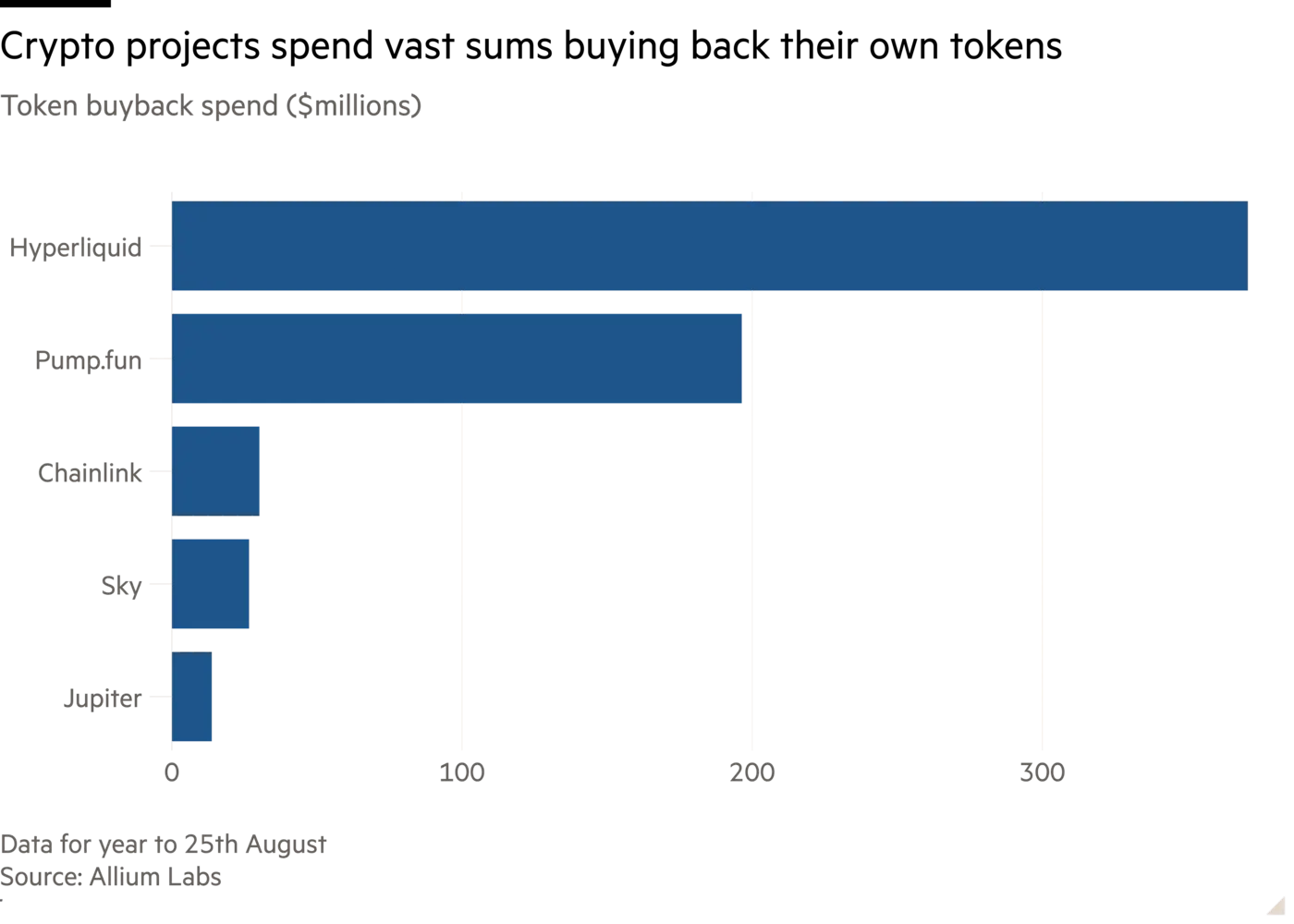
The scale of these repurchases is directly tied to the robust underlying business models and fee generation capabilities of the protocols. Hyperliquid, for instance, reinvests roughly 99% of its operational revenue directly back into token buybacks. Demonstrating its strong financial performance, Hyperliquid reported $169 million in revenue for the second quarter alone on August 6, out of which it directed a formidable $141 million toward repurchasing HYPE tokens.
Similarly, Pump.fun allocates approximately 50% of its net protocol revenue toward token repurchases. The high-volume memecoin launchpad currently commands an annualized revenue figure of $420 million, calculated based on the average daily revenue generated over the preceding 90 days. Such consistent cash flows provide the financial foundation necessary to sustain large-scale, ongoing buyback programs even during broader market corrections.
Market observers suggest that this strategic evolution could permanently alter how digital assets are valued by institutional and retail investors alike. Speaking earlier in August, Bitwise Chief Investment Officer Matt Hougan noted that overall crypto valuations could potentially double over the next two years as a growing number of protocols transition toward using organic revenue to fund token buybacks and permanent token burns. By shifting away from purely speculative tokenomics and toward models that return tangible economic value to token holders, successful decentralized applications are increasingly aligning their long-term growth with the interests of their investor communities.