As rising geopolitical tensions continue to introduce volatility across global markets, a new and potentially catastrophic concern has gripped the digital asset ecosystem. The cryptocurrency industry is currently engaged in a heated debate over a cryptography doomsday scenario, driven by fears that rapid advancements in artificial intelligence could allow malicious actors to derive private cryptographic keys directly from public keys. This theoretical breakthrough, once considered far-fetched, has sparked urgent discussions about the foundational security of blockchain networks and the safety of billions of dollars in digital assets.
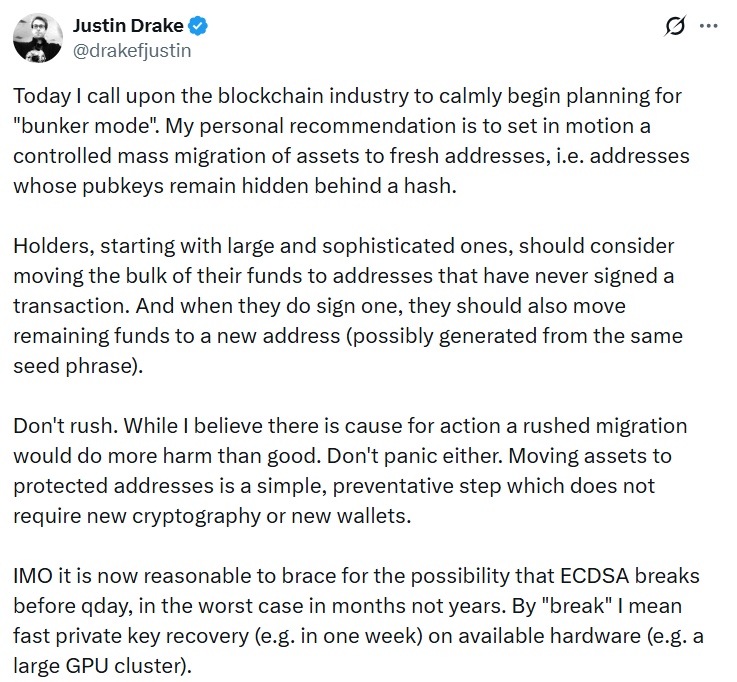
The debate intensified last week when Ethereum researcher Justin Drake called for "bunker mode" planning. Citing what he described as "humbling" advancements in artificial intelligence, Drake warned that these technological leaps could significantly accelerate the discovery of mathematical attacks capable of ultimately breaking core cryptographic systems. In a public statement shared on social media, Drake stated that it is now reasonable to brace for the possibility that the Elliptic Curve Digital Signature Algorithm, commonly known as ECDSA, could break before the anticipated arrival of functional quantum computing, known as Q-day, noting that in a worst-case scenario, such a vulnerability could emerge in months rather than years.
To mitigate this perceived threat, Drake suggested that the broader cryptocurrency industry should begin planning a controlled migration of digital assets to fresh, unused addresses. By moving funds to addresses where public keys have not yet been exposed, users could theoretically reduce the amount of information available for a potential attacker to exploit. However, this stark warning has triggered widespread division among cryptographers, blockchain developers, and industry leaders regarding whether the panic is genuinely justified or an overreaction to a remote theoretical risk.
Is the Crypto Panic Justified?

The core of Drake’s concern extends beyond the traditional timeline for quantum computers, which are widely expected to eventually break current cryptographic standards. Instead, his warning focuses on the possibility that modern AI systems could independently discover novel mathematical attacks using classical computing power—methods that human cryptographers have thus far overlooked.
Drake argues that elliptic curves, the cryptographic foundation underlying the vast majority of modern blockchains, possess a greater degree of mathematical structure compared to hash functions. This structural complexity, he contends, makes elliptic curve cryptography potentially more vulnerable to unexpected classical algorithmic breakthroughs.
The warning quickly drew reactions from prominent figures across the sector. Matthew Green, a cryptography professor at Johns Hopkins University, weighed in on the assessment, amplifying concerns by suggesting that the industry might face a reality where public key cryptography is severely compromised.
Conversely, prominent cryptographic experts have pushed back against the alarmism. Yehuda Lindell, head of cryptography at Coinbase, stated that to his knowledge, there is no evidence whatsoever indicating that the decades-old mathematical assumptions underpinning elliptic curve cryptography have been weakened. This sentiment was echoed by Lucien Bourdon, a Bitcoin analyst at the hardware wallet manufacturer Trezor. According to Bourdon, there are currently no credible published advances against the underlying mathematics of ECDSA, whether driven by artificial intelligence or any other technology.
Bourdon noted that recent publications of AI-written mathematics papers by organizations like OpenAI have not introduced any viable attacks on ECDSA. While Drake views the absence of such discoveries with suspicion, Bourdon emphasizes that Drake’s timeline represents an extreme worst-case scenario and that industry participants should avoid reacting with undue panic. Furthermore, critics have pointed out that moving funds may not provide the absolute security advocates claim, particularly when considering how modern wallet infrastructure operates.
Why Moving Coins May Not Be Enough
Addressing the practical limitations of "bunker mode," Zach Herbert, chief executive and co-founder of hardware wallet provider FoundationHQ, explained that simply moving funds to fresh addresses within the same account may prove insufficient. Many modern wallets utilize extended public keys, known as xpubs, which allow applications to generate multiple public keys for a single account automatically, including addresses that have never been actively used.
If a wallet application or a third-party service has already been granted access to an extended public key, that entity or any potential attacker already possesses the necessary information to derive the public keys users are attempting to conceal. In a scenario where ECDSA became practically breakable, an attacker could potentially recover corresponding private keys without ever needing to interact with a physical hardware wallet.
Eli Ben-Sasson, co-founder and chief executive of the Ethereum scaling protocol StarkWare, concurred that moving coins alone is far from sufficient protection. He noted that if users ever wish to utilize their assets again after such a cryptographic failure, they would be forced to adopt entirely new wallet architectures. Furthermore, Ben-Sasson highlighted that a breach of this magnitude would impact far more than basic wallet signatures. Ethereum’s infrastructure-level signatures, consensus mechanisms, and data availability components, such as the Kate-Zaverucha-Goldberg polynomial commitment scheme used for data blobs, would also require immediate intervention. Additionally, network functionality disruptions would likely cause transaction gas fees to increase dramatically.
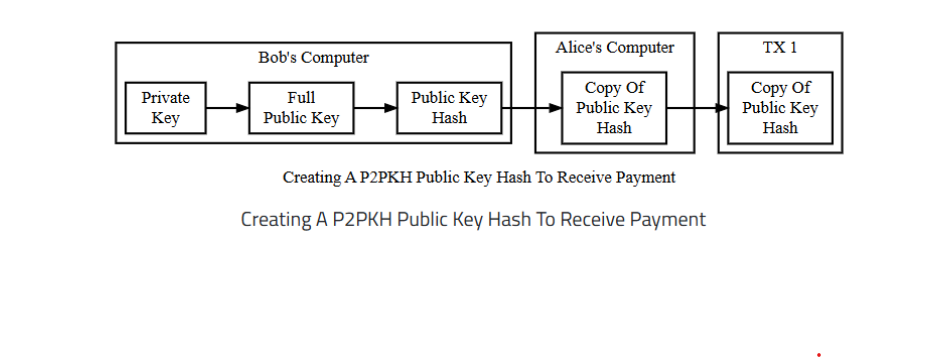
Different blockchain architectures handle public key exposure in distinct ways. On Bitcoin, certain address types conceal the full public key behind a cryptographic hash until a transaction is formally spent. If the underlying hash functions remain secure, this mechanism provides an additional layer of protection against attempts to derive private keys from public keys. Conversely, modern Taproot addresses expose public keys directly on-chain. SegWit addresses and standard wallet practices that continuously generate fresh receiving addresses help limit key reuse, though spending a Bitcoin inevitably exposes the public key in the mempool during the transaction validation window, creating a brief window of vulnerability.
Not All Crypto Assets Are Created Equal
As the debate continues, various blockchain networks are taking differing approaches to long-term cryptographic security. The NEAR Protocol, for instance, has incorporated quantum-safe roadmap features that allow users to add quantum-resistant FIPS-204 keys to existing mainnet accounts via a single transaction, avoiding the need to migrate assets entirely. Meanwhile, Ethereum developers have mapped out a comprehensive post-quantum strategy incorporating hash-based signatures and zero-knowledge proof aggregation to secure transaction signatures, consensus layers, and data security.
Ethereum core contributors have also conceptualized emergency measures, including potential emergency hard forks designed to address catastrophic security failures. In previous research proposals, Ethereum co-founder Vitalik Buterin outlined potential hard fork mechanisms that could roll back blocks following widespread theft, temporarily disable conventional transactions, and allow legitimate users to reclaim funds utilizing zero-knowledge proofs of their seed phrases. However, industry researchers emphasize that these proposals remain theoretical frameworks without fixed deployment timelines.
Other ecosystems are exploring alternative paths to resilience. Starknet leverages account abstraction architecture, enabling users to seamlessly switch signature schemes without requiring a manual migration of funds to a new address. Conversely, networks like Solana expose public keys by default, requiring users to migrate funds to specialized post-quantum vaults if necessary, though developers have researched experimental recovery upgrades to allow seed phrase verification through alternative cryptographic proofs.
As the industry weighs the severity of these theoretical threats against the logistical challenges of widespread asset migration, leading analysts advise measured prudence over reactionary fear. While the possibility of cryptographic failure serves as a reminder of the technological challenges facing decentralized networks, experts emphasize that there is currently no tangible evidence indicating an imminent collapse of standard cryptographic algorithms, and rushed responses often invite avoidable security mistakes and predatory scams.