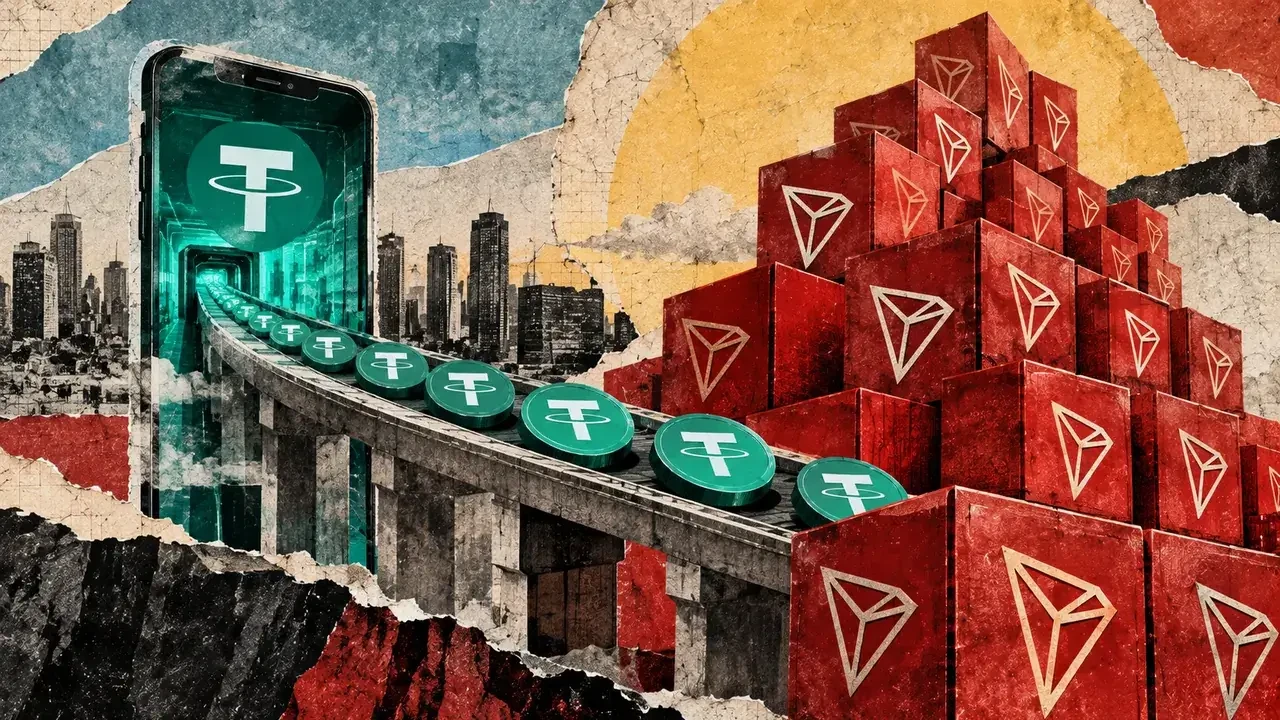
TRON’s stablecoin settlement business expanded further during the third quarter of 2026, anchoring its position as a major infrastructure layer for digital dollar transactions. However, despite processing trillions of dollars in value, the blockchain’s native token supply continued to swell, marking consecutive days of net expansion that extended well into October.
According to data compiled by TRON DAO Research, the network processed $2.2126 trillion in stablecoin settlements throughout the third quarter. This figure represents a 5.1% increase compared to the previous quarter. At the same time, combined balances of major stablecoins such as USDT and USDD on the TRON network reached $93.88 billion by the end of Q3, reflecting a 5.5% growth quarter-over-quarter.
Yet, this robust economic activity on the settlement front did not translate into a deflationary environment for TRON’s native asset, TRX. Blockchain records from TRONSCAN show that the supply of TRX increased on every single day from July 1 through October 16. After subtracting tokens permanently removed from circulation through network burns, the blockchain added 125.8 million TRX to its circulating supply during the third quarter alone. This upward trajectory persisted into the final quarter of the year, with the network adding another 22.9 million TRX over the first 16 days of October.
The persistence of this daily token expansion highlights a core structural dynamic of the TRON network: the blockchain is capable of facilitating immense volumes of dollar-pegged transfers without simultaneously destroying more of its native token than it mints through block-production and voting incentives. TRON’s architectural design allows these two distinct economic forces to coexist. Reusable network resources efficiently cover transactional activity, while ongoing consensus rewards continue to mint new TRX tokens on a regular basis.
A closer examination of the daily records provided by TRONSCAN illustrates the consistency of this trend. Across the 92 days comprising the third quarter—spanning the individual records for July, August, and September—issuance consistently outpaced burns without a single exception. When adding the subsequent 16 daily records from the beginning of October, the sample expands to 108 consecutive days of net positive TRX issuance.
During the July-to-September period, total TRX issuance reached 360,217,352 tokens, while total burns amounted to 234,453,624 tokens, resulting in a net issuance of 125,763,728 TRX. This pattern continued into the October window from the 1st to the 16th, during which 62,650,984 TRX were issued and 39,778,374 TRX were burned, yielding an additional net supply of 22,872,610 TRX.
CryptoSlate’s aggregation of these daily issuance and burn metrics indicates that roughly 148.6 million TRX were added to the total supply over the combined 108-day window, based on figures retrieved on October 17. Despite the headline-grabbing volume of these numbers, the actual scale of the expansion remains modest relative to the network’s massive size. The net addition recorded throughout the third quarter amounted to approximately 0.133% of an opening supply that stood at roughly 94.850 billion TRX.
Market observers note that stablecoin supply and native token supply operate as separate financial stocks within the ecosystem. Because these dollar-pegged tokens and TRX serve fundamentally different operational roles, growth in stablecoin balances does not automatically dictate the trajectory of the native asset’s circulating supply. Furthermore, the reported 5.1% quarterly increase in settlement value differs slightly from the 3.9% increase in daily average settlement, a discrepancy driven purely by calendar math as Q3 contained 92 days compared to Q2’s 91 days.
How Reusable Resources and Rewards Affect TRX Supply
To understand why a surge in stablecoin transfers does not inherently trigger a massive contraction in TRX supply, one must examine TRON’s underlying resource model, which meters both transaction size and computational execution. The network divides transaction requirements into two primary categories: Bandwidth, which covers the raw bytes recorded on the blockchain ledger, and Energy, which accounts for smart-contract execution. Notably, the fiat or dollar value of stablecoins moving through a given transaction does not directly dictate the cost of either resource.
Users can acquire these necessary resources by committing TRX through a staking mechanism, or they can receive delegated resources from another account holder. TRON’s network architecture is designed so that both Bandwidth and Energy recover automatically over a rolling 24-hour window. Once used, resources fully regenerate after 24 hours without requiring any further token consumption, though subsequent network activity continuously adjusts an account’s ongoing recovery schedule.
Crucially, utilizing these resources does not destroy the underlying staked TRX. The initial stake simply supports access rights that can be deployed repeatedly as network capacity replenishes over time. Delegation further expands this utility by allowing a receiving account to leverage resources supplied through an entirely different participant’s stake.
When transactions occur, TRON applies specific fallback rules depending on the resource type. For ordinary Bandwidth charges, the system first attempts to draw from the user’s staked or delegated quota, followed by any available free daily quota. Each quota must fully cover the entire byte cost of the transaction. If neither option is sufficient to cover the transaction, the network burns TRX to pay for the full Bandwidth charge.
Energy operates under a flexible framework where it can cover a portion or all of a caller’s smart-contract execution costs, with TRX burned for any remaining balance on the caller side within the designated fee limit. Consequently, resource allocation and availability play just as critical a role as raw transactional activity when evaluating overall token burns.
On the issuance side, TRON distributes newly minted tokens to compensate block producers and voting participants. According to the network’s consensus rules, block producers earn 8 TRX per produced block, while voter rewards are set at 128 TRX per block, though these parameters remain subject to future governance updates.
Distribution mechanics also shape how tokens circulate. Under TRON’s economic model, voters receive a proportional share of rewards after the chosen super representative retains its designated brokerage cut. Simply holding unstaked TRX in a private wallet does not automatically confer a claim to these consensus rewards.
As a result, a resource user, a staker, and a passive token holder experience the network’s economic environment in entirely different ways. A network user consumes transaction capacity, a staker supplies security and participates in governance for rewards, and an unengaged token holder sees no automatic increase in their balance simply because the broader network issues more TRX over time.
October’s Gap to Supply Balance
The dynamics of supply balance came into sharper focus during the first half of October. Between October 1 and October 16, token burns offset approximately 63.5% of new issuance. During this 16-day span, average daily issuance hovered at 3.916 million TRX, while average daily burns stood at 2.486 million TRX, leaving a daily average gap of 1.430 million TRX.
Hypothetically, holding issuance steady at the observed 62,650,984 TRX for that period, aggregate burns would have needed to climb from 39,778,374 TRX to the full issuance amount of 62,650,984 TRX to achieve equilibrium. This required increase of 22,872,610 TRX represents a 57.5% jump over the burns actually observed during the window. Conversely, if burns had been held fixed at their observed levels, issuance would have had to drop by that same 22,872,610 TRX amount—representing a 36.5% reduction from the actual issuance total—to reach balance. These two perspectives yield different percentages simply because they rely on different starting denominators.
These calculations highlight the distance between current operational metrics and a neutral supply state. Achieving true supply balance does not mean minting stops entirely; rather, it implies that newly minted tokens and destroyed tokens match in equal amounts over a given period. Deflation, meanwhile, would require burns to permanently exceed issuance.
If network operators and governance participants were to close the gap entirely through increased burning, it would necessitate higher consumption of TRX through resource payments or alternative fee mechanisms. That added financial burden would inevitably fall upon the accounts funding those network charges. On the other hand, closing the gap by reducing issuance would shrink the aggregate newly minted reward pool, altering individual allocations based on existing reward distribution rules and representative brokerage structures.
For standard token holders whose balances remain static, positive net issuance slightly expands the total supply against which their individual holdings are measured. While the roughly 0.133% expansion witnessed throughout the third quarter provides a clear measure of that dilutive effect, active reward recipients and stakers continue to derive utility and supplemental tokens through network participation and recurring access to blockchain capacity.