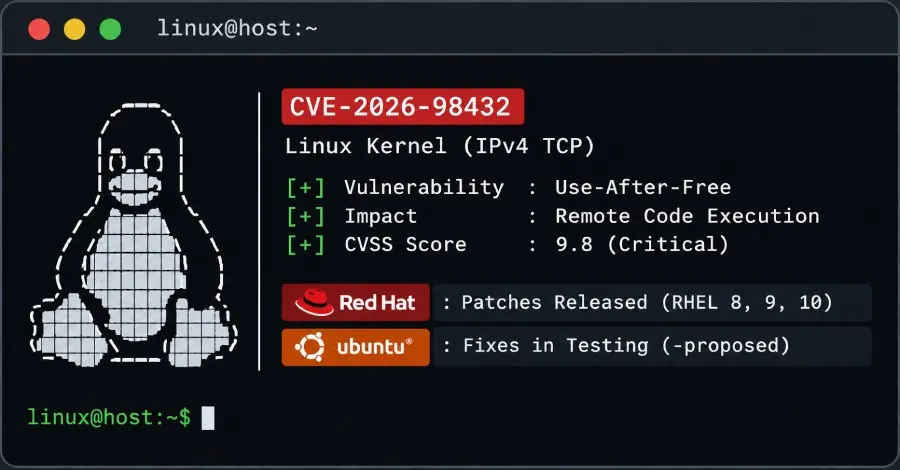
Fixed kernels addressing a severe use-after-free vulnerability within the Linux kernel’s IPv4 TCP subsystem are now widely available for enterprise environments, though distinct ecosystems are experiencing varying deployment timelines. Red Hat has released official kernel packages for Red Hat Enterprise Linux versions 8, 9, and 10 to remediate the critical flaw. Meanwhile, Canonical has made its corresponding updates for Ubuntu’s three newest long-term-support releases accessible within its opt-in testing repository, leaving system administrators awaiting a finalized rollout to standard update channels.
The security defect, officially tracked and cataloged under the identifier CVE-2026-98432, can be exploited by an unauthenticated remote attacker over a network connection. According to advisories published by both Red Hat and Canonical, successful exploitation of the vulnerability can ultimately lead to remote code execution on affected systems without requiring any prior user interaction or valid login credentials.
Initially assigned a moderate severity score of 5.9 by Red Hat, the vulnerability has since been re-evaluated and elevated to a critical rating with a maximum score of 9.8 out of 10 on the Common Vulnerability Scoring System (CVSS), mirroring the evaluation established by the Linux kernel’s internal CVE response team. Historical code analysis indicates that the underlying programming bug has silently resided within the networking stack since the release of Linux kernel version 4.4, with the official upstream vendor patch only successfully landing in code repositories during October.
Understanding the Mechanism of the Vulnerability
The flaw originates in how the operating system handles incoming network parameters during the establishment of a standard IPv4 TCP connection. When a server socket accepts a new connection request, the kernel historically passes Internet Protocol options directly from the incoming data packet stream to the newly created socket structure without performing an independent memory copy.
If a remote client deliberately initiates a retransmission of its initial connection request while a separate central processing unit core or thread is actively reading those same IP options, a severe race condition occurs. Under precise timing conditions, this concurrency conflict causes the kernel to read and process memory regions that have already been deallocated and freed, creating a classic use-after-free vulnerability scenario.

An attacker can deliberately trigger this race condition by bombarding any open, listening TCP network port with specially crafted connection requests carrying explicit IPv4 Record Route or Timestamp options. Because these options are parsed during the early stages of the handshake process, no user authentication or system access is necessary to initiate the sequence. Interestingly, the primary attack path is strictly confined to IPv4 traffic, leaving the IPv6 protocol stack unaffected under default configurations.
Addressing the crisis for its enterprise subscriber base, Red Hat issued multiple security advisories and updated kernel packages on November 1. These releases include errata RHSA-2026-93414 for Red Hat Enterprise Linux 8, RHSA-2026-93412 for Red Hat Enterprise Linux 9, and RHSA-2026-93413 for Red Hat Enterprise Linux 10. System administrators applying these critical updates must subsequently perform a full system reboot to load the remediated kernel into active memory.
Distribution Responses and Deployment Challenges
Canonical adopted a more cautious deployment strategy, announcing that security updates designed to mitigate CVE-2026-98432 across Ubuntu 22.04 LTS, Ubuntu 24.04 LTS, and Ubuntu 26.04 LTS have been routed to its proposed repository channel. This specific opt-in testing pocket allows for preliminary evaluation, meaning the packages will not deploy automatically through standard system upgrade pathways.
Before pushing kernel updates to regular users, Canonical typically subjects the packages to rigorous automated and manual validation across more than two thousand certified server models and enterprise hardware configurations. Consequently, the organization has not yet committed to a firm release date for when the packages will graduate to the main production update repositories.
Administrators managing critical infrastructure who cannot afford to wait for the standard release channel can manually opt into the testing pocket using package management tools to fetch the updated kernel packages, followed by a necessary system reboot. For older enterprise distributions, such as Ubuntu 20.04, 18.04, and 16.04, direct fixes are not currently available through standard channels, meaning organizations running these legacy environments must rely on Expanded Security Maintenance subscriptions through Ubuntu Pro to secure their infrastructure.
Other major Linux ecosystems have moved swiftly to address the vulnerability. Amazon Linux evaluated the risk profile as important with an 8.1 score, noting that the primary operational impact often manifests as a service crash coupled with potential memory corruption, and successfully deployed updates across all supported packages between October 24 and October 30. Additional enterprise distributions, including Debian, Oracle Linux, and SUSE, also published corrective patches throughout the month of October.

Interim Mitigations and Threat Landscape
In the absence of an immediate system update, organizations have sought temporary defensive measures to protect vulnerable infrastructure. Red Hat published a specialized nftables packet filtering rule designed to intercept and drop inbound IPv4 TCP packets that carry active IP options. While this administrative control successfully blocks the known trigger mechanism used to initiate the race condition, security experts caution that it cannot entirely eliminate the underlying exposure and may inadvertently disrupt legitimate network workloads that rely on specific IPv4 options for routing or diagnostics. Furthermore, this type of host-based filtering only protects the local operating system, leaving internal container-to-container traffic on the same host vulnerable to bypass.
Some initial industry discussions recommended disabling Multipath TCP as a functional workaround. However, security researchers and kernel maintainers have clarified that the vulnerability exists within the core IPv4 TCP handling logic rather than the Multipath TCP extensions, rendering such configuration changes insufficient. Canonical explicitly emphasized that applying official software security updates remains the only comprehensive and appropriate mitigation strategy.
Regarding active exploitation in the wild, no commercial vendors, national computer emergency readiness teams, or kernel security groups have verified active cyberattacks leveraging this specific vulnerability in real-world environments. The flaw was notably absent from the Known Exploited Vulnerabilities catalog maintained by the Cybersecurity and Infrastructure Security Agency.
Nevertheless, the threat landscape shifted following a disclosure by Anthropic, which revealed that an unreleased internal artificial intelligence research model successfully synthesized a working remote root exploit targeting the vulnerability. According to the report, the automated model constructed an exploit capable of targeting Linux servers running an MPTCP listener without requiring user interaction or valid credentials. The proof-of-concept routine reportedly required 48 minutes to leak a valid kernel address before successfully securing a root shell access point, though Anthropic elected to withhold the functional exploit code from public release.
Independent security researchers have since published proof-of-concept code designed strictly to trigger the race condition and detect whether a vulnerable kernel echoes freed memory structures during a TCP handshake, though this publicly available material does not implement remote code execution capabilities. Organizations running affected Linux kernels are strongly encouraged to apply official vendor patches as soon as operational testing allows.