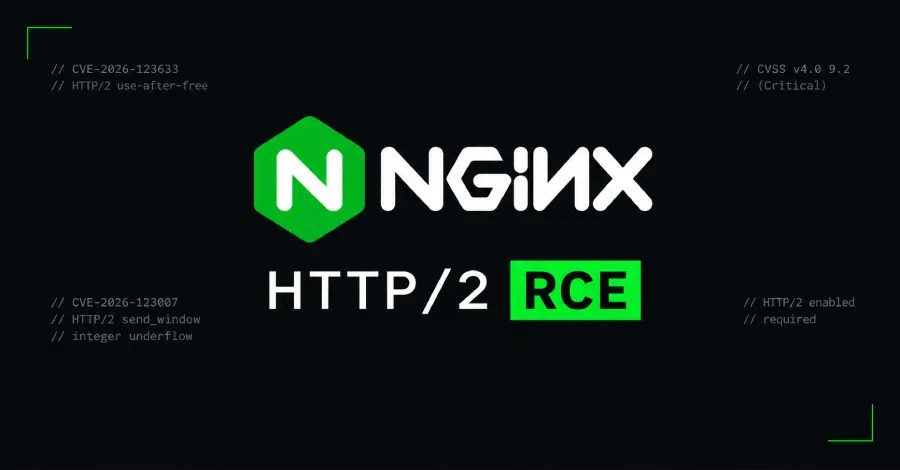
A severe vulnerability residing in the HTTP/2 implementation of NGINX has been uncovered, carrying the potential to allow unauthenticated attackers to execute arbitrary code on vulnerable servers. Tracked as CVE-2026-123007 and colloquially dubbed "nginx2root," this high-severity security flaw has lurked within the widely used open-source web server software for more than a decade, having been quietly introduced in version 1.9.5 back on September 22, 2015.
The discovery of the vulnerability prompted a swift response from F5, the enterprise behind NGINX, which released patched versions 1.31.9 and 1.30.7 to address the issue alongside a suite of other newly uncovered security flaws. According to technical assessments shared by major cybersecurity firms, the flaw
can be exploited by remote threat actors who merely need access to a reachable HTTP/2 port, eliminating the traditional requirement for valid user credentials or authentication tokens.
Security researchers at Wiz and Xint conducted independent evaluations of the vulnerability, confirming that attackers can successfully trigger the flaw and execute unauthorized code under specific conditions. F5 noted that exploitation primarily succeeds where Address Space Layout Randomization (ASLR) is either disabled or successfully bypassed by the attacking payload. Researchers at Wiz successfully engineered a bypass against ASLR during their testing phase, while Xint’s investigations demonstrated that exploitation could be achieved using nothing more than standard network connectivity to an active HTTP/2 endpoint.
When code is successfully executed via this vulnerability, it inherits the permissions of the specific NGINX worker process handling the connection. However, security analysts at the Computer Incident Response Center Luxembourg (CIRCL) pointed out that achieving complete root-level privileges on the underlying host operating system typically requires chaining the initial NGINX exploit with a secondary privilege escalation vector.

During their laboratory tests, researchers at Xint discovered that code executing within an unprivileged NGINX worker process could successfully elevate its privileges to root on the host system by leveraging an entirely separate security flaw residing within the Linux kernel’s SCTP networking code. Alarming to enterprise infrastructure teams, this privilege escalation path remained viable even when the NGINX server instance was isolated inside a Docker container.
Despite the critical nature of the vulnerability and the subsequent release of proof-of-concept exploit code on GitHub, neither the vendor nor prominent security research organizations such as Wiz and Rapid7 have observed active exploitation of the flaw in the wild. Furthermore, the Cybersecurity and Infrastructure Security Agency (CISA) had not added the vulnerability to its Known Exploited Vulnerabilities catalog as of the initial disclosure. The public proof-of-concept code hosted on GitHub includes explicit disclaimers noting that the script is engineered specifically to demonstrate the attack vector against a freshly initialized Docker container running locally on the same hardware machine.
Official security advisories published by NGINX confirm that every standard open-source release spanning from version 1.9.5 through version 1.31.8 is impacted by the flaw. This extensive list of vulnerable builds encompasses version 1.31.8 released on October 21, as well as preceding security updates deployed on October 14, including versions 1.31.7 and 1.30.6. Furthermore, commercial deployments of NGINX Plus are also affected, specifically impacting version 37.x releases prior to the newly deployed patched builds, alongside product lines ranging from R34 through R36, according to the vendor’s official product advisory.
Alongside the primary HTTP/2 flaw, the newly issued software releases resolve four additional security vulnerabilities that the vendor notes could similarly result in arbitrary code execution under comparable ASLR conditions. Each of the five vulnerabilities has been assigned a critical CVSS 4.0 severity score of 9.2 out of 10. However, each distinct flaw requires a specific configuration or operational setup to be successfully reachable by an attacker.
The primary flaw, CVE-2026-123007, requires HTTP/2 support to be active on the server. A secondary vulnerability, tracked as CVE-2026-123633, requires HTTP/2 to be enabled alongside incoming requests being passed to a backend server while the NGINX worker process is experiencing resource constraints or running low on available worker connections. A third issue, designated as CVE-2026-123634, involves proxied server names constructed dynamically from variables, combined with server-side include operations or mirror subrequests directed toward a location evaluating the identical naming parameters. Additionally, CVE-2026-121810 requires HTTP/3 to be enabled, while CVE-2026-113425 affects instances where NGINX is explicitly deployed to function as a mail proxy.
Administrators seeking to determine whether their servers support HTTP/2 can inspect their configuration files for listen directives incorporating the http2 parameter or explicit declarations of http2 on. Network-level validation can be performed by executing diagnostic tools such as OpenSSL s_client with the -alpn h2 parameter against the target server, where a successful response indicating an ALPN protocol of h2 confirms that the endpoint accepts HTTP/2 traffic. For infrastructure deployed behind a content delivery network or reverse proxy, security teams must evaluate the origin NGINX server directly, as an origin configured exclusively to handle HTTP/1.1 traffic cannot be targeted via HTTP/2 attack vectors.

The newly released software versions 1.31.9 and 1.30.7 provide definitive fixes for all five identified security defects. For enterprise users operating NGINX Plus, dedicated builds designated as 37.3.0.1 and 37.0.8.1 resolve four of the vulnerabilities, while the fix for CVE-2026-123633 was integrated into slightly earlier iterations, specifically versions 37.2.0.1 and 37.0.7.1. Following the application of software upgrades, systems administrators must perform a full restart of the NGINX service or execute a live binary upgrade procedure. Merely reloading the configuration leaves the legacy executable running, allowing existing network connections to persist on older, vulnerable worker processes.
Official Docker container images for NGINX have been promptly updated to incorporate versions 1.31.9 and 1.30.7, including lightweight Alpine variants. Meanwhile, major enterprise Linux distributions such as Ubuntu and Debian were still in the process of preparing and backporting patched packages for their respective repositories. Ubuntu’s security tracking pages identified vulnerable package statuses across releases ranging from version 16.04 up to 26.10, while Debian trackers highlighted vulnerabilities across bookworm, trixie, forky, and sid distributions. System administrators are advised to review complete package version metadata rather than relying strictly on version strings reported by standard utility commands, as distribution maintainers frequently apply security backports without modifying baseline version identifiers.
Where immediate software upgrades are not feasible, official vendor guidance provides targeted configuration workarounds for a limited subset of the vulnerabilities. To mitigate the resolver-related flaw, administrators can avoid utilizing server-side include and mirror directives while ensuring proxied server names are not constructed from variables. For the mail proxy vulnerability, exposure can be restricted by limiting active listeners exclusively to trusted internal network ranges. CIRCL’s incident response recommendations similarly advise temporarily disabling HTTP/2 as an interim defense mechanism to block CVE-2026-123007 and CVE-2026-123633, though this measure does not mitigate the remaining associated flaws. Similarly, disabling HTTP/3 where deployed eliminates the prerequisites required to exploit CVE-2026-121810.
Technical analyses published by security firms shed further light on the specific operational thresholds required for successful exploitation. Research from Rapid7 indicated that their particular execution of the attack against CVE-2026-123007 required transferring approximately 128 gigabytes of HTTP/2 traffic over a sustained duration of roughly two and a half minutes. Consequently, network links operating at speeds below approximately 300 megabits per second would cause the transfer duration to exceed NGINX’s default one-hour connection timeout threshold, resulting in an unsuccessful attack attempt. Furthermore, the exploitation method relies heavily on specific glibc memory-copy routines optimized for x86-64 processor architectures featuring advanced vector extensions.
Security organizations have also outlined specific indicators of compromise and forensic artifacts that system administrators can monitor to detect potential unauthorized activity. CIRCL recommends auditing system logs and operational metrics for NGINX worker processes unexpectedly spawning external utility programs, crashing abnormally, or leaving behind unexpected core dump files. Additional suspicious indicators include long-lived, persistent HTTP/2 connections characterized by heavy incoming data transmission paired with minimal logged application requests, alongside abnormal outbound network connections or anomalous internal DNS queries. Analysts emphasize that standard web access logs may remain entirely clean during an attack, as HTTP/2 protocol control frames typically do not register as conventional requests within access logging mechanisms.