A recent ruling by the Texas Business Court has highlighted the legal consequences of corporate reincorporation, establishing a fresh precedent that could reshape how shareholders challenge past actions following a state-to-state move. In an October 2, 2026 ruling, Judge Andrea K. Bouressa dismissed a shareholder derivative action brought against Coinbase directors, ruling that the company’s transition from Delaware to Texas altered the procedural rules a plaintiff must follow before filing suit.
The decision centers on a lawsuit filed by shareholder Gary Guillaume, who attempted to hold Coinbase directors accountable for alleged conduct stretching back to the company’s historical Delaware era. However, rather than addressing the substance of the underlying claims, the Texas court dismissed the action without prejudice because Guillaume failed to satisfy Texas’s mandatory pre-suit demand requirement.
The consequential finding pivots on who possesses the authority to pursue claims belonging to a corporation. Even though the court assumed without deciding that Delaware law governed the merits of the underlying conduct, it ruled that Texas law strictly applied to the shareholder’s procedural authority to sue. Consequently, the Texas demand rule stood as a barrier, effectively cutting off the litigation before it could reach the merits.
The legal victory quickly drew high-profile attention within the corporate and cryptocurrency sectors. On October 9, Coinbase CEO Brian Armstrong took to social media to praise the judicial precedent. He endorsed the decision as a development that could encourage more companies to incorporate in Texas, while also thanking Texas Governor Greg Abbott.
The endorsement arrived just one week after Judge Bouressa signed the order, signaling to public shareholders that the legal framework governing a company’s historical conduct and the rules governing a shareholder’s ability to challenge it can diverge significantly following a corporate reincorporation.
Why Older Claims Faced Texas’s Demand Rule
To understand the weight of the court’s decision, it is necessary to examine the mechanics of a derivative action. In corporate law, a derivative action allows an individual shareholder to pursue a legal claim on behalf of the corporation itself. Because the legal claim ultimately belongs to the company, the shareholder is essentially attempting to exercise authority that is ordinarily reserved for the board of directors. This fundamental distinction explains why the initial dispute in the Coinbase case focused entirely on whether the plaintiff had the proper permission and standing to bring the action, rather than evaluating the directors’ alleged misconduct.
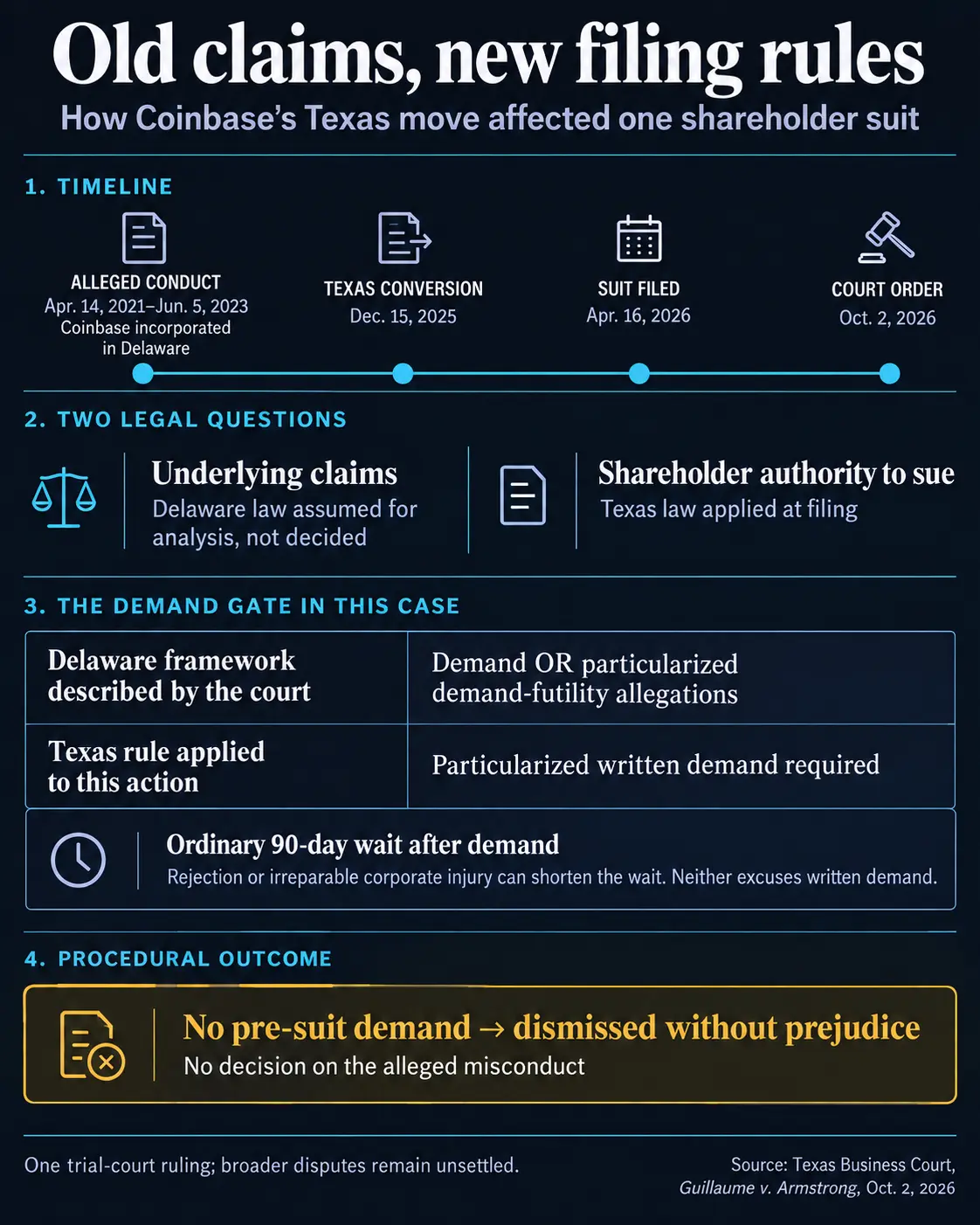
According to court filings, the legal timeline began when Guillaume filed his lawsuit on April 16, 2026. The complaint targeted alleged corporate misconduct occurring between April 14, 2021, and June 5, 2023. During this historical window, Coinbase was officially incorporated in Delaware. However, the corporate landscape shifted significantly when Coinbase completed its reincorporation conversion to Texas, which became effective on December 15, 2025, several months before Guillaume filed his complaint.
The procedural conflict arose from the stark differences between Delaware and Texas legal frameworks regarding how a shareholder initiates a derivative suit. Under the Delaware framework detailed in the opinion, a derivative plaintiff has two primary pathways: they can make a formal pre-suit demand on the board of directors, or they can plead that making such a demand would be futile. Proving demand futility under Delaware law requires particularized factual allegations concerning individual directors. Courts examine whether those directors received a material personal benefit from the disputed conduct, face a substantial likelihood of legal liability, or lack independence from someone who benefited or faces liability. Crucially, at least half of the relevant board members must satisfy this test for futility to be established.
Guillaume attempted to bypass a formal demand by relying on the futility route, choosing not to make a pre-suit demand on the board.
However, Texas law operates under a different mandate. For actions involving public companies, Texas law requires a strict, particularized written demand that clearly identifies the disputed conduct and requests appropriate corporate action. The October 2 opinion outlined the standard Texas procedure, which enforces an ordinary 90-day waiting period following the submission of the demand. Derivative proceedings are only permitted to move forward starting on the 91st day. While a corporate rejection of the demand or proof of irreparable injury to the corporation can shorten this waiting period, both exceptions still leave the core written-demand requirement firmly in place.
Because of this statutory framework, Guillaume’s futility-based arguments could not serve as a legal substitute for the explicit written request mandated by Texas law. The absence of the required pre-suit demand was enough to terminate the action before the court ever reached the underlying merits of the dispute.
During the proceedings, Guillaume argued that Delaware law should continue to apply because the contested claims arose directly out of events that occurred prior to Coinbase’s relocation to Texas. Judge Bouressa accepted that premise regarding the underlying claims for the sake of her legal analysis, without formally resolving the broader conflict-of-laws question.

However, the judge drew a sharp line when considering a separate legal question: which state’s law governed the shareholder’s actual authority to file those claims on behalf of Coinbase?
The court’s ultimate answer hinged entirely on the state of incorporation at the exact time the shareholder exercised that authority. The ruling established that a corporate claim can originate under one state’s legal code, while a subsequent effort to pursue it derivatively can be governed by an entirely different state’s procedural rules. The opinion reasoned that a shareholder does not acquire a vested right—simply because a corporate claim has arisen—to bring that claim personally on the corporation’s behalf under a permanent set of rules at some later date.
This judicial reasoning imparts lasting consequences on corporate reincorporations, extending their impact far beyond future board decisions. In Coinbase’s case, the December 2025 conversion directly altered the legal pathway required to challenge alleged corporate conduct dating all the way back to 2021.
Furthermore, disclosures issued by Coinbase surrounding its corporate conversion supplied Guillaume with an additional legal argument. He relied heavily on specific disclosure language that appeared to preserve the standing and ability of eligible shareholders to bring derivative claims concerning prior conduct, provided they maintained continuous stock ownership.
The court’s interpretation of those disclosures, however, was considerably narrower than Guillaume’s reading. The opinion concluded that the corporate disclosures did not constitute a binding promise that Delaware law would permanently govern shareholder authority following the conversion. Moreover, the disclosures explicitly warned that Texas law would govern the internal affairs of Coinbase following the move.
Judge Bouressa also found that Guillaume failed to present any legal argument or concrete evidence demonstrating how losing the option to plead demand futility materially prejudiced his ability to sue. He did not show that submitting a written demand was impossible, that it caused irreparable harm or unfair prejudice, or that the futility pleading option provided him with any unique legal advantage. Additionally, the court found no evidence indicating that Coinbase had successfully contracted around the mandatory Texas demand requirement through private agreements.
Concentrated Votes and Alternative Accountability Routes
The broader corporate governance structure surrounding Coinbase provides essential context for why these procedural distinctions carry such significant weight. According to Coinbase’s November 2025 information statement, a consenting shareholder group associated with CEO Brian Armstrong and co-founder Fred Ehrsam held approximately 78.40% of the company’s total voting power as of the October 31, 2025 record date. This dominant group formally approved the corporate reincorporation by written consent on November 4, 2025.
Before recommending the move, Coinbase noted that a special committee composed of independent directors Christa Davies and Paul Clement evaluated the corporate landscapes of Delaware, Nevada, and Texas before ultimately recommending Texas. Following that recommendation, the Coinbase board unanimously approved the relocation.
In public filings, the company cited several key motivations for the shift, including greater litigation predictability, potential long-term savings on defense costs, enhanced indemnification and insurance protections, and the state of Texas’s broadly crypto-friendly regulatory environment.
The concentrated voting figures outlined in late 2025 reflect the ownership dynamics during the reincorporation process. In its subsequent annual proxy statement filed on April 24, 2026, Coinbase reported updated voting-power figures as of March 31. Those figures showed Armstrong holding 49.6% of the voting power, separately listed Armstrong-associated entities and trusts with an independent trustee holding 18.9%, and Ehrsam holding 10.6%. These calculations incorporated SEC beneficial-ownership rules and qualifying options, operating under a dual-class share structure where Class B shares carry 20 votes each compared to one vote for Class A shares.
Additional financial disclosures underscored this concentrated governance structure. Coinbase’s February 2026 annual filing described Brian Armstrong and the independent trustee as collectively possessing the ability to exercise majority voting rights within the corporation. Subsequent quarterly disclosures, including the July 30 filing, reported no material changes to the company’s annual risk factors, though they did not provide a new, updated individual voting-power percentage.