
The United Kingdom is approaching a critical juncture that could permanently define its financial future: policymakers must decide whether decentralized finance, commonly known as DeFi, will be allowed to develop safely through regulated financial gateways, or whether it will be rigidly constrained to an isolated silo.
This pressing question extends far beyond the immediate interests of cryptocurrency enthusiasts and digital asset traders. At its core, the policy debate speaks directly to the future evolution of global capital markets, the long-term international competitiveness of London’s historic financial district known as the City, and the sovereign ability of the United Kingdom to effectively shape and lead the next generation of modern financial infrastructure.
To understand the stakes, one must examine the mechanics of the technology itself. DeFi is fundamentally software that allows individuals to borrow, lend, and trade financial assets directly with one another without relying on a traditional trusted intermediary, such as a commercial bank, a clearinghouse, or a traditional broker. Rather than functioning like a legacy financial institution bound by legacy hours and physical locations, DeFi operates much more like the open internet. It promises significantly cheaper, faster financial services that remain continuously accessible to anyone with an internet connection anywhere in the world, at any time of day or night.
While decentralized applications and protocols will always remain fundamentally accessible through open-source pathways or direct peer-to-peer routes, mainstream regulated financial providers can also establish secure bridges to DeFi. These regulated gateways allow everyday retail and institutional customers to safely engage with cutting-edge blockchain technology while simultaneously receiving vital disclosures, clear investor protection information regarding the services they are accessing, and transparent warnings about the specific financial risks they should be fully aware of before committing capital.
However, a looming policy clash threatens to upend this cooperative vision. Under the Financial Conduct Authority’s newly proposed cryptoasset regime, regulatory requirements could inadvertently make secure integration virtually impossible. The FCA’s policy framework expects fully regulated trading platforms to ensure that any customer orders are exclusively executed on an official, FCA-authorized trading venue.
While this strict supervisory requirement is ostensibly designed to prevent unauthorized overseas firms from illegally targeting and accessing the domestic UK market, it simultaneously creates a severe collateral risk. It threatens to completely block off legitimate access to DeFi protocols because the decentralized smart contracts, liquidity pools, and automated exchanges where users execute peer-to-peer orders do not possess a corporate entity, director, or legal person behind them that could realistically register for formal regulatory authorization.
Although the regulatory text does not explicitly outlaw firms from offering technical DeFi integrations to their clients, the FCA has made it abundantly clear through its policy statements that it does not intend to draft rules tailored specifically to these novel decentralized products. Instead, the regulator has opted to apply the exact same rigid compliance framework to DeFi as it applies to fully centralized trading desks. The practical, real-world consequence of this one-size-fits-all regulatory posture could very well be a de facto ban on decentralized financial products within the regulated UK perimeter.
Unless the regulatory authority shifts its strategic approach, regulated financial platforms operating in the United Kingdom may find themselves legally unable to provide their customer base with access to decentralized finance services by the time the rules take full effect in October 2027.
This regulatory roadblock directly contradicts stated government ambitions. Ministers across the government have repeatedly pledged that they want the United Kingdom to lead the world on digital assets and blockchain innovation. Yet, independent observers note that the nation will inevitably struggle to realize this lofty ambition if domestic British firms are effectively cut off from the very decentralized infrastructure upon which modern digital asset markets are built.

DeFi Is Becoming Part of the Next Financial Infrastructure
Financial regulators in other major international jurisdictions are already recognizing the immense economic opportunities presented by decentralized technology and are actively exploring pragmatic ways to enable DeFi innovation within a controlled supervisory framework.
Within the European Union, the European Securities and Markets Authority has formally proposed allowing regulated financial firms to provide direct access to decentralized finance products. ESMA noted in recent regulatory consultation responses that such a path could successfully allow innovation in decentralized finance to flourish safely inside a regulated, transparent environment rather than driving it underground.
Similarly, across the Atlantic, the United States Securities and Exchange Commission recently took a notable step by granting a temporary "Innovation Exemption" specifically designed to accommodate the peer-to-peer trading of tokenized stocks utilizing automated market-making systems and decentralized liquidity pools.
These regulatory developments demonstrate that both the United States and the European Union are actively exploring how traditional finance and innovative DeFi infrastructure can successfully work in tandem. Industry leaders argue that the United Kingdom should be exploring the exact same technological and commercial potential before it prematurely closes off this avenue entirely.
Onchain tokenized finance simply cannot reach its full economic potential if it remains forcibly confined to closed, highly fragmented legacy systems that struggle to interact natively with the fast-moving decentralized technology underpinning the future of global commerce.
A De Facto Ban May Push DeFi Beyond the Regulator’s Reach
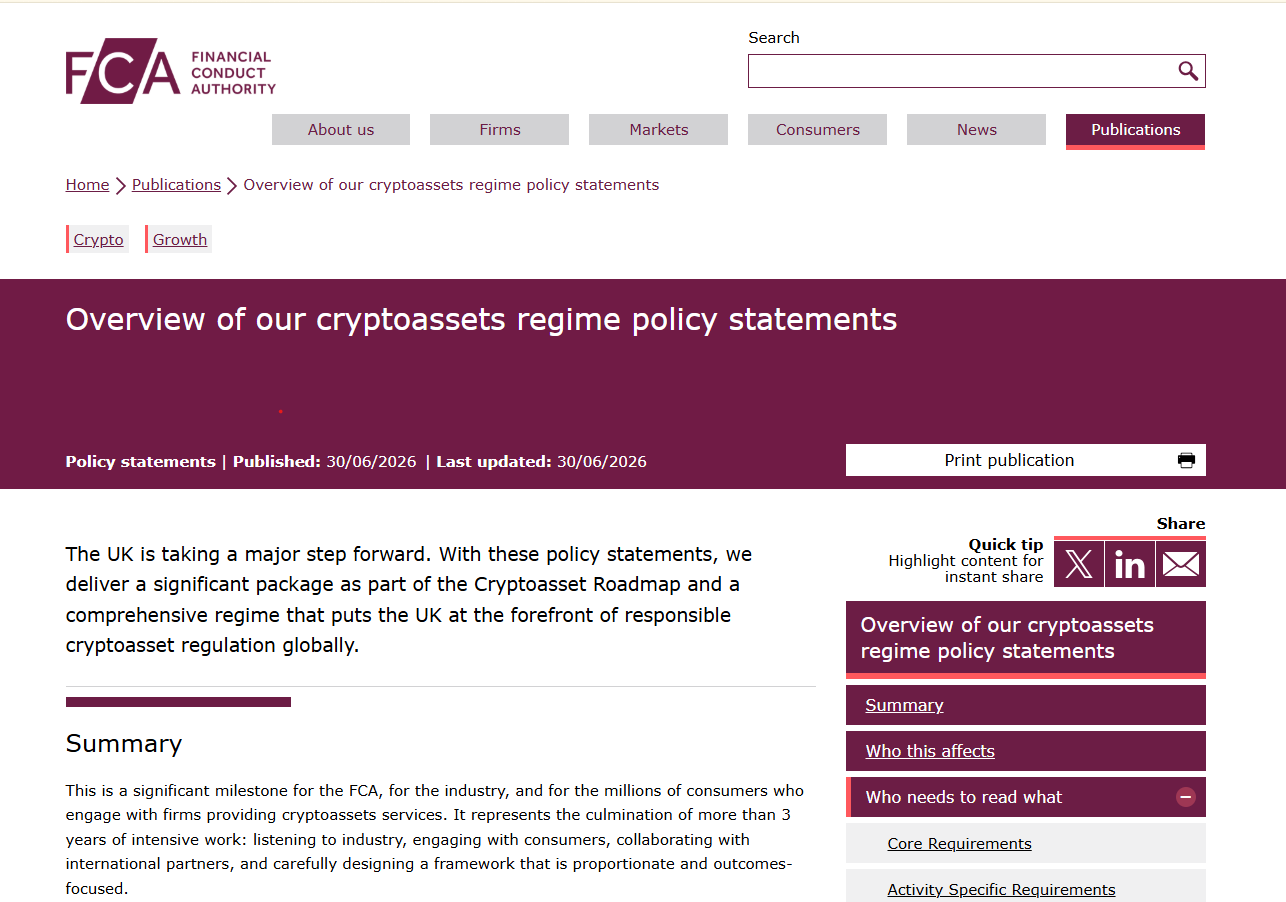
The United Kingdom has formally set out its first comprehensive regulatory rulebook governing the crypto sector. Beginning on October 25, 2027, financial firms offering crypto-related services to UK-based customers will be legally required to secure explicit authorization from the FCA. As part of this rollout, the FCA is currently consulting on specific regulatory guidance detailing how its overarching rulebook will apply to financial institutions that offer services utilizing or interacting with decentralized finance.
Policy discussions surrounding potential risks tied to DeFi integrations generally center on three main concerns. First, retail customers using a familiar, highly regulated platform might not fully realize when they have crossed over into an underlying environment where traditional regulatory protections and safety nets no longer apply. Second, bad actors or fringe firms could theoretically attempt to leverage DeFi integrations as a loophole to evade standard compliance and regulatory obligations. Third, decentralized protocols could theoretically introduce systemic risks related to financial crime, market manipulation, and technical resilience.
Yet, industry advocates emphasize that these legitimate supervisory concerns point directly to the clear necessity for consumer education, transparent disclosures, and strict institutional responsibilities—rather than an outright regulatory prohibition.
A de facto ban would likely produce the exact opposite of its intended policy outcome. Rather than eliminating DeFi activity among UK citizens, a ban would push a greater volume of financial activity entirely beyond the practical visibility of the FCA. Furthermore, it would strip regulated firms of their ability to help educate customers, monitor risks, and shape how everyday users interact with the technology.
Regulated platforms possess the unique capability to serve as vital points of supervision. They can explicitly inform customers when they are stepping outside a fully protected regulatory perimeter and require explicit, informed consent before permitting the transaction. Furthermore, regulated financial firms can actively curate access to vetted protocols, rigorously assess operational and governance risks, and report suspicious usage patterns and operational incidents directly to supervisory authorities.
Regulate the Gateway, Not the Technology
The United Kingdom already acknowledges in other sophisticated areas of finance that regulated institutions can safely provide client access to underlying products or markets that do not carry the identical level of institutional oversight.
A wide variety of retail trading platforms and consumer "super apps" currently offer everyday users seamless access to a diverse array of financial instruments—ranging from equities and money market funds to physical commodities and foreign exchange—each carrying distinct regulatory protections. The FCA routinely permits these mixed-product offerings, provided that the platforms maintain absolute transparency, making it abundantly clear to retail consumers which specific protections apply to each individual product and service.
This precedent is precisely why DeFi integrations demand a more flexible and pragmatic solution. The FCA has a fundamental mandate to protect consumers from harm, but it should not seek to achieve consumer protection through total exclusion and isolation.
A policy of responsible integration would provide consumers with clearer information, offer supervisors greater systemic visibility, and grant UK financial services institutions a fighting chance to compete globally in the next phase of financial technological evolution.
Consumers Will Use DeFi, So the Question Is Where
DeFi protocols are already fully operational and can be accessed directly by anyone on the internet without the involvement of regulated financial intermediaries. The central question facing policymakers is whether consumers will also be permitted to access DeFi safely through a regulated gateway, complete with clear disclosures, risk warnings, and structural guardrails.
The economic stakes extend far beyond niche cryptocurrency trading. Decentralized finance underpins the single greatest potential source of cost savings as global financial services transition onchain, dramatically reducing the need for costly intermediaries while supporting uninterrupted 24/7 activity across international borders. Crafting regulations that establish a clear, predictable route to support DeFi is absolutely crucial if the UK hopes to give firms the commercial confidence to invest in domestic technological innovation over the long term.
If overly rigid barriers to access are stubbornly imposed within the UK, the development of tokenized capital markets and broader financial innovation risk migrating entirely to more progressive jurisdictions that display a decisive willingness to support decentralized financial infrastructure.
The United Kingdom cannot credibly aspire to lead the world in digital finance while simultaneously closing its doors to the decentralized technological foundations upon which the future of global finance is actively being built.