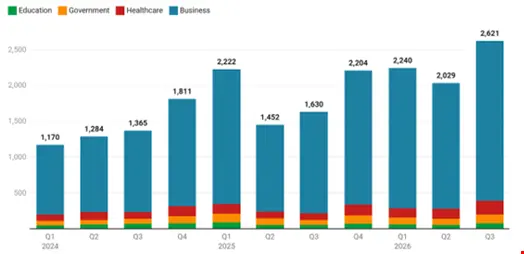
The global cybersecurity landscape faced a harrowing escalation in the third quarter of 2026, as ransomware attacks surged to their highest quarterly volume on record. According to a comprehensive analysis released by Comparitech, the period between July and September 2026 marked a pivotal shift in the threat landscape, characterized by an unprecedented intensity in criminal operations that transcended historical trends.
Data from the report identified a staggering 2,627 claimed ransomware attacks during this three-month window. This figure represents a 27% increase over the second quarter of 2026 and a dramatic 61% rise compared to the same period in 2025. While these numbers reflect the claims made by various threat actor groups—only 247 of which were officially confirmed by the victimized entities—the sheer volume of activity points to a systemic breakdown in the status quo of digital defense.
A Broad-Spectrum Threat Across Critical Sectors
Perhaps most alarming to cybersecurity researchers is the uniformity of the surge across various industries. While some quarters in the past have seen localized spikes in specific sectors, Q3 2026 saw widespread, simultaneous growth in attacks across all critical infrastructure.
The finance and technology sectors bore the brunt of this expansion, witnessing increases of 72% and 70% respectively when compared to Q2 2026. These industries, which often hold both highly sensitive proprietary data and vast liquidity, have long been primary targets, but the acceleration of attacks suggests that threat actors have refined their reconnaissance and breach capabilities to target these verticals more efficiently.
Public sector and essential services were not spared. Education institutions saw a 50% jump in incidents, while the healthcare sector, which provides critical life-sustaining services, faced a 39% increase. Government entities and utilities, both of which are fundamental to national security and social stability, experienced growth in attack volumes of 36% and 32% respectively.
Rebecca Moody, the head of data research at Comparitech, characterized these figures as highly unusual and a significant cause for concern for both policymakers and private industry. "I’m often asked what I think lies ahead in the ransomware threat landscape, and it’s notoriously difficult to predict," Moody explained. "Figures frequently fluctuate and a sector might see a bit of an increase one month, only to see a slight decrease the next month. However, Q3 2026 is different. We’re not seeing slight increases or decreases. We’re seeing significant increases across all key sectors."
The AI Catalyst and the Shift in Attack Dynamics
The rapid expansion of the threat landscape is not merely a matter of more criminals entering the space; it is a matter of increased capability. Cybersecurity experts have pointed to the proliferation of artificial intelligence as a primary engine for this surge. AI technology is currently being weaponized by ransomware syndicates to increase both the scale and the speed of their campaigns. By automating initial access, vulnerability scanning, and even the crafting of sophisticated social engineering lures, attackers can achieve greater effectiveness with fewer manual inputs.
The maturation of these tools was underscored in July 2026, when researchers identified the "JadePuffer" campaign. Widely believed to be the world’s first ransomware attack driven entirely by autonomous AI agents, the campaign signaled a transition toward a future where human oversight may be minimized, allowing for hyper-fast, relentless cycles of intrusion and extortion.
The Rise of Triple Extortion
Beyond the sheer volume of attacks, the methodology of the attackers is evolving toward a more malicious and persistent model known as "triple extortion." In this paradigm, the traditional two-pronged threat—encrypting systems and exfiltrating data—is supplemented by the direct harassment of individuals affected by the breach.
This strategy is designed to maximize pressure on the victim organization by making the human cost of the data loss impossible for the company to ignore. A stark example of this occurred in mid-2026 involving the South African technology company MIP Holdings. After falling victim to a group known as "The Gentlemen," MIP reportedly paid a ransom under the expectation that their stolen data would be permanently deleted.
However, in a move that highlighted the utter lack of integrity in criminal dealings, The Gentlemen began adding MIP’s own clients to their data leak site weeks later. The goal was clear: to force the clients of the original victim to pay their own ransoms to prevent their private information from being exposed. This incident serves as a grim reminder that paying a ransom is never a reliable guarantee of data security or privacy.
Financial Stakes and Notable Incidents
The financial toll of these incidents remains astronomical. The average ransom demand during the third quarter of 2026 reached $602,400. However, the extremes of these demands reveal the brazen nature of today’s cyber syndicates.

The most significant demand recorded in the quarter reached $12.3 million, directed at the Swiss railway manufacturing firm Stadler Rail by the Everest group. The firm’s refusal to meet the demand resulted in the group leaking 201 gigabytes of internal data. Similarly, the state government of Berlin faced a demand of $2.3 million from the Rhysida group. Upon the government’s public refusal to pay, the group followed through on its threat, publishing 5.7 terabytes of stolen data, which included the sensitive personal information of thousands of citizens.
Dominant Syndicates and Global Impact
The report also shed light on the hierarchy of the cybercriminal underground. The groups Qilin and The Gentlemen dominated the landscape, claiming 357 and 342 attacks, respectively. Both groups demonstrated significant growth, with Qilin’s activity up by 24% and The Gentlemen’s by 29% compared to the previous quarter.
Other groups displayed sudden, aggressive spikes in activity. The Clop group, which had remained relatively quiet in Q2 with a single claimed attack, surged to 48 incidents in Q3—a 4,700% increase. The Direwolf group similarly saw a massive expansion in its operational footprint, with claimed attacks rising by 1,450%.
Geographically, the United States remains the most targeted nation, accounting for 1,066 of the total claimed attacks, or 41% of the global total. This represents a 34% rise from the previous quarter, indicating that despite increased awareness and defensive investment, US infrastructure remains the most lucrative target for ransomware actors. Germany followed as the second most targeted country, with 121 attacks—a 22% increase. Meanwhile, Argentina and India saw the most rapid acceleration in threat activity, with their incident counts rising by 150% and 116% respectively, suggesting that ransomware groups are actively expanding their geographic focus to regions that may have previously been considered less lucrative or less defended.
As 2026 moves into its final quarter, the data suggests that the ransomware threat is not only growing in scope but is also becoming more deeply entrenched in the digital economy. The intersection of AI-enabled attack tools, the normalization of triple extortion, and the increasing boldness of major syndicates paints a challenging picture for organizations worldwide as they attempt to secure their networks against a relentless and increasingly sophisticated adversary.