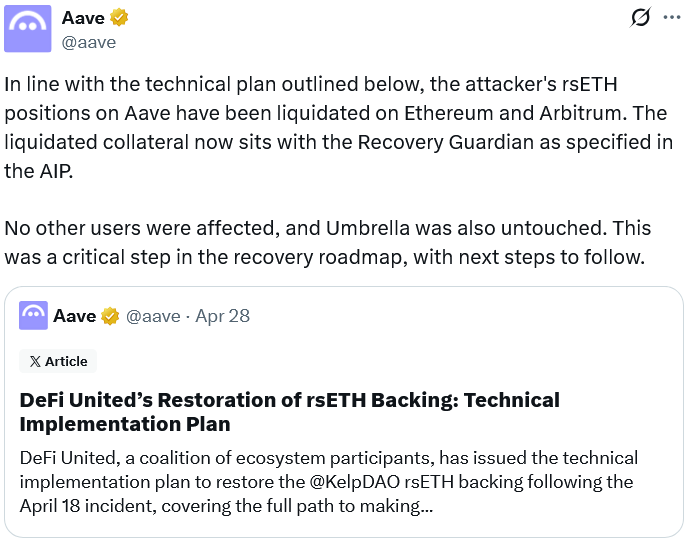
Aave Labs has successfully liquidated the remaining rsETH positions tied to the Kelp DAO attacker across both the Ethereum and Arbitrum networks, bringing the decentralized finance ecosystem a significant step closer to fully restoring the backing of the restaked token and compensating affected users.
The move represents a critical milestone within the broader "DeFi United" recovery initiative, according to an official announcement shared by Aave on X on Wednesday. Under the execution plan, the liquidated collateral directly associated with the massive $293 million exploit that occurred on April 18 was securely transferred to the Recovery Guardian, a specialized multisignature wallet managed collaboratively under the DeFi United umbrella.
With these liquidations finalized, the collective recovery effort is now closing in on its goal. DeFi United is only about 10% short of the total Ether required to fully restore the Kelp DAO restaked ETH token, known as rsETH, according to Thaddeus Pinakiewicz, vice president of the research team at Galaxy Digital.
The Kelp DAO exploit has rapidly cemented its status as one of the most devastating and disruptive cryptocurrency hacks of 2026. The security breach triggered an immediate and severe ripple effect throughout the decentralized finance lending markets, destabilizing billions of dollars in liquidity and severely eroding user confidence across the wider ecosystem.

Despite the sheer scale of the disruption and the immediate pressure placed on lending protocols, Aave confirmed that everyday user funds remained entirely unaffected by the liquidations. Furthermore, the platform’s native automated insurance mechanism designed to protect against bad debt—known as Umbrella—was not triggered or utilized during the process, underscoring the resilience of Aave’s isolated risk frameworks despite the external shock.
Back on April 28, Aave outlined that clearing out the remaining hacker-associated collateral resting on Ethereum and Arbitrum would successfully unlock and release approximately 13,000 Ether, which equates to nearly $30.2 million based on prevailing market valuations.
However, the recovery path continues to navigate complex regulatory and legal hurdles. Pinakiewicz pointed out that an additional 30,765 ETH remains frozen by the Arbitrum DAO, currently trapped in what he described as legal limbo. The complication arose after a United States-based law firm, Gerstein Harrow LLP, filed a formal restraining notice on Friday aimed at preventing the Arbitrum DAO from redistributing the frozen funds, purportedly on behalf of clients claiming they are owed assets linked to the Democratic People’s Republic of Korea (DPRK) cyber activities. In direct response to the legal maneuver, Aave filed an emergency motion demanding that the court vacate the restraining notice so that the recovery funds can be safely channeled back to victims.
Simultaneously, members of the Arbitrum DAO are actively participating in an ecosystem vote regarding the release of the frozen ETH directly into the DeFi United recovery fund. Community sentiment has proven overwhelmingly supportive, with over 90% of participating voters casting ballots in favor of the proposal ahead of the voting period’s scheduled closure on Friday.
Beyond the ongoing legal and DAO-level governance battles, the DeFi United initiative is actively anticipating formal commitments from major industry stakeholders. These include prominent stablecoin issuers such as Circle, Ethena, and Frax, alongside Ink, the Ethereum layer-2 network built by Kraken.
Pinakiewicz emphasized that securing these final commitments is essential for the initiative to successfully cross the finish line and permanently plug the financial hole left in the wake of the exploit.
Aave’s TVL Bleeding Has Stopped
The aftermath of the Kelp DAO exploit dealt a severe blow to Aave’s platform metrics. The protocol was hit exceptionally hard, suffering a staggering decline in its total value locked of nearly $12 billion within a single week. The exploit unfolded after the attacker deposited stolen rsETH tokens as collateral onto Aave’s lending markets to borrow wrapped Ether. This maneuver left the protocol facing more than $190 million in bad debt and immediately sparked an aggressive wave of capital withdrawals by cautious liquidity providers.
Nevertheless, recent on-chain metrics indicate that the worst of the crisis has abated. Data provided by DefiLlama reveals that net outflows from Aave’s lending markets have eased substantially over the past week. Demonstrating a return of user trust and liquidity stability, the protocol’s total value locked has steadily climbed back up, recovering from a local low of $14.2 billion recorded on April 26 to comfortably push back above the $15 billion threshold.