

Ripple USD, the stablecoin issued by prominent cryptocurrency firm Ripple, was initially heralded as a strictly "enterprise-focused" financial product. However, it has increasingly transcended its original corporate positioning, capturing significant adoption and traction among everyday retail users across the digital asset ecosystem.
Officially introduced in late 2024, the Ripple USD (RLUSD) stablecoin was heavily marketed during its rollout by Ripple CEO Brad Garlinghouse, who consistently highlighted its primary institutional focus. This institutional-grade framing was intentionally designed to carve out a distinct niche for RLUSD, setting it apart from competing stablecoin assets that historically catered primarily to retail traders and decentralized finance participants.
Despite this deliberate corporate messaging, market realities have quickly begun to shift. The rapid adoption of RLUSD by prominent self-custodial wallets, such as Xaman, alongside strategic platform integrations with entities like Transak, clearly demonstrates that the stablecoin’s utility is expanding far beyond institutional balance sheets.
Reflecting on this unexpected organic growth, the chief operating officer of XRPL Labs and Xaman noted that while RLUSD initially entered the market with an enterprise-focused narrative—largely driven by the inherent technological strengths of the XRP Ledger, including high transaction speeds, cost-efficiency, and absolute settlement finality—market demand is telling a broader story. Real adoption and undeniable traction are actively materializing on the retail side of the equation as everyday users seek out efficient digital dollar alternatives.
Controversy and Debate Over RLUSD’s Enterprise Focus
The trajectory of Ripple USD has been accompanied by considerable discussion regarding its target audience since initial reports surfaced well ahead of its formal debut. Rumors and early disclosures about the stablecoin circulated months before its official announcement in December 2024. In October of that year, Ripple CEO Brad Garlinghouse publicly characterized the digital asset as the "gold standard for enterprise-grade stablecoins," establishing a tone of high-level corporate exclusivity.

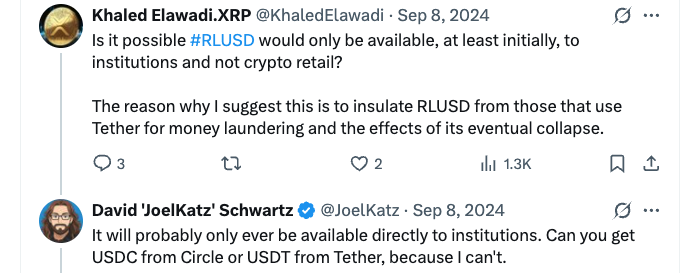
This narrative was further reinforced by Ripple’s chief technology officer, David Schwartz, who suggested during discussions in late 2024 that RLUSD would "probably only ever be available directly to institutions." Schwartz’s remarks sparked widespread debate and speculation across the crypto community regarding whether the stablecoin would remain entirely locked away from retail participants, reserved exclusively for corporate treasuries, cross-border payments, and banking partners.
When Ripple formally announced the launch of RLUSD on Dec. 16, 2024, the official corporate statements notably omitted any direct mentions of retail use cases. Instead, the announcement focused heavily on its initial availability and compliance infrastructure across major institutional-friendly platforms, including Uphold, Bitso, and MoonPay, maintaining the perception of an asset tailored strictly for institutional and enterprise clientele.
RLUSD Emerges as a Direct Competitor to Established Stablecoins
Despite the initial corporate messaging emphasizing enterprise exclusivity, industry participants quickly recognized that market dynamics rarely adhere strictly to marketing narratives. Speaking on the evolving utility of the asset, Transak’s marketing head, Harshit Gangwar, noted that while RLUSD was meticulously engineered with enterprise-grade utility in mind, its underlying issuance and redemption infrastructure inherently supports both institutional and retail accessibility.
Echoing this sentiment, Huma Finance co-founder Erbil Karaman observed that RLUSD currently operates much like any general-purpose stablecoin on the open market. In practice, it is now competing directly with established market leaders—such as Circle’s USDC—across virtually all market segments. Karaman emphasized that this ongoing evolution underscores a fundamental truth of the digital asset industry: the initial branding or intended target audience of a stablecoin matters far less than what it actually becomes useful for once deployed in the wild, a reality that only becomes fully apparent after launch.
Ethereum Hosts the Majority of Supply, While Holders Prefer XRPL
A fascinating dynamic has emerged regarding the technical infrastructure and user distribution underpinning RLUSD. According to data provided by RWA.xyz, the vast majority of the stablecoin’s supply is minted and issued on Ethereum. Specifically, Ethereum-issued RLUSD accounts for approximately 88% of the asset’s overall market capitalization, which sits at roughly $557 million, while less than 12% of the total supply is native to the XRP Ledger (XRPL).
However, this capital concentration on Ethereum stands in stark contrast to user preferences. Data highlighted by prominent community members indicates that the vast majority of individual RLUSD holders—representing more than 90% of the total 34,160 active users—prefer utilizing the XRP Ledger. This leaves only about 10% of the active user base interacting with the stablecoin on Ethereum.
Commenting on this divergence between supply distribution and user preference, XRPL Labs representative Kiuru pointed out that Ripple continues to promote the asset through an enterprise lens. This branding aligns naturally with the historical positioning of the XRP Ledger, which has been marketed as an enterprise-grade blockchain since its inception due to its speed and scalability.
At the same time, Kiuru emphasized that broad retail adoption represents a significant victory for the ecosystem. He noted that the ongoing expansion into retail use cases does not signal a retreat from Ripple’s core enterprise strategy, but rather highlights the versatile utility of the underlying ledger and the stablecoin itself.
As RLUSD continues to circulate across multiple networks and integrate deeper into the broader digital asset economy, market participants and developers alike continue to monitor how Ripple will balance its institutional ambitions with burgeoning retail demand.