
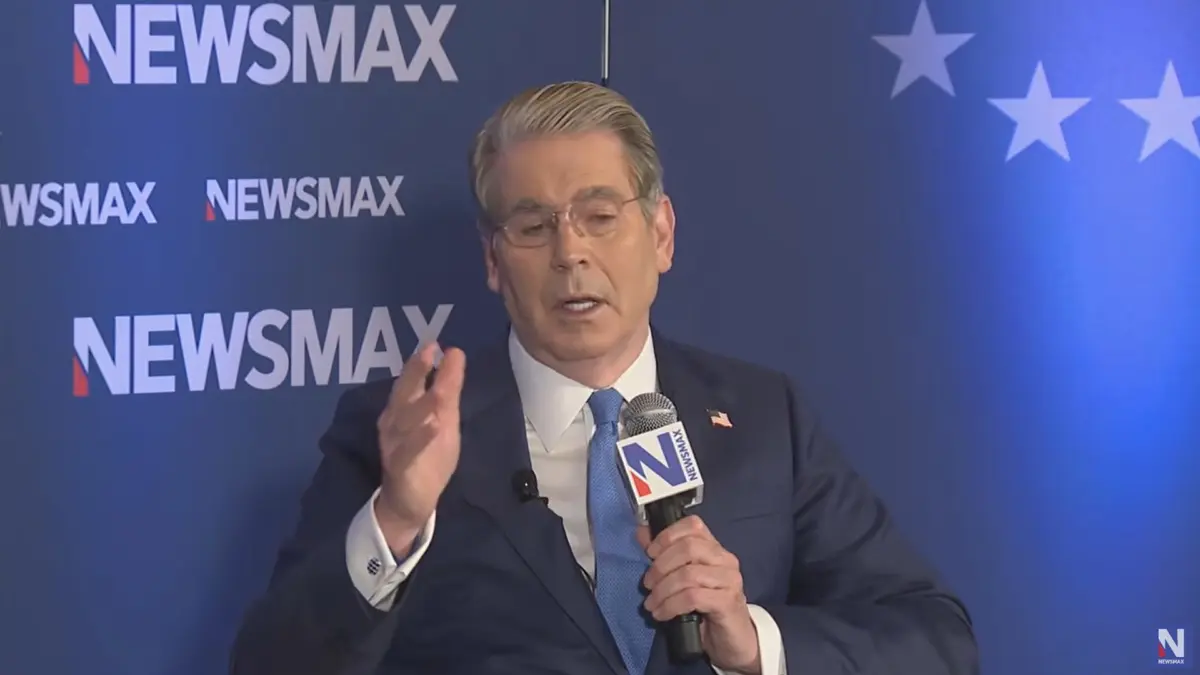
Speaking at Newsmax’s NPolicy Summit in Washington, D.C. on Thursday, Bessent detailed the ongoing crackdown, emphasizing that comprehensive economic sanctions targeting Tehran are yielding concrete results. According to the Treasury Secretary, Iran has increasingly relied on digital assets—including Bitcoin and various stablecoins—as a mechanism to bypass traditional international banking restrictions and evade heavy U.S. sanctions.
The U.S. government initially began systematically targeting cryptocurrency wallets associated with the Iranian regime in April of last year, a strategy that Bessent highlighted as unprecedented in scale and execution. Reflecting on the administration’s broader geopolitical and financial strategy during his summit appearance, Bessent stated that what American authorities have accomplished in terms of tracking and dismantling these illicit financial channels has never been seen before.
Elaborating on the immediate horizon of these operations, Bessent revealed that authorities expect to seize a massive sum of digital assets within the week. He asserted that officials know precisely where the funds are located, noting that the administration’s previous "maximum pressure" campaign has successfully evolved into what he termed an "absolute isolation campaign" that is actively working.
While Bessent did not specify which exact cryptocurrencies would be targeted in the upcoming seizure operation or the precise technical mechanisms being deployed by federal agencies, financial and blockchain analysts note the inherent technical limitations and capabilities of different digital assets in such scenarios. Experts point out that executing a direct freeze on decentralized assets like Bitcoin is historically difficult—if not entirely impossible—unless the funds are being held directly on centralized cryptocurrency exchanges. Because Bitcoin is fundamentally censorship-resistant and operates on a decentralized peer-to-peer network without a central authority capable of reversing transactions or freezing addresses, sovereign governments cannot easily confiscate it from self-custodied wallets.
However, the landscape changes significantly when dealing with centralized stablecoins, such as Tether’s USDT, which feature built-in administrative controls allowing issuers to freeze tokens at the request of law enforcement agencies. Bessent has previously noted that prior federal seizures of Iranian-linked digital assets successfully targeted funds held in the form of popular stablecoins, which possess the centralized vulnerabilities that allow governments to intercept them.
The upcoming seizure underscores a broader, growing trend of nation-states turning to digital assets to maintain trade and financial liquidity in the face of severe economic isolation. Earlier this year, Iran reportedly established a Bitcoin-backed insurance service specifically tailored to protect and facilitate operations for its national shipping companies, attempting to secure safe passage through critical maritime chokepoints such as the Strait of Hormuz.
Furthermore, reports from the Financial Times last month highlighted that Tehran has been actively utilizing Bitcoin to settle international cross-border transactions through domestic Iranian cryptocurrency exchanges. This pivot followed direct guidance from the Central Bank of Iran advising citizens and domestic entities to utilize any necessary means—including digital currencies—to sustain the national economy and keep trade flowing despite mounting foreign pressures.
These aggressive financial containment measures stem directly from policies enacted by U.S. President Donald Trump, who revived and intensified the "maximum pressure" campaign mere weeks after returning to office. A national security memorandum signed in February 2025 formally directed the Department of the Treasury to launch a sustained, multi-agency campaign specifically designed to dismantle Iran’s shadow banking infrastructure, international money laundering rings, and sophisticated sanctions-evasion networks operating across global jurisdictions. As the Treasury moves forward with its latest wave of enforcement actions, the intersection of digital asset tracking and national security remains at the forefront of American foreign policy in the Middle East.