

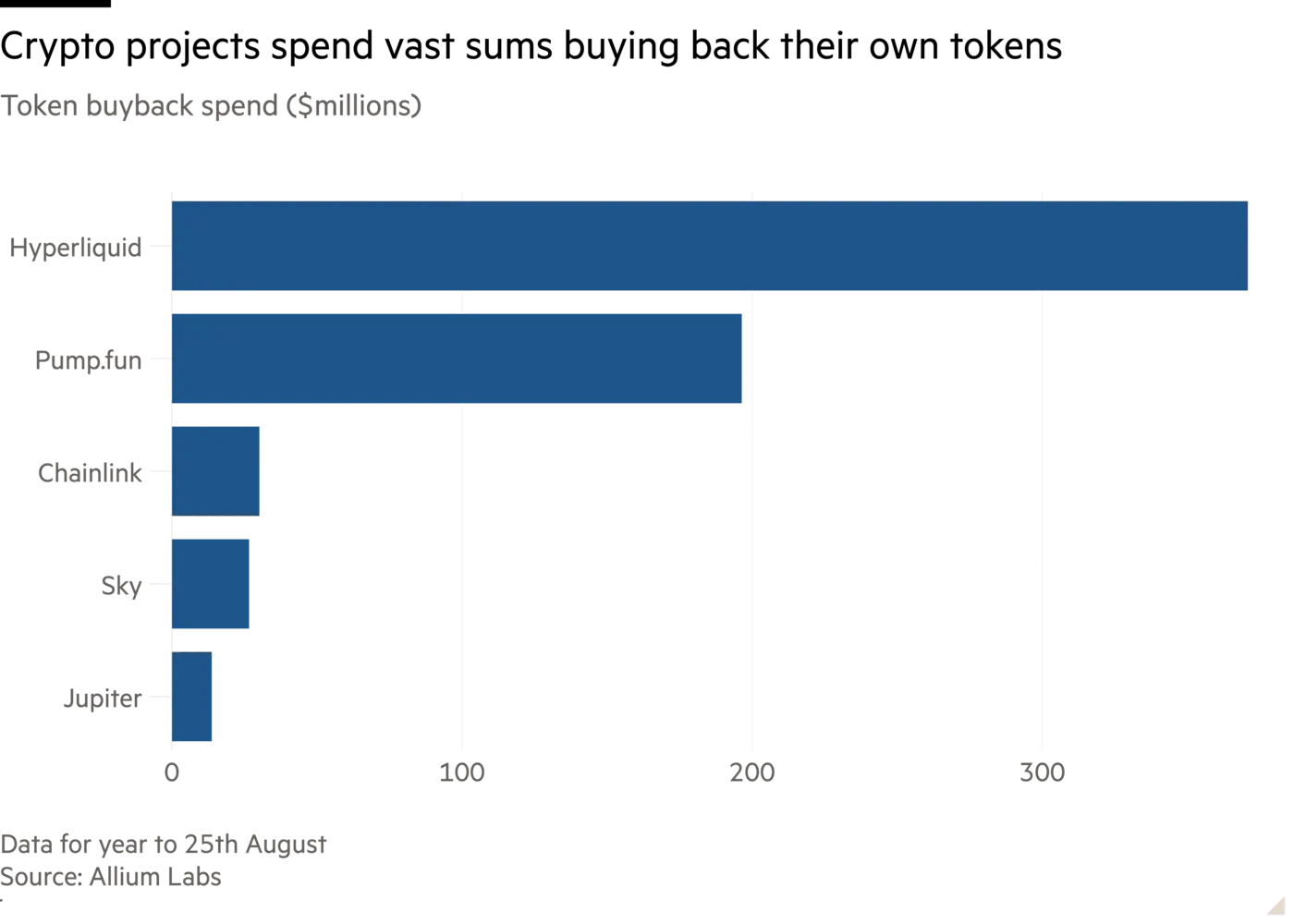
Decentralized exchange Hyperliquid and prominent memecoin launchpad Pump.fun have emerged as the primary powerhouses behind a historic surge in cryptocurrency repurchases, collectively accounting for nearly 90% of a record $638 million in token buybacks carried out by digital asset projects so far in 2026.
According to data compiled by Allium Labs and cited in a recent Financial Times report, crypto projects have rapidly accelerated their capital allocation toward repurchasing their native assets. The year-to-date figure of $638 million represents a substantial escalation compared to the same period in 2025, when projects spent $545 million. The practice has grown exponentially from just $366,000 during the corresponding timeframe in 2024, signaling a profound structural shift in how decentralized finance protocols manage their treasury revenues and attempt to return value to tokenholders.
Out of the massive $638 million total recorded across the industry, decentralized derivatives powerhouse Hyperliquid accounted for approximately $370 million, while high-velocity memecoin deployment platform Pump.fun drove nearly $200 million in repurchases.
The mechanism of token buybacks mirrors the traditional financial strategy employed by publicly listed corporations on conventional stock exchanges. In traditional equity markets, companies use corporate cash reserves or surplus operational revenues to buy back their own shares from the open market. This process reduces the circulating supply of equity, helps support falling share prices, and enhances per-share metrics, ultimately increasing long-term returns for existing shareholders.

While share repurchases are a ubiquitous and time-tested component of traditional corporate finance, token buybacks have historically remained a relatively rare phenomenon within the volatile and fast-moving cryptocurrency industry. For years, the prevailing model relied on token emissions, inflationary reward structures, and venture capital dilution rather than direct market absorption. However, as the digital asset ecosystem matures and protocol business models generate tangible, cash-flow-positive revenues, an increasing number of companies are taking structural cues from traditional equity markets to support their native assets.
This momentum is rippling across various sectors of the decentralized finance landscape. The trend was further underscored when the Ethena Foundation officially opened a community governance vote on a comprehensive fee-switch proposal. Under the terms of the proposal, an overwhelming 95% of the net revenue generated and paid to the foundation from Ethena’s core business lines would be systematically redirected toward repurchasing ENA tokens from the open market. The market reaction to the governance vote was immediate and pronounced, with the ENA token rallying 10.7% on the very same day the proposal went live.
HYPE, PUMP Outperform Crypto Market as Buybacks Boost Token Valuations
The aggressive capital allocation strategy deployed by market leaders has yielded tangible results for token valuations, allowing several prominent protocols to decouple from broader market trends. The native tokens associated with the year’s largest buyback programs—Hyperliquid’s HYPE and Pump.fun’s PUMP—have significantly outperformed the broader cryptocurrency market during a challenging macroeconomic and sector-wide correction in 2026.
Market data from TradingView indicates that HYPE surged by an impressive 145% year-to-date, while PUMP climbed 109% over the same period. These gains stand in sharp contrast to the rest of the digital asset economy. Bitcoin, the industry’s benchmark asset, experienced a 10% price decline year-to-date, while the total capitalization of the entire cryptocurrency market contracted by 11.9% over the corresponding timeframe. Analysts attribute the exceptional relative strength of HYPE and PUMP directly to the continuous, programmatic buying pressure exerted by their respective treasury programs.
The scale of these buyback initiatives is directly tied to the robust revenue models underpinning each platform. Hyperliquid operates on an aggressive value-accrual model, dedicating approximately 99% of its substantial platform revenue directly to token buybacks. Financial disclosures illustrate the sheer magnitude of this commitment; on August 6, Hyperliquid reported $169 million in revenue for the second quarter alone, of which an extraordinary $141 million was immediately directed toward repurchasing HYPE tokens from the open market.
Similarly, Pump.fun maintains a high-velocity capital return mechanism, allocating roughly 50% of its net protocol revenue toward continuous token repurchases. Driven by sustained retail engagement and speculative volume within the memecoin sector, the launchpad currently boasts an impressive $420 million in annualized revenue, calculated using the average daily revenue generated over the preceding 90 days.
Industry analysts suggest that this evolving emphasis on revenue-backed buybacks could fundamentally alter how digital assets are valued by institutional and retail participants alike. Earlier in August, Bitwise Chief Investment Officer Matt Hougan shared his outlook on the sector, projecting that cryptocurrency valuations could potentially double over the next two years. According to Hougan, this projected growth will be largely driven by protocols increasingly leveraging their operational revenue to fund systematic token buybacks and permanent supply burns, thereby returning sustainable economic value directly to investors.