
The United Kingdom’s financial watchdog has officially published its landmark crypto regulatory framework, marking the final stage of an extensive roadmap designed to bring digital assets firmly under the regulator’s comprehensive purview. The sweeping new rules introduce critical changes to the country’s digital asset sector, aiming to balance stringent market integrity with sustainable innovation.
According to a press release shared with Cointelegraph, the significant new elements of the framework include mandatory licensing for a broad range of crypto firms, rigorous capital stress-testing requirements, and vastly improved rules regarding market manipulation and insider trading. Additionally, the guidelines establish simplified capital requirement standards specifically tailored for stablecoin issuers operating within the UK jurisdiction.
The timeline for implementation has been clearly defined by the regulator. The formal licensing window for crypto companies will open in September and run until Feb. 28, 2027, before the new regulatory regime officially goes live on Oct. 25, 2027. This phased rollout gives existing and prospective market participants a designated period to prepare for full compliance.
The introduction of this framework means that cryptocurrency companies operating in the UK will soon be held to standards comparable to those governing other traditional financial service providers in the country. David Geale, executive director of payments and digital finance at the Financial Conduct Authority (FCA), emphasized this philosophy in the announcement.
"We’ve created a framework that doesn’t force firms to choose between regulatory certainty and room to innovate — this regime means they can have both in a stable, competitive home to build and grow," Geale wrote.
Under the updated guidelines, a wide array of cryptocurrency entities—including trading platforms, digital asset custodians, stablecoin issuers, staking service providers, and various other intermediaries—must successfully obtain formal FCA authorization to legally operate within the United Kingdom.
This comprehensive framework arrives nearly a month after the regulator concluded its public consultation window on the guidelines for the country’s future crypto regime on June 3. The finalized draft marks a pivotal transition for the UK crypto market, shifting it away from an enforcement-focused environment and into a fully integrated financial services framework.

Edwin Mata, a practicing lawyer and the CEO of tokenization platform Brickken, noted that the framework illustrates the FCA’s dedicated efforts to make crypto firms operate akin to traditional, regulated financial institutions.
However, while traditional finance integration is welcomed by many, major industry players are already scrutinizing the finer details of the compliance costs and structural impact. Katie Harries, Coinbase’s head of policy in Europe, praised the final rules for helping preserve vital access to global liquidity and commended the innovative licensing structure established by the regulator. Despite this, she highlighted two pressing issues that continue to concern major industry participants.
"While the FCA has made welcome changes to its prudential framework, it is an open question as to whether these changes have gone far enough to ensure the cost of doing business in the UK is not materially higher vis-a-vis other jurisdictions," Harries told Cointelegraph.
She further noted that the UK’s future approach to decentralized finance regulation remains her second major concern. According to Harries, earlier policy proposals regarding the sector essentially amounted to a de facto ban on centralized platforms providing retail and institutional users with access to decentralized finance applications.
AML-Authorized Crypto Firms Need New Licenses in the UK
As the regulatory landscape shifts, existing crypto businesses face administrative changes. Crypto firms that currently hold authorization strictly under existing money laundering regulations will not have their licenses automatically converted under the new regime. Instead, these entities will be required to go through the comprehensive process of obtaining a brand-new authorization.
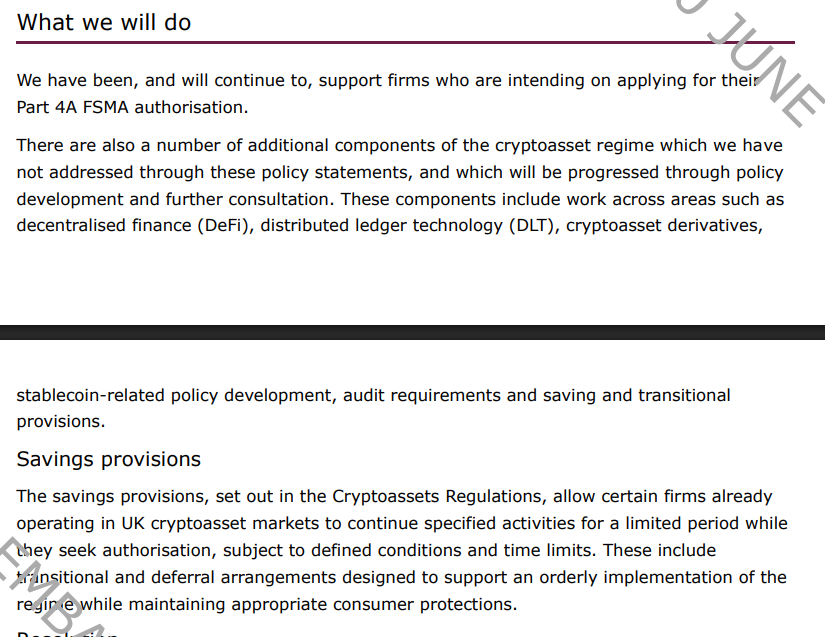
To prevent sudden market disruption, certain companies already operating within the UK will be permitted to continue specified activities for a limited period. This grace period will allow them to seek formal authorization under the framework’s transitional savings provisions.
To aid firms through this complex transition, the FCA announced that pre-application support meetings for companies will become available starting next month. The regulator plans to elaborate further on its official policy statements during a dedicated webinar scheduled for July 17. Furthermore, the agency will publish an additional policy statement in September to precisely establish how the regulatory perimeter applies to various cryptoasset activities.
FCA Simplifies Stablecoin Capital Standards, Promises Tailored DeFi Guidance
In refining its approach to digital currency, the FCA has largely maintained its core stablecoin framework while introducing several minor yet impactful adjustments. These changes include simplifying the backing asset composition requirements. Specifically, issuers will no longer be burdened by the requirement to calculate estimated redemption forecasts. At the same time, the framework adds new mandates requiring a statutory trust over reserve assets while removing unallocated backing fund accounts.
The updated guidelines will also require stablecoin issuers to offer specific, clear withdrawal rights to their users. Moreover, the framework permits a 5% excess to be held within the backing asset pool and allows for limited intragroup custody arrangements, provided that stringent institutional safeguards are met.
The FCA noted that these adjustments establish a solid baseline regime for stablecoin issuance in the country. Looking ahead, the regulator added that it will consult closely with the Bank of England later this year regarding how regulatory rules will apply to stablecoin issuers that are formally recognized as systemic by His Majesty’s Treasury.
Beyond stablecoins, the FCA has outlined a roadmap for addressing other complex sectors of the digital asset economy. Later this year, the regulator will host a separate consultation dedicated entirely to decentralized finance guidance, alongside operational resilience guidelines tailored specifically for firms utilizing distributed ledger technology. The agency also plans to consult on necessary updates to the Financial Crime Guide to ensure it remains relevant to cryptoasset firms.
Matthew Long, director of payments and digital assets at the FCA, underscored the regulator’s commitment to engaging with emerging technologies.
"We’re going to continue to work on DeFi," Long said, explaining that the agency is actively pursuing a case-by-case regulatory approach. He pointed out that true decentralized finance, characterized by an absolute absence of any identifiable person undertaking the underlying activity, will naturally fall outside the intended scope of the new regulations.