
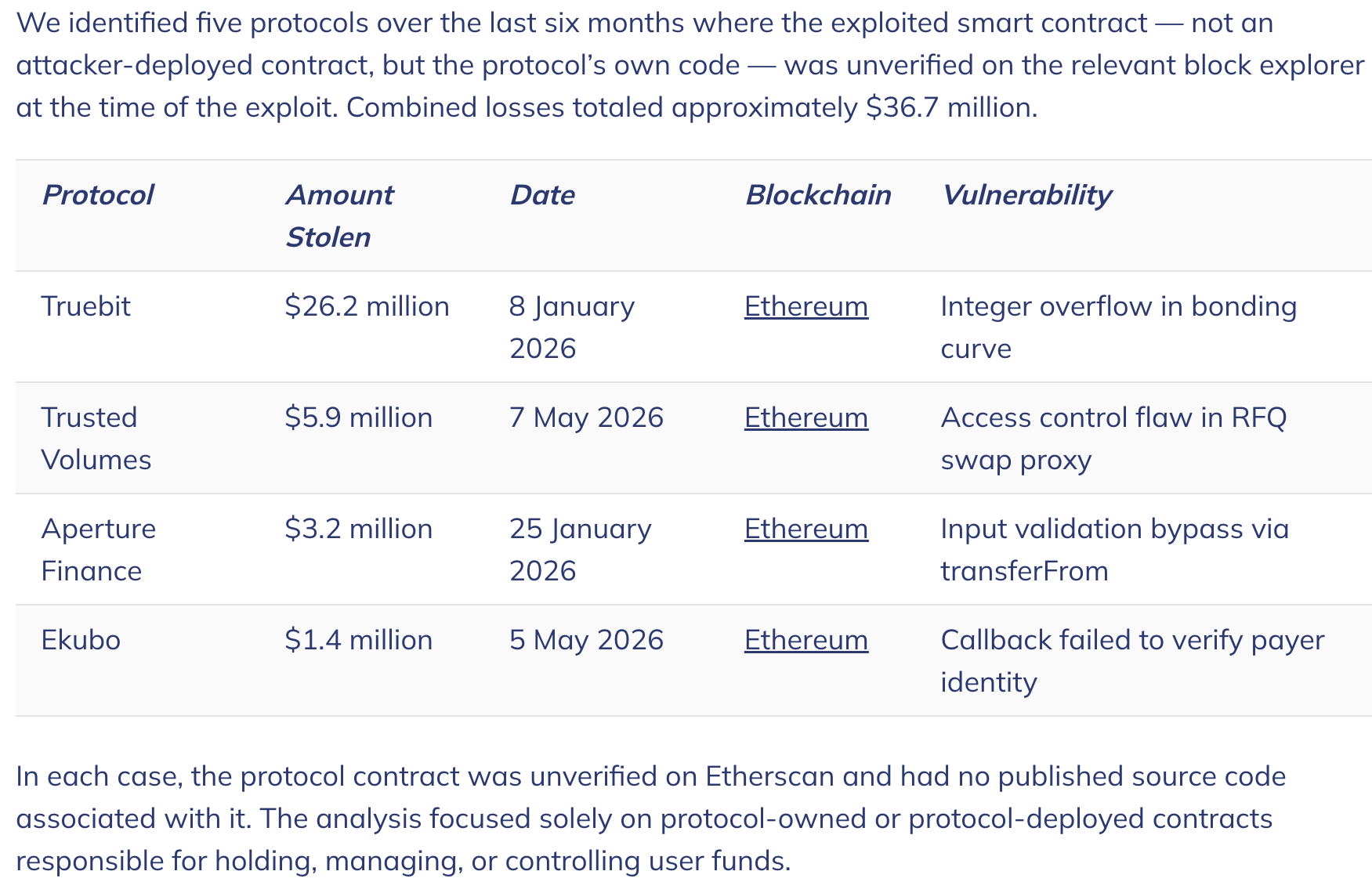
Decentralized finance protocols relying on hidden source code are facing a stark new security reality as attackers increasingly target unverified smart contracts. According to a recent report by blockchain analytics firm Chainalysis, unverified smart contracts have been directly linked to at least $36.7 million in losses across four distinct DeFi exploits over the past six months.
The findings challenge a longstanding assumption within the decentralized finance ecosystem that keeping smart contract source code private provides an effective layer of defense. For years, some developers and protocols have operated under the belief that concealing code discourages malicious actors by forcing them to work in the dark. However, rapid advancements in automated decompilation tools and artificial intelligence have dramatically shifted the balance of power, rendering the strategy of security through obscurity largely obsolete.
The largest single incident highlighted in the Chainalysis report involved Truebit, which suffered a devastating $26.2 million loss. The exploit was executed after an attacker targeted an integer overflow vulnerability embedded within a contract that had remained unverified on the Ethereum blockchain since 2021. Alongside Truebit, the report identified three other protocols—Trusted Volumes, Aperture Finance, and Ekubo—that fell victim to similar vulnerabilities in unverified infrastructure over the same timeframe.
In each of these cases, the exploited smart contracts shared a critical operational characteristic: they had not been verified on a blockchain explorer. On public ledgers like Ethereum, contract verification allows anyone to view, audit, and verify the human-readable source code that corresponds to the deployed bytecode. When protocols leave their contracts unverified, the source code remains hidden from public view.

According to Chainalysis, this lack of transparency imposes severe trade-offs. While it may temporarily keep prying eyes away from proprietary logic, it simultaneously limits rigorous scrutiny from independent security researchers, academic auditors, and white-hat hackers. Furthermore, unverified contracts are routinely excluded from comprehensive bug bounty programs because participants cannot adequately review the code to identify logic flaws or security vulnerabilities. Despite operating in the shadows, these unverified contracts frequently control significant volumes of user funds, turning them into high-value honeypots for determined attackers.
The growing effectiveness of attacks against hidden code is heavily driven by technological evolution. Chainalysis pointed out that modern reverse-engineering tools, combined with artificial intelligence capabilities, have transformed how attackers analyze smart contract bytecode. In the past, dissecting an unverified contract required a highly skilled reverse engineer to spend days, or even weeks, manually analyzing a single contract to understand its execution logic.
Today, that labor-intensive process can be partially automated across large batches of unverified contracts simultaneously. Attackers can leverage AI-assisted tools to rapidly translate complex bytecode back into understandable patterns, flag logical weaknesses, and simulate exploits long before executing them on-chain. This capability has effectively dismantled the defensive moat that protocols once believed they gained by withholding their source code from public blockchain explorers.
As security through obscurity continues to fail, Chainalysis has urged the decentralized finance industry to overhaul its approach to contract deployment and protocol defense. The analytics firm recommends standardizing full source code verification across all operational contracts, expanding bug bounty coverage to incentivize ethical researchers to find bugs before malicious actors do, and implementing robust real-time monitoring tools to detect anomalous contract interactions instantly.
DeFi Security Concerns Persist After Record April Losses
The revelations regarding unverified smart contracts arrive amid a broader, more volatile wave of security breaches and exploits plaguing the wider cryptocurrency ecosystem. According to aggregated data from DeFiLlama, malicious actors managed to steal an astronomical $629.7 million in April alone, marking the highest monthly total for crypto-related losses since February 2025.
The staggering figures from April were largely driven by two massive infrastructure incidents. KelpDAO suffered a catastrophic $293 million exploit, while Drift Protocol was hit by a parallel $280 million breach. Together, these two incidents accounted for more than 80% of all funds stolen during the month, sending shockwaves through the liquidity-staking and perpetual-trading sectors of decentralized finance.
Although overall financial losses from exploits fell sharply in May—with blockchain security firm CertiK reporting a significantly reduced total of $68.3 million stolen during the month—the long-tail consequences of April’s devastation continued to ripple across the market. In June, blockchain intelligence platform Arkham reported that the hacker responsible for the KelpDAO breach had successfully laundered nearly all of the roughly $220 million in unfrozen stolen funds, moving the capital through complex laundering channels to evade tracking and law enforcement recovery efforts.
The sheer scale of the KelpDAO exploit also prompted widespread introspection across the decentralized finance industry. Numerous protocols began aggressively reviewing and upgrading their underlying security infrastructure to prevent similar systemic failures. Among them, projects such as Solv Protocol announced formal plans to migrate their critical operations to Chainlink’s crosschain infrastructure following comprehensive internal security audits.
The intersection of advanced technology and cybersecurity threats has also drawn scrutiny far beyond the boundaries of blockchain protocols. Earlier this month, artificial intelligence developer Anthropic disclosed that out of 832 accounts it banned for policy violations over a strict one-year monitoring period, 560 accounts had actively utilized AI models to assist in preparing cyberattacks. These malicious use cases included writing custom malware, optimizing exploit scripts, and identifying complex software vulnerabilities, underscoring a sweeping industry-wide challenge as automated tools become standard equipment for digital adversaries.