It was a week that security professionals and system administrators are unlikely to forget anytime soon—a relentless deluge of high-severity vulnerabilities, aggressive automated scanning, and software supply-chain compromises that pushed IT departments to their absolute limits. If the past seven days have proven anything, it is that the gap between vulnerability disclosure and active exploitation has narrowed to a razor’s edge.
From critical remote code execution (RCE) flaws affecting foundational web technologies to supply-chain breaches triggered by leaked cryptographic keys, the threat landscape experienced a turbulent period. The collective sentiment across the cybersecurity community can be summarized by a recurring nomenclature dominating threat intelligence reports: PHP2Shell, Node2Shell, and variations that underscored how easily attackers can turn core infrastructure into execution vectors. With security teams facing a mountain of urgent patches that outpaces human and automated capacity alike, the digital ecosystem found itself under siege from every conceivable vector.
Threat of the Week: PHP2Shell Flaws Put Organizations Worldwide on High Alert
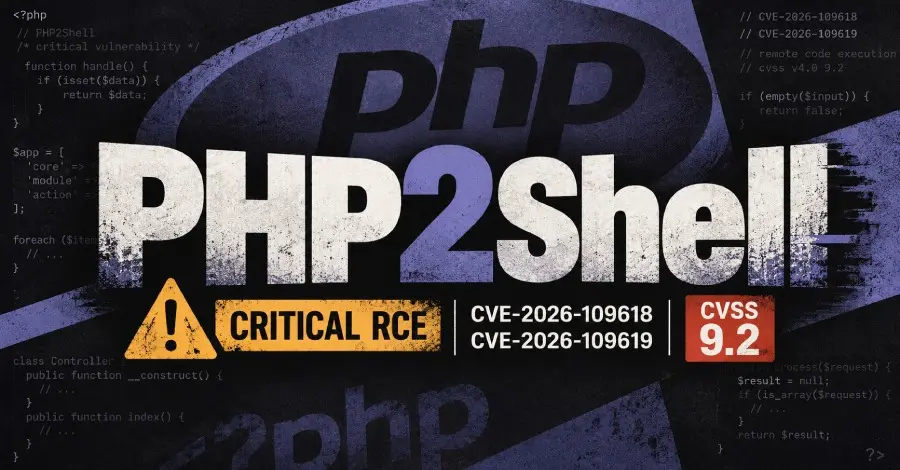
The most alarming development of the week centered on the PHP Foundation, which released critical security patches addressing two severe vulnerabilities tracked as CVE-2026-109618 and CVE-2026-109619. Dubbed collectively by researchers as "PHP2Shell," these flaws pose an existential risk because they enable unauthenticated remote code execution, meaning malicious actors can potentially take over vulnerable servers without needing valid credentials or prior system access.
Immediately following public disclosure, the vulnerabilities triggered an unprecedented wave of malicious activity across the internet. Infrastructure providers and security firms reported massive spikes in automated scanning. Cloudflare, among other prominent security networks, disclosed that it detected millions of individual exploitation attempts targeting the flaws within hours of the advisory going live.
Given the sheer ubiquity of PHP across the global web ecosystem—powering a vast majority of dynamic websites, content management systems, and enterprise backends—the potential blast radius is immense. While security telemetries confirmed that widespread scanning and probing were underway, no confirmed successful breaches tied directly to these zero-day vectors had been verified at the time of reporting. However, the severity of the flaws combined with the sheer volume of incoming attack traffic prompted several organizations to temporarily take their websites and web applications offline as a precautionary measure, illustrating the palpable panic among system administrators unwilling to roll the dice.
A Cascade of High-Impact Vulnerabilities and Trending CVEs
The PHP2Shell phenomenon was far from an isolated incident. The weekly vulnerability cycle delivered a punishing blow of high-severity CVEs spanning operating systems, network appliances, databases, developer tools, and enterprise platforms. The sheer breadth of the flaws forced security operations centers to prioritize triage based on active exploitation risks, network exposure, and authentication requirements.
Among the heavy hitters drawing intense scrutiny from security researchers were the aforementioned PHP flaws alongside CVE-2026-115560, which joined the PHP vulnerability queue. Hardware and enterprise infrastructure also saw heavy patching demands, notably with Xerj Console API vulnerability CVE-2026-97406 and ASUS Control Center’s CVE-2026-75754, the latter of which highlighted ongoing concerns regarding automated vulnerability discovery and AI-assisted exploitation vectors.
Enterprise software giants were heavily represented in the advisory boards. Splunk issued patches for a cluster of high-priority vulnerabilities including CVE-2026-76299, CVE-2026-76302, CVE-2026-76531, and CVE-2026-76407. SolarWinds addressed CVE-2026-28328 within its Observability platform, while Cisco grappled with a massive wave of security advisories spanning over a dozen distinct identifiers—most notably CVE-2026-20043, CVE-2026-20236, CVE-2026-20291, CVE-2026-20356, and a series ranging from CVE-2026-76466 through CVE-2026-76481. Oracle also contributed to the October crunch with critical patch updates addressing hundreds of vulnerabilities, highlighted by CVE-2026-91403.
Web applications and developer environments were similarly plagued. WordPress administrators were forced to scramble following the discovery of CVE-2026-82814, a high-severity unauthenticated PHP object injection flaw affecting the widely deployed Duplicator and Duplicator Pro plugins. Google pushed out stable channel updates for desktop environments to neutralize browser-level threats such as CVE-2026-113341, CVE-2026-113279, CVE-2026-113072, and related components. GitLab addressed code execution and regex validation concerns under CVE-2026-110264, while Ruby language maintainers rolled out critical regular expression fixes to ward off related parsing flaws.
Artificial intelligence and language model integration tools emerged as a prominent new attack surface. A flurry of CVEs—including CVE-2026-77934 in Coze Studio, CVE-2026-77933 and CVE-2026-77932 in DB-GPT, CVE-2026-77936 and CVE-2026-77937 in Letta, alongside flaws in EvoScientist, JoySafeter, Aix-DB ChatBI, Langchain-Chatchat, piflow, OpenSRE, LangAlpha, Cognition, Astron Agent, MaxKB, and Yuxi—demonstrated that AI agents and frameworks are increasingly vulnerable to prompt manipulation, insecure deserialization, and command injection attacks.
Network edge devices and developer libraries did not escape unscathed. Arista addressed VeloCloud Orchestrator vulnerabilities via CVE-2026-114625, while the Node.js ecosystem was rattled by "Node2Shell" (CVE-2026-111497), a critical flaw tied to Brotli data handling that allowed remote code execution. Python developers had to contend with multiple Pillow image processing vulnerabilities (CVE-2026-112900, CVE-2026-112403, and CVE-2026-112393), and Atlassian issued extensive advisories covering data center editions of Fisheye, Crucible, Crowd, Confluence, Jira Service Management, and Bamboo. Finally, HPE released sweeping updates covering wireless operating systems ranging from CVE-2026-79844 through CVE-2026-79895, alongside additional blocks of identifiers up to CVE-2026-95721.
Conclusion
If the relentless barrage of the past week served any purpose, it was to strip away any remaining complacency within corporate IT and security divisions. With critical remote code execution bugs accumulating at an unsustainable pace, attackers actively probing newly dropped patches, and millions of automated scanning operations battering internet-facing perimeters, the margin for error has vanished. Widely trusted tools and foundational software components are increasingly acting as entry points for sophisticated threat actors, compounded by the troubling reality that certain critical flaws require no authentication whatsoever, while others still lack complete remediation paths.
The takeaway for system administrators and security leaders is clear: proactive posture management cannot wait for definitive proof of active exploitation. Organizations must audit their attack surfaces, apply patches with rigorous prioritization, isolate systems that cannot be immediately fixed, and treat exposed infrastructure secrets with maximum urgency. While not every automated scan results in a catastrophic breach, malicious actors need only find a single open door. Leaving even one critical vulnerability unpatched in the current threat climate is a risk few organizations can afford to take.