Meta-owned messaging platform WhatsApp has swiftly moved to address a series of security vulnerabilities across its infrastructure
, including a critical bug impacting its Android application that investigators suspect was actively weaponized to lend credibility to malicious scam operations.
The security update comes as part of WhatsApp’s ongoing platform maintenance and threat disruption efforts. According to security advisories published by the company, the most prominent issue involves an incomplete validation flaw found within specific iterations of the application. Internal researchers working within the WhatsApp Security Team successfully identified and reported the vulnerabilities, prompting immediate patch deployments across the affected software versions.
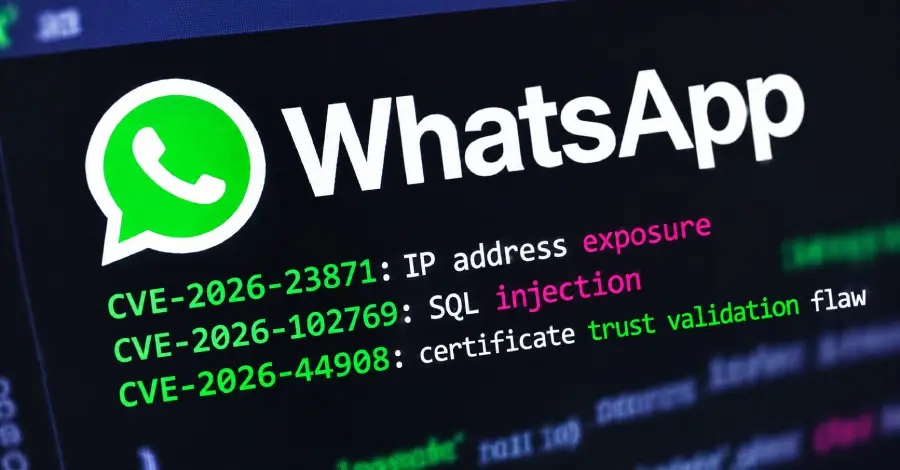
The primary vulnerability, tracked by security identifiers as CVE-2026-23871, has been formally classified as a case of incomplete validation of external ad-reply URLs. The flaw specifically impacts WhatsApp for Android and WhatsApp Business for Android prior to version 2.26.17.4.

Technical details provided by the messaging platform outline how the vulnerability could have been leveraged by malicious actors. The issue had the potential to cause a targeted user’s device to inadvertently reveal its Internet Protocol (IP) information to an external entity. This exposure could occur if an attacker transmitted media originating from an attacker-controlled URL under specific conditions—namely, when a crafted "Click to WhatsApp" ad-reply message was rendered and displayed within an active message thread.
While external security researchers and industry observers frequently track such capabilities, WhatsApp confirmed that this specific flaw may have been abused in conjunction with targeted spam messages designed to deceive unsuspecting users.
When approached for further comment regarding the nature of the discovery, a WhatsApp spokesperson told industry publication The Hacker News that the vulnerability was uncovered while the platform’s security personnel were actively working to disrupt an ongoing scam campaign. The spokesperson elaborated that the company believes a scammer was utilizing the underlying mechanism to make their fraudulent messages appear significantly more credible to recipients, thereby increasing the perceived legitimacy of the outreach.
Despite confirming that the flaw was integrated into broader deceptive tactics, WhatsApp has not publicly disclosed the exact scale of the malicious activity, nor has it provided definitive metrics regarding whether the scammers’ efforts yielded widespread success before the vulnerability was neutralized.
In addition to the Android ad-reply URL validation flaw, the recent security advisory highlights two other technical issues addressed by Meta’s engineering teams. These supplementary vulnerabilities present unique threat vectors involving side-channel information leakage and infrastructure-level certificate validation checks.

One of these additional issues, tracked as CVE-2026-102769, involves a timing-based side channel capable of extracting minute fragments of data. Specifically, the flaw allows an attacker to leak one bit of information concerning a user’s chat database under precise conditions—namely, if the targeted user happens to be online at the exact moment a malicious message is received.
WhatsApp noted that this vulnerability functioned through an induced-crash delivery receipt timing side channel, which could answer a single binary question asked by the attacker regarding the state of the user’s data. However, the company emphasized that, unlike the Android ad-reply flaw, there is currently no evidence indicating that CVE-2026-102769 has been exploited in the wild by malicious actors.
The third issue addressed in the advisory, designated as CVE-2026-44908, relates to deeper infrastructure checks. Successful exploitation of this vulnerability could have theoretically allowed a bad actor who managed to position themselves within Meta’s internal infrastructure to bypass the hardware root of trust. This bypass would have relied on a Versioned Chip Endorsement Key certificate that was not properly signed by the original hardware manufacturer’s key.
Addressing potential concerns regarding this infrastructure-level risk, WhatsApp explained that any such unauthorized VCEK certificate would first have to be published to the third-party binary transparency ledger utilized by WhatsApp Private Processing. Upon reviewing the ledger logs, the company confirmed that every published VCEK certificate correctly chains back to the legitimate hardware root of trust, verifying that no exploitation of this vector occurred.
As a matter of standard digital security hygiene, WhatsApp is strongly advising all users to ensure their applications and mobile operating systems are kept fully up to date to maintain optimal protection against emerging threats. The company also reiterated its commitment to continuously reinforcing its system architectures and acknowledged the ongoing contributions of the broader bug bounty and security research community in helping keep the messaging ecosystem safe for billions of global users.