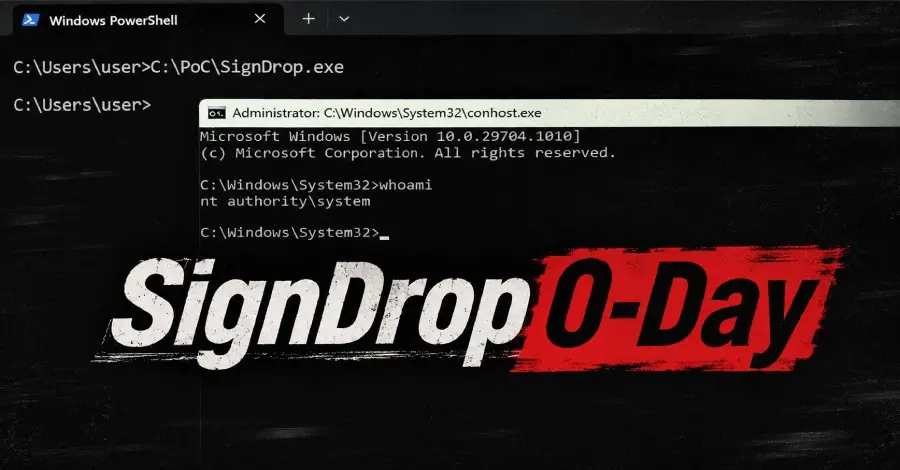
A newly released public proof-of-concept exploit dubbed "SignDrop" has brought fresh scrutiny to the Common Log File System (CLFS) driver in Windows. Published earlier this week, the exploit claims that a standard, unprivileged local user can manipulate the logging subsystem to ultimately achieve full SYSTEM privileges, bypassing recent security enhancements introduced by Microsoft.
The exploit centers on a specialized log-authentication feature that Microsoft added to the CLFS driver to curb a long history of privilege escalation vulnerabilities. However, according to the security researcher behind the release—who publishes under the pseudonym MSNightmare—the underlying logic of how the driver handles companion files creates an opening for path redirection and abuse. As of now, Microsoft has not confirmed the flaw, assigned a Common Vulnerabilities and Exposures (CVE) identifier, or released an official software patch.
The exploit code and a comprehensive technical write-up were published on GitHub on Tuesday, coinciding precisely with the release of Microsoft’s regular monthly security updates. The timing and nature of the disclosure have immediately drawn attention from the broader cybersecurity community, especially given the history of the CLFS component in Windows architecture.
The Target: CLFS and the Path to Escalation
The Common Log File System is a high-performance logging subsystem built directly into the Windows operating system kernel, designed to be used by transactions and applications requiring robust logging capabilities. Over the years, the CLFS driver (clfs.sys) has proven to be a frequent vector for local privilege escalation attacks. According to tracking data from the Cybersecurity and Infrastructure Security Agency (CISA), at least ten distinct CLFS vulnerabilities have historically been cataloged as actively exploited in the wild, including a critical flaw leveraged by organized ransomware campaigns as recently as April 2025.
In an effort to mitigate this chronic exposure and harden the operating system against malicious log manipulation, Microsoft rolled out specialized security updates in October 2025 for modern environments, including Windows 11 versions 25H2 and 26H1, as well as Windows Server 2025. These updates introduced an authentication check designed to verify the integrity of CLFS log files.
Under this mitigation framework, the driver attaches a hash-based message authentication code (HMAC), which is constructed using the log data combined with a unique key generated for each specific machine. Consequently, the driver is intended to parse exclusively those log files that it has authored itself. To facilitate recovery operations, a companion file with a .cnpf extension is generated alongside each primary log, created with the exact same security attributes as the original file.

SignDrop specifically targets the creation and management of this companion file. According to the published proof-of-concept repository, a standard, unprivileged user can carefully prepare a customized CLFS log and container utilizing file paths under the user’s direct control. When a privileged system process subsequently opens that prepared log, the driver creates the associated .cnpf file within the security context of the privileged process rather than falling back to the standard user’s restricted context.
Utilizing object manager symbolic links, the exploit successfully redirects this file creation routine to a specific location dictated by the attacker. In the proof-of-concept code provided by MSNightmare, the targeted privileged process is the Windows Defender antimalware service, which is deliberately invoked through its internal update interface.
"Everything is done properly by Microsoft here, but the logic allows abuse," the researcher noted in the accompanying technical analysis.
Because the newly created .cnpf file automatically inherits the permissions structure of the original log, the outcome is a file created with SYSTEM-level privileges that can still be written to by the standard, unprivileged user. The researcher asserts that this condition can subsequently be chained into acquiring a fully interactive SYSTEM shell.
Testing details provided in the repository indicate that the exploit has been validated against Windows 11 version 26H2, a Windows 11 26H2 Experimental build, and Windows Server 2025 Experimental environments. The vulnerability manifests when the CLFS authentication registry mode is configured to either 0 (fully enforced) or 1 (learning mode). Because standard installations automatically transition systems from learning mode to enforcement after 90 days, established enterprise and consumer machines operating under default configurations fall directly into the scope targeted by the exploit.
Conversely, setting the registry value to 2 or 3 explicitly disables the mitigation entirely, placing the system outside the attack surface claimed by the exploit. However, both the researcher and official driver documentation strongly advise against disabling the feature, as doing so would allow the CLFS driver to parse unauthenticated and tampered log files, thereby reopening the door to the severe memory corruption vulnerabilities the security mechanism was designed to eliminate in the first place.
Independent Testing and Security Assessments
Following the public release of the GitHub repository, independent security researchers moved quickly to analyze and test the validity of the SignDrop claims. Sungyup Nam, head of research at the South Korean cybersecurity firm 78researchlab, published an assessment detailing evaluations conducted by Heewon Song, a researcher on the firm’s PurpleHound offensive security team.

According to Nam’s published notes, Song successfully verified that the exploit works as described, though the assessment cautioned that the current implementation does not execute reliably enough for stable operational use in professional offensive scenarios. Furthermore, the testing revealed that Windows Defender must be actively running for the published exploitation chain to complete successfully. When executed, the process alters system behavior by causing standard User Account Control (UAC) prompts to inadvertently open a standard user shell alongside a SYSTEM shell, consuming screen real estate, blocking concurrent user actions, and making the ongoing attack immediately noticeable to anyone physically or remotely present at the machine.
The repository also posits that the underlying technique could theoretically be leveraged against any third-party or native antimalware engine whose core processes execute with elevated privileges, though this broader assertion remains untested by independent third-party analysts.
Current Status and Defensive Outlook
As of the latest security cycle, no official CVE identifier, security advisory, or dedicated patch addressing SignDrop has been issued by Microsoft. Furthermore, the vulnerability is not currently tracked within CISA’s Known Exploited Vulnerabilities catalog, and security analysts have received no verified reports of threat actors utilizing the SignDrop proof-of-concept in active cyberattacks.
System administrators and enterprise defenders seeking to evaluate their potential exposure can check the active configuration of the CLFS authentication mode by inspecting the registry path at HKLMSYSTEMCurrentControlSetServicesCLFSAuthentication. A configured Mode value of 0 or 1 places the system squarely within the operational parameters outlined by the researcher. Detailed vendor guidance regarding these settings and the inherent risks of altering them can be found via Microsoft’s official support documentation.
MSNightmare has a documented history of discovering and disclosing sophisticated flaws targeting Windows architecture and the Windows Defender service, beginning with an exploit released in April. Among these, an earlier Defender vulnerability designated as RoguePlanet was confirmed by Microsoft in June as CVE-2026-50656 and subsequently patched in July, while a later bypass known as ShieldBreak was cataloged as CVE-2026-69414 in August. Several of these previously disclosed flaws have been observed in active exploitation campaigns.
However, security professionals emphasize that SignDrop represents a distinct classification of issue. While prior disclosures primarily exploited race conditions within Defender’s internal file-handling routines, SignDrop directly targets the authentication mechanisms embedded within the core CLFS kernel driver itself. Security teams are advised to monitor official vendor update channels and security guidance updates for future developments regarding the disclosure.