
Ripple USD, the native stablecoin issued by prominent cross-border payment firm Ripple, was initially rolled out under a strict enterprise-centric narrative. However, evolving market dynamics and growing integration across decentralized platforms indicate that the asset is rapidly transcending its original corporate boundaries to capture significant traction among everyday retail users.
Officially introduced to the broader crypto ecosystem in late 2024, Ripple USD (RLUSD) was heavily marketed by executive leadership as a specialized financial instrument designed to meet the rigorous demands of institutional entities. Ripple CEO Brad Garlinghouse frequently emphasized the stablecoin’s institutional focus during its rollout phase, positioning the asset as a distinct alternative to competing stablecoins that have historically prioritized consumer-facing retail markets.
Despite this deliberate positioning, expanding support from self-custodial wallets such as Xaman alongside strategic integrations with mainstream fiat-to-crypto gateways like Transak suggests that RLUSD is steadily evolving into a versatile, multi-purpose digital asset.
Reflecting on this unexpected shift in usage patterns, the chief operating officer of XRPL Labs and Xaman noted that while the stablecoin may have entered the market with an enterprise-focused narrative—largely due to the inherent strengths of the XRP Ledger, including high speed, cost efficiency, and deterministic settlement finality—authentic organic traction is increasingly materializing on the retail side of the ledger.
Controversy Over RLUSD’s Enterprise Focus
The trajectory of Ripple USD has been accompanied by considerable debate regarding its intended accessibility. Initial rumblings and preliminary reports concerning the development of an enterprise-grade stablecoin surfaced well ahead of its formal debut in December 2024. As early as October of that year, Ripple CEO Brad Garlinghouse publicly characterized the upcoming asset as the "gold standard for enterprise-grade stablecoins" on social media, signaling a primary focus on institutional balance sheets and corporate treasury management.

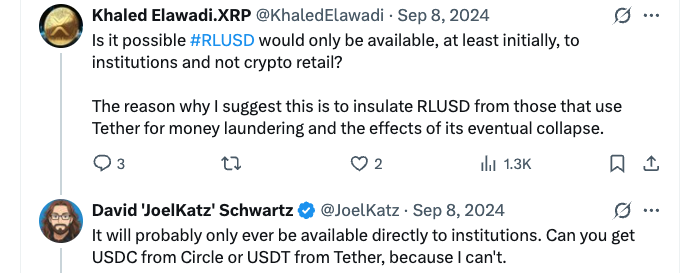
Adding fuel to the exclusivity debate, Ripple Chief Technology Officer David Schwartz remarked that the asset would likely remain available exclusively to institutional clients, generating substantial discourse across the digital asset community regarding whether everyday market participants would be locked out of the ecosystem entirely.
When Ripple formally announced the launch of RLUSD on Dec. 16, 2024, the official corporate messaging omitted explicit references to retail use cases, choosing instead to highlight immediate availability and liquidity partnerships across major trading and liquidity platforms such as Uphold, Bitso, and MoonPay. This omission reinforced the perception that the token was primarily engineered to streamline corporate settlements, liquidity management, and cross-border commercial transactions rather than decentralized finance speculation or consumer payments.
RLUSD Emerges as a Direct Competitor to Circle’s USDC
As the stablecoin has matured in the open market, industry observers have noted a stark contrast between its initial marketing and its day-to-day operational reality. Last week, Transak’s head of marketing, Harshit Gangwar, observed that while RLUSD was meticulously designed with enterprise-grade utility in mind, the underlying issuance and redemption architecture inherently supports both institutional liquidity and retail accessibility.
Erbil Karaman, co-founder of Huma Finance, offered a similar perspective, pointing out that RLUSD currently functions identically to any other general-purpose stablecoin in the global market. According to Karaman, the asset is actively competing with established industry heavyweights, most notably Circle’s USDC, across every conceivable market segment.
Karaman emphasized that this ongoing evolution highlights a fundamental truth within the cryptocurrency sector: the identity and original marketing strategy behind an asset’s issuer ultimately matter far less than the practical utility the asset achieves once it is released into the wild, a reality that only becomes transparent after launch.
Most RLUSD is Issued on Ethereum, but Holders Prefer XRPL
A fascinating nuance in the adoption data surrounding Ripple USD involves a clear divergence between where the stablecoin is minted and where end users actually choose to hold and utilize it. Addressing the mechanics of RLUSD distribution, Kiuru of XRPL Labs pointed out a notable statistical gap between the total volume of stablecoins issued on Ethereum versus the concentration of individual users favoring the native XRP Ledger.
According to comprehensive network data compiled by RWA.xyz, RLUSD minted on the Ethereum network accounts for the overwhelming majority—approximately 88%—of the stablecoin’s total market capitalization, which currently hovers around $557 million. By contrast, less than 12% of the total circulating supply is minted directly on the XRP Ledger.
However, this supply concentration stands in sharp contrast to user demographics. Data shared by a prominent community member named Vet and highlighted by Kiuru reveals that over 90% of the total user base—encompassing more than 34,160 distinct holders—prefer to maintain their balances on the XRP Ledger. Only about 10% of holders utilize the Ethereum network for their RLUSD storage.
Kiuru attributes this persistent enterprise branding to the historical architecture of the network itself, noting that the XRP Ledger has been purposefully positioned as a high-speed corporate blockchain since its inception. While acknowledging that retail adoption represents a substantial victory for the ecosystem, Kiuru maintained that this organic consumer uptake does not signal a strategic pivot away from Ripple’s core institutional focus.
Cointelegraph reached out to Ripple for official commentary regarding the accelerating trend of retail participation in RLUSD, but had not received a response by the time of publication.