
Business utilization of stablecoins is on the cusp of a massive expansion over the next twelve months, driven by an accelerating mainstream embrace of digital currencies for everyday corporate finance and cross-border operations. According to a comprehensive new report released by payments infrastructure firm Cybrid, the shift toward blockchain-based digital cash is moving swiftly from experimental territory into core corporate strategy.
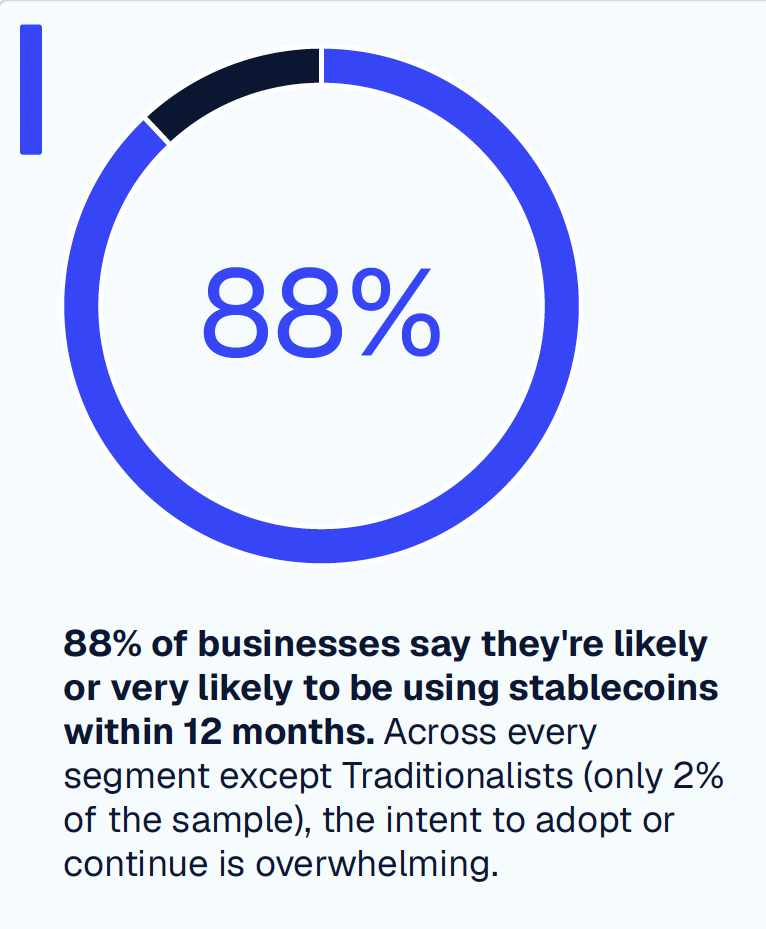
The report highlights that 42% of businesses surveyed are already actively utilizing stablecoins to execute cross-border payments. Furthermore, an overwhelming 88% of respondents indicated that they are either likely or very likely to integrate stablecoins into their operational workflows within the coming year. In a striking testament to the diminishing reliance on legacy financial infrastructure, a mere 2% of surveyed executives identified themselves as committed users of traditional payment rails, signaling a profound structural transformation in how modern enterprises handle capital movement and global commerce.
For companies navigating the complexities of international trade, the financial incentives driving this transition are difficult to ignore. Businesses leveraging stablecoins reported an average cost savings of 35% on cross-border payments. Even more compellingly, larger enterprises processing transactional volumes exceeding $100 million on a monthly basis reported average savings scaling up to 47%. These substantial reductions in friction and administrative overhead illustrate why corporate treasurers are increasingly looking past legacy banking networks in favor of blockchain-powered settlement layers.

This swelling corporate demand coincides with significant expansion within the broader digital asset economy. According to market data from CoinGecko, the global stablecoin market capitalization has climbed to $307.64 billion. The sector continues to be dominated by Tether’s USDT, which commands a market capitalization of $184.7 billion, followed by Circle’s USDC at $73.51 billion. Moreover, bolstered by recent legislative developments, compliant stablecoins aligned with the GENIUS Act have surpassed a market capitalization of $76 billion. This regulatory milestone has successfully established the first comprehensive federal framework for payment stablecoins within the United States, providing a foundational bedrock of legal certainty that institutional players have long demanded.
Cybrid’s findings are derived from a targeted survey of 468 executives and business leaders conducted over a brief window between April 28 and May 4. The surveyed cohort comprised C-suite executives, finance and treasury managers, and operational and payments leaders representing prominent sectors including technology, financial services, and e-commerce across the United States, Canada, and the United Kingdom.
Varied Users Look for Regulatory Clarity to Gain Confidence
When examining the practical applications driving this wave of adoption, the report revealed that payroll and contractor disbursements represent the single most common use case for stablecoins among respondents. This primary function is closely followed by supplier payments, customer payment collections, investment and yield-generation strategies, vendor payouts, and broader treasury and liquidity management operations.
Despite the widespread enthusiasm and documented cost efficiencies, business leaders remain pragmatic about the hurdles facing broader deployment. Regulatory clarity emerged as the single most critical factor that would elevate corporate confidence and accelerate the expansion of stablecoin utilization. In fact, 71% of survey participants identified clear regulatory frameworks as more vital to their strategic planning than trusted infrastructure providers or seamless integration with existing enterprise resource planning systems. As regulatory bodies around the world continue to grapple with the integration of digital assets into the formal financial architecture, corporate decision-makers are watching closely for rules that offer long-term stability and compliance peace of mind.
Companies Expand Infrastructure for Stablecoin Payments
The narrative of institutional and corporate migration toward stablecoins is further corroborated by independent industry data and a flurry of recent infrastructural developments across the financial sector.
In June, payments infrastructure provider Paybis released figures indicating that business customers accounted for nearly 98% of all stablecoin payout volume processed through its platform during the initial four months of 2026. This represents a dramatic escalation from 2023, when business payments made up just 36% of Paybis’s volume. Paybis also highlighted research from McKinsey estimating that business-to-business transactions accounted for roughly 60% of the staggering $390 billion in global stablecoin payment volume recorded throughout 2025.
To accommodate this surging demand, traditional financial institutions and digital asset firms are rapidly expanding their underlying technological and custody infrastructure. In May, Falcon Finance introduced its dollar-backed stablecoin, fUSD, leveraging Anchorage Digital Bank’s federally regulated issuance platform. The product is specifically engineered to target institutional trading, collateral management, and sophisticated treasury workflows.
Adding to this momentum, major traditional financial institutions are deepening their integration with digital assets. BNY expanded its digital asset custody platform to provide robust support for Circle’s USDC. This integration empowers institutional clients to securely store, transfer, mint, and redeem the stablecoin directly through the established trust and custody mechanisms of the bank, bridging the gap between traditional banking and decentralized liquidity.