Security teams today find themselves swimming in a sea of telemetry. Modern enterprises are equipped with more alerts, system logs, and continuous monitoring tools than at any point in cybersecurity history. Yet, when a sophisticated attack breaches the perimeter or an anomalous event triggers an alert, security analysts often find themselves stalled by one fundamental, deceptively simple question: Who or what is truly behind this activity, and exactly what resources can they access?
A suspicious login attempt or unusual session token might originate from a legitimate employee working remotely. Alternatively, an anomalous application programming interface (API) call could stem from an automated machine account operating quietly in the background. In increasingly modern cloud and hybrid environments, that same request might even be driven by an autonomous artificial intelligence agent utilizing elevated permissions that nobody has audited or reviewed in recent months.
Traditional Security Information and Event Management (SIEM) systems or Endpoint Detection and Response (EDR) platforms are typically quite effective at catching these activities as they unfold. However, without knowing who actually owns that underlying identity, what specific privileges have been assigned to it, and which critical internal systems it can legally or technically reach, a Security Operations Center (SOC) is missing a critical part of the investigative puzzle.
That missing context—the invisible link between security telemetry and identity governance—can easily transform a manageable, isolated security incident into a much broader, highly damaging enterprise-wide problem. To help organizations address this growing operational hurdle, cybersecurity industry experts are hosting a dedicated webinar exploring how real-time identity context can empower SOC analysts to investigate threats faster, accurately evaluate active risk, and respond with absolute confidence.
The Blind Spot Between Identity and Security Operations
To understand why modern incident response often stalls, it is necessary to examine the organizational and technical divide that frequently exists within enterprise IT structures.
On one side of the operational house are the Identity and Access Management (IAM) teams. These professionals are responsible for provisioning users, managing role-based access controls, enforcing multi-factor authentication, and ensuring that the right individuals have access to the right corporate resources. On the other side are the security operations teams, whose primary mission is monitoring network traffic, tracking suspicious endpoint behavior, hunting for malicious actors, and responding swiftly to active security threats.
While both departments share the overarching goal of protecting the organization, they frequently operate in silos. They often rely on entirely different toolsets, analyze disparate data streams, and prioritize divergent operational metrics.
When a high-priority security alert flashes across a SOC dashboard, analysts may have a clear picture of what happened from a technical standpoint, but they routinely struggle to understand what that event actually means in the broader business context. Consider the scenario of a compromised service account. An analyst might detect unusual data exfiltration or unexpected lateral movement stemming from that specific service credential. However, several critical operational questions immediately arise that pure endpoint and network logs cannot easily answer.
Analysts must quickly determine whether the service account is currently tied to a critical business-critical application, which specific human administrator holds ultimate responsibility for its lifecycle, whether its permissions have drifted beyond their original scope, and what disastrous operational consequences might occur if the account is abruptly disabled to stop the threat.
These answers matter deeply to the overall health of the enterprise. Blocking the wrong identity or shutting down a critical service account in haste can severely disrupt production environments and halt revenue-generating business operations. Conversely, hesitating too long while trying to verify ownership can give an advanced adversary more than enough time to escalate privileges, dump credentials, and move deeper into the corporate network.
With non-human machine identities, automated software pipelines, and autonomous AI agents rapidly becoming standard components of everyday enterprise operations, this fundamental lack of contextual visibility is growing increasingly complex.
More Identities, More Access, More Risk
Historically, traditional security monitoring architectures were built primarily around human users, physical and virtual devices, and observable network traffic patterns. Security analysts tracked user accounts logging into workstations and monitored perimeter firewalls for unauthorized ingress.
In the modern digital landscape, however, enterprise networks are dominated by a massive proliferation of non-human actors. Organizations rely heavily on automated service accounts, hardcoded and dynamically generated API keys, continuous integration pipelines, automated workloads, and sophisticated AI agents capable of executing complex tasks without direct human supervision.
Crucially, these non-human identities often wield extensive privileges, frequently possessing direct access to highly sensitive corporate databases, intellectual property, and critical cloud infrastructure. If even one of these automated identities is compromised by an external threat actor or abused via an internal vulnerability, detecting the suspicious action is only the initial step of the battle. Security teams must immediately understand the full scope of the identity’s permissions, its network connections, and its potential impact radius.
This is precisely where integrating rich identity context fundamentally transforms a security investigation. Instead of treating every individual alert as an isolated, out-of-context technical event, analysts can instantly connect suspicious behavior directly to the specific identity driving it. By understanding how far an attacker could potentially move from that specific foothold, security teams can choose a surgical containment response that actively limits organizational damage without unnecessarily interrupting critical business operations.
What Does a Better SOC Response Actually Look Like?
The ultimate objective of modernizing security operations is not simply to introduce yet another complex dashboard or flood overburdened analysts with a higher volume of automated alerts.
Instead, the goal is to provide security professionals with the precise, actionable information they desperately need precisely when an incident is actively unfolding. Achieving this requires tightly linking deep identity intelligence with existing SIEM, EDR, and extended detection and response alerts.
When identity context is seamlessly woven into the daily workflow of a SOC analyst, security teams gain the ability to immediately correlate user and machine behavior with access rights and privilege levels. The operational difference is stark and straightforward: knowing that something unusual and potentially malicious has occurred is certainly useful, but knowing exactly what systems that activity can affect and how to decisively stop it is infinitely more valuable to an enterprise under attack.
Learn How to Close the Gap
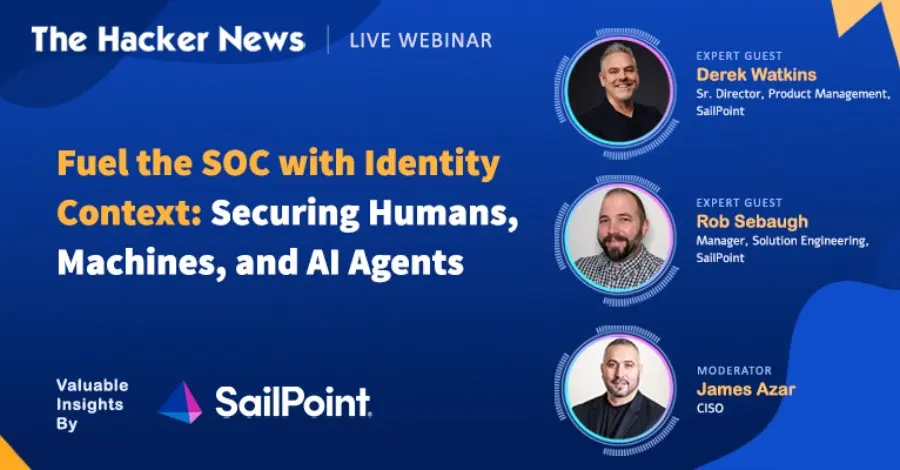
To address these pressing challenges, security practitioners and enterprise leaders are invited to participate in an upcoming expert-led webinar titled "Fuel the SOC with Identity Context: Securing Humans, Machines, and AI Agents."
Drawing directly from real-world enterprise deployments and lessons learned from the field, the upcoming educational session will explore practical, scalable approaches for enriching standard security alerts with comprehensive identity context. Industry experts will discuss methods for investigating complex lateral movement across hybrid networks, evaluating the true potential blast radius of an active intrusion, and refining incident response procedures to protect systems without harming production uptime.
Furthermore, the webinar will examine how organizations can successfully bridge the historical divide between IAM and security operations by aligning both departments around shared operational metrics, streamlined escalation paths, and unified incident response playbooks.
Security operations centers already possess the alerts, the telemetry, and the monitoring tools. The next vital step is providing them with the necessary context to act decisively. Registration for the complimentary webinar is open for professionals looking to transform raw identity intelligence into faster, smarter enterprise security responses.