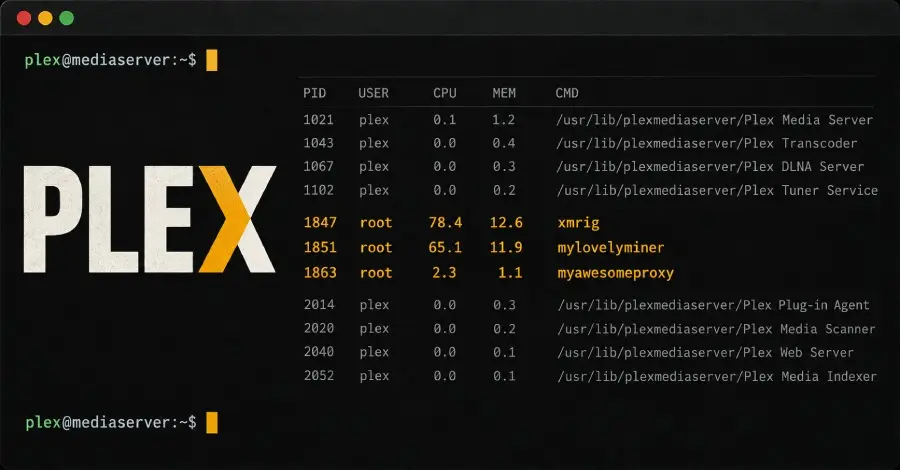
Threat actors have begun actively exploiting a powerful chain of security flaws affecting Plex Media Server instances to deploy unauthorized cryptocurrency miners and stealthy reverse proxy software. The attacks emerged just a day after a proof-of-concept exploit script was publicly released, catching many self-hosted administrators off guard and prompting urgent renewed calls for software patching across the media-sharing community.
According to technical analysis shared by a security researcher operating under the online alias boredhackerblog, the ongoing exploitation campaign leverages a sophisticated multi-stage exploit chain collectively known as Plex2Shell. This attack methodology strings together four distinct vulnerabilities to successfully bypass authentication protocols and achieve unauthenticated remote code execution on susceptible Plex Media Server installations.
The underlying security issues that make up the Plex2Shell chain were initially discovered and responsibly disclosed to Plex by security researcher Zach Main on July 27, 2026. This research included CVE-2026-96651, a vulnerability bearing a CVSS score of 7.1. In response to the disclosure, Plex moved to secure its platform by releasing Plex Media Server version 1.43.3.10861 on August 3, 2026, which contained the necessary patches to neutralize the flaw vectors.

Despite the availability of software updates for more than two months, a large number of internet-exposed media servers remained unpatched, creating a ripe environment for malicious actors. Technical details and a functional proof-of-concept for the Plex2Shell chain went public on October 16, 2026. In-the-wild exploitation attempts targeting vulnerable instances were recorded by researchers merely a day later.
Forensic analysis of the early attacks reveals that successful exploitation results in the automated download and execution of cryptocurrency mining payloads sourced from a remote server located at the IP address 217.60.194.116. Subsequent telemetry and observation of the threat actors’ infrastructure have highlighted multiple attacking IP addresses attempting to probe and compromise internet-facing Plex servers across different geographic regions.
Beyond the unauthorized use of computational resources for cryptocurrency mining, the attackers have utilized the Plex2Shell exploit chain to deliver an additional malicious artifact designated as "myawesomeproxy." According to analysis from VirusTotal, this specific binary functions as a stealthy Linux backdoor and reverse proxy tool designed to route external network traffic through compromised residential and enterprise servers.
When executed on a victim machine, the proxy program displays a clear internal warning message indicating its core operational purpose, noting that running the software on any connected device forces agreement to the potential external routing and utilization of the host’s internet bandwidth. This behavior aligns closely with broader trends in cybercrime where compromised servers are weaponized as residential proxy nodes to facilitate traffic laundering, ad fraud, and stealthy lateral movement.

Concurrently with the proxy software, automated attack scripts have been observed deploying an XMRig cryptocurrency mining process appropriately named "mylovelyminer." This mining component is configured to connect to a mining pool server anchored at the domain ota.proxystream.st. The infrastructure surrounding this domain has raised alarm bells within the broader threat intelligence community. Notably, another closely related subdomain under the same umbrella, global.relay.proxystream.st, was previously flagged by security firm Bitsight in August 2026. That infrastructure was heavily linked to the activities of the AISURU distributed denial of service and proxyware botnet ecosystem.
Recent discussions and user reports surfaced on community forums such as Reddit, where multiple Plex administrators reported that their self-hosted media servers had been compromised with the identical "mylovelyminer" payload. While these community observations confirm active targeting of the platform, researchers note that it remains definitively unconfirmed whether all individual reports stem directly from the newly exploited Plex2Shell flaws or if separate attack vectors are simultaneously targeting older server configurations.
This wave of compromises arrives a little over a month after Plex management urged its user base to apply immediate updates following the deployment of a software release designed to address multiple unspecified security vulnerabilities. At the time of those security advisories, it remained unclear whether the specific vulnerabilities comprising the Plex2Shell chain were explicitly referenced in the alert bulletin. Industry watchdogs and journalists have reached out to Plex representatives for official clarification regarding the timeline and scope of the affected versions, with updates anticipated should further details emerge.
In light of the confirmed active exploitation in the wild, cybersecurity professionals and server administrators are strongly advised to verify their server versions and ensure that all Plex installations are updated immediately to the latest patched releases for optimal defense against remote compromise.