
The corporate landscape is rapidly transforming as business use of stablecoins prepares for a dramatic surge over the next 12 months. According to a comprehensive new report from payments infrastructure firm Cybrid, the adoption of these digital currencies is moving decisively into the mainstream, fundamentally altering how modern companies handle cross-border transactions, payroll, and treasury management.
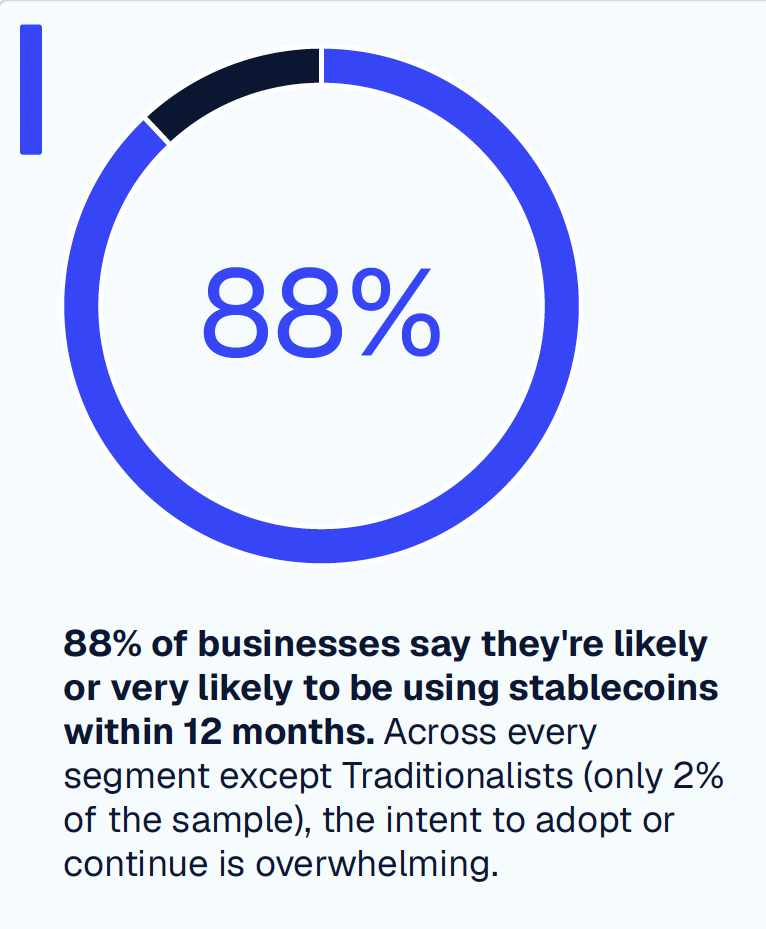
The Cybrid report revealed that 42% of businesses surveyed are already actively utilizing stablecoins for cross-border payments. Looking ahead, an overwhelming 88% of respondents indicated that they are likely or very likely to incorporate stablecoins into their financial operations within the next year. Conversely, traditional payment rails are seeing a sharp decline in loyalty, with only 2% of survey participants identifying as committed users of legacy banking infrastructure for international settlements.
For businesses making the switch, the financial incentives are clear. Companies utilizing stablecoins reported average cross-border payment cost savings of 35%. Furthermore, larger enterprises processing more than $100 million in monthly payment volume experienced even more substantial economic benefits, reporting average cost savings of up to 47%. These efficiency gains are helping drive unprecedented momentum across the digital asset ecosystem.
The broader market reflects this accelerating demand. The global stablecoin market capitalization currently stands at $307.64 billion, dominated by Tether’s USDT at $184.7 billion and Circle’s USDC at $73.51 billion, according to data from CoinGecko. At the same time, recent legislative developments have provided a significant tailwind. GENIUS Act-compliant stablecoins have surpassed a market cap of $76 billion, establishing the first federal regulatory framework for payment stablecoins in the United States and giving institutional players greater confidence to enter the space.
The findings from Cybrid are based on a targeted survey of 468 executives and business leaders conducted between April 28 and May 4. The participant pool offered a broad cross-section of the corporate world, hailing from the technology, financial services, and e-commerce sectors across the United States, Canada, and the United Kingdom. Respondents included C-suite executives, finance and treasury managers, and critical payments and operations leaders who manage the day-to-day liquidity of their respective organizations.

Varied Users Look for Regulatory Clarity to Gain Confidence
As businesses diversify their use of digital assets, operational applications are expanding well beyond simple remittances. Payroll and contractor payments emerged as the most common stablecoin use case among survey respondents, highlighting a growing demand for instantaneous, borderless compensation methods. Following payroll, supplier payments ranked as the next major use case, closely trailed by customer payments, investment and yield generation, vendor payments, and broader treasury and liquidity management strategies.
Despite the rapid adoption and clear financial advantages, corporate leaders emphasize that certain hurdles must still be cleared to achieve universal integration. Regulatory clarity was cited as the paramount factor that would increase corporate confidence in expanding stablecoin use. An impressive 71% of respondents identified clear government regulations as more critical to their long-term strategy than partnering with trusted infrastructure providers or securing seamless integration with existing enterprise software systems.
This emphasis on regulation underscores the cautious yet optimistic approach traditional businesses are taking toward blockchain technology. While the cost savings and speed are undeniable, corporate boards and compliance officers require legal certainty before migrating core financial operations entirely onto decentralized networks.
The corporate appetite for stablecoin solutions is further reinforced by separate industry data pointing to identical macroeconomic trends. In June, payments infrastructure provider Paybis released figures showing that business customers accounted for nearly 98% of all stablecoin payout volume processed through its platform during the first four months of 2026. This represents a staggering shift from just a few years prior, when business payouts accounted for only 36% of the platform’s volume in 2023.
Paybis also highlighted research from management consulting firm McKinsey, which estimated that business-to-business transactions accounted for roughly 60% of the $390 billion in global stablecoin payment volume recorded in 2025. These figures demonstrate that the growth of stablecoins is not merely driven by retail crypto traders or speculative investors, but rather by heavy corporate usage aimed at solving friction-heavy legacy payment systems.
Companies Expand Infrastructure for Stablecoin Payments
To meet this surging institutional and corporate demand, financial institutions and infrastructure providers have rapidly expanded their product offerings and technical capabilities. The ecosystem is evolving to provide the robust, secure, and compliant architecture that corporate treasurers demand.
In May, Falcon Finance debuted its dollar-backed stablecoin, known as fUSD, through Anchorage Digital Bank’s federally regulated issuance platform. The product was specifically designed to target institutional trading, collateral management, and complex treasury workflows, bridging the gap between traditional banking security and decentralized finance utility.
The institutional expansion continued with major traditional banking heavyweights entering the fray. BNY announced an expansion of its digital asset custody platform to support Circle’s USDC. This integration allows institutional clients to store, transfer, mint, and redeem the stablecoin directly through the bank’s established infrastructure, signaling a major milestone in the convergence of traditional banking and digital currency rails.
Additional innovation is emerging across the blockchain landscape to remove remaining technical barriers. Companies are developing cross-chain solutions that allow traditional financial apps and wallets to route funds seamlessly across various distributed ledgers, ensuring that businesses are not locked into a single blockchain network. As infrastructure matures and regulatory frameworks solidify, the transition from legacy payment rails to blockchain-based digital currencies appears increasingly inevitable for the global corporate sector.