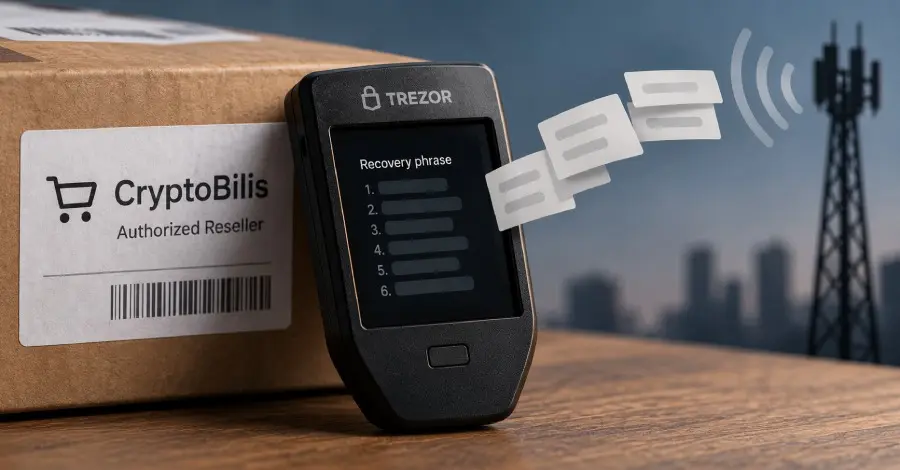
Hardware security and cryptocurrency communities have been thrown into renewed turmoil following a startling discovery concerning compromised physical wallets in Southeast Asia. Cryptocurrency hardware wallet manufacturer Trezor has issued an urgent safety warning to customers who purchased Trezor Safe 5 devices through the regional reseller CryptoBilis. The advisory comes after a customer reported finding an unauthorized, stealthy circuit board physically implanted inside their newly purchased device, specifically engineered to siphon off sensitive recovery phrases via a cellular network.
The unsettling disclosure was made public by Trezor on October 30, following an incident report submitted just two days prior by an Indonesian customer. According to the details provided in the report, the buyer had acquired the Trezor Safe 5 hardware wallet in August through CryptoBilis’s storefront on the popular Indonesian e-commerce marketplace Tokopedia. While the customer had fortunately transferred their funds off the device before uncovering the hardware modification, the implications of the discovery have sent shockwaves through the digital asset security sector.
Trezor’s preliminary assessment of the customer’s documentation—which included detailed photographs, an extensive descriptive report, and a direct video interview conducted by Trezor personnel—indicated that the threat was credible enough to bypass the traditional waiting period required for a full physical lab analysis. The company emphasized that waiting for formal laboratory confirmation would unnecessarily leave countless CryptoBilis buyers exposed to potential financial theft in the interim. Consequently, Trezor has strongly urged anyone who purchased a Trezor device from CryptoBilis or its affiliated storefronts since March 2026 to immediately migrate their digital assets to a brand-new wallet initialized with a completely fresh recovery phrase.
Anatomy of an Advanced Supply Chain Interception
The unauthorized modification discovered inside the Indonesian customer’s Trezor Safe 5 goes far beyond traditional software phishing or digital malware vectors, representing a sophisticated physical supply chain attack. The rogue component consists of an additional, custom-built circuit board cleverly wedged between the hardware wallet’s legitimate main board and its internal display screen.
Technical assessments shared by the customer revealed that this surrogate circuit board was equipped with a dedicated cellular module and a microscopic antenna. Whenever the compromised hardware wallet is plugged into a power source or a computer, the malicious implant activates, monitoring the device’s screen interface in real-time. Because hardware wallets require users to view and note down their recovery phrases—the master backup sequence used to restore access to funds—during the initial setup phase, the hidden board is capable of capturing these critical sequences visually. Once captured, the cellular module covertly transmits the sensitive data over a mobile network to an external, unauthorized recipient, effectively neutralizing the offline security guarantees that hardware wallets are specifically designed to provide.

Despite the severity of the threat, Trezor confirmed that no affected buyers have thus far reported actual financial losses stemming from this specific incident. Because Trezor operates under a zero-knowledge architecture, the company has no visibility into what assets customers hold or manage on their devices, making proactive user alerts the primary defense mechanism.
The scope of Trezor’s advisory applies broadly to any Trezor model purchased via CryptoBilis since March 2026, encompassing all retail outlets and third-party partner stores supplied by the reseller, including its dedicated Tokopedia channel. At the time of the announcement, Trezor confirmed it had received no similar reports or warnings involving any other authorized resellers or distribution channels worldwide.
Risks of DIY Inspection and Looming Phishing Threats
Amid mounting concerns, Trezor explicitly cautioned device owners against attempting to physically inspect, weigh, or dismantle their hardware wallets to check for similar tampering. Although the Indonesian customer initially suspected foul play due to a subtle, unaccounted-for variance in the device’s physical weight, Trezor noted that minor manufacturing weight tolerances can fluctuate for entirely benign reasons. Attempting to pry open a hardware wallet not only risks permanently damaging the device’s tamper-evident casing but also fails to provide a reliable method for detecting sophisticated, professional-grade hardware implants.
Furthermore, Trezor warned its user base to remain highly vigilant against secondary attacks. The company anticipates that opportunistic scammers and malicious threat actors will attempt to exploit the panic surrounding the incident by launching targeted phishing campaigns. These deceptive operations are expected to leverage fraudulent emails, physical letters, and unsolicited phone calls impersonating Trezor support staff, attempting to trick panicked users into surrendering their newly generated recovery phrases under the guise of security remediation.
Fallout From CryptoBilis Ties and Regional Investigations
The emergence of the compromised Trezor device is deeply intertwined with a broader, unfolding supply chain security crisis that first erupted earlier in the month. Trezor officially severed its business relationship with CryptoBilis, which had served as its authorized reseller in Southeast Asia, on October 9. The decision followed an independent security investigation launched by competing hardware wallet maker Ledger, which began tracking mysterious financial losses among its own customers who had likewise purchased devices through CryptoBilis.

Ledger subsequently confirmed that an unauthorized hardware implant had been discovered inside a customer’s device sourced from the same regional reseller. That specific implant was similarly designed to intercept and exfiltrate recovery phrases during the critical setup phase. While Trezor noted that the rogue circuit board found inside its Safe 5 device shares functional similarities with the implants previously identified in Ledger hardware, the company stated that it will not perform direct comparative analyses while independent investigations remain ongoing, noting that each manufacturer utilizes distinct internal layouts and hardware architectures. At present, neither company has publicly identified the individuals or entities orchestrating the supply chain interferences.
Expanding Concerns and Official Law Enforcement Advisories
The private sector revelations are now drawing formal attention from international law enforcement agencies. The Singapore Police Force issued an official safety advisory addressing the escalating threat of tampered cryptocurrency hardware wallets circulating within the region. According to the Singaporean authorities, at least two separate cases involving Ledger hardware wallets purchased from local retail outlets in Singapore were formally reported starting September 10.
The police advisory confirmed that these retail-purchased devices contained malicious hardware components capable of covertly recording recovery phrases and private keys, echoing the supply chain vulnerabilities reported in Indonesia. As criminal investigations continue to probe how these compromised devices infiltrated established retail supply chains across Southeast Asia, cryptocurrency holders are being reminded to exercise extreme caution regarding their hardware sourcing and to rely strictly on official, direct-from-manufacturer distribution channels to safeguard their digital wealth.