If rising geopolitical tensions were not already causing enough anxiety across global markets, the cryptocurrency industry is now facing its own theoretical doomsday scenario. A heated debate has erupted across the digital asset ecosystem over a newly popularized concept: whether rapid advancements in artificial intelligence could soon allow bad actors to derive private keys directly from public keys, potentially placing billions of dollars in crypto assets at immediate risk.
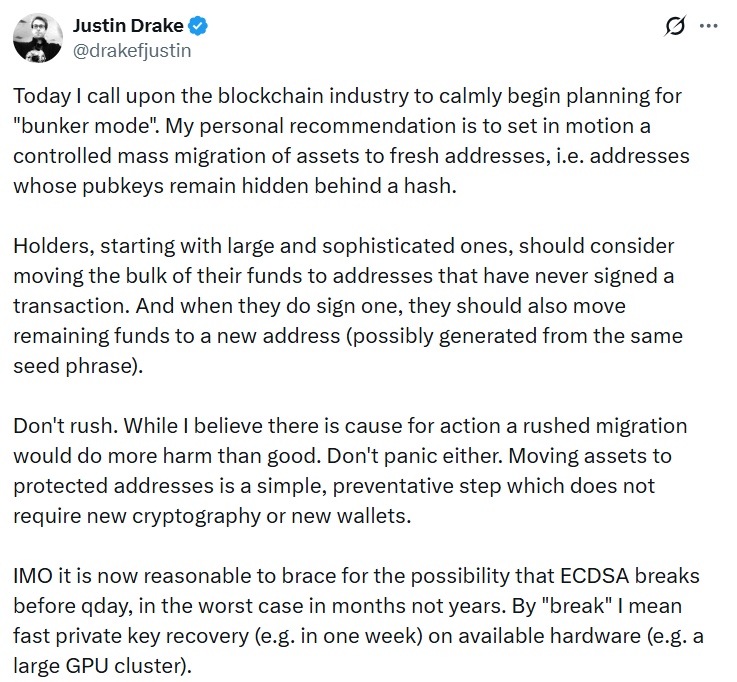
The discussion gained significant traction when prominent Ethereum researcher Justin Drake publicly called for "bunker mode" planning during a recent statement. Citing what he described as "humbling" advancements in artificial intelligence, Drake argued that machine learning systems could drastically accelerate the discovery of advanced mathematical attacks and ultimately break foundational cryptography.
"IMO it is now reasonable to brace for the possibility that ECDSA [Elliptic Curve Digital Signature Algorithm] breaks before Qday, in the worst case in months not years," Drake stated on social media, referring to the Elliptic Curve Digital Signature Algorithm that secures the vast majority of blockchain networks.
Drake’s proposal suggests that the industry should begin organizing a controlled migration of digital assets to fresh addresses whose public keys have not yet been exposed on-chain. By doing so, users could theoretically reduce the amount of information available for a potential attacker to exploit. However, his warning has triggered a sharp division among cryptographers, developers, and industry executives regarding the plausibility of the threat and the practicality of the proposed countermeasures.
Is the Crypto Panic Justified?
At the core of Drake’s concern is not merely whether AI will accelerate the arrival of quantum computers—machines long feared for their eventual ability to shatter modern encryption—but whether classical AI systems might independently discover mathematical vulnerabilities that human cryptographers have so far overlooked.
Drake argues that elliptic curves, the cryptographic foundation underlying most modern blockchains, possess a higher degree of mathematical structure than simple hash functions. This intricate structure, he suggests, leaves them more susceptible to potential breakthroughs achieved through advanced classical algorithms powered by AI.
Matthew Green, a cryptography professor at Johns Hopkins University, weighed in on the assessment, amplifying the sense of urgency circulating through the digital asset community. "I think we might lose public key cryptography," Green remarked.

Yet, a substantial portion of the cryptographic community remains deeply skeptical of these claims, arguing that the panic is premature and unsupported by empirical evidence. Yehuda Lindell, head of cryptography at Coinbase, stated that to his knowledge, there is "no evidence whatsoever" indicating that the decades-old mathematical assumptions underpinning elliptic curve cryptography have been weakened or compromised.
Lucien Bourdon, a Bitcoin analyst at the hardware wallet provider Trezor, echoed this sentiment, emphasizing that reality does not yet match the doomer narrative. "There are no credible published advances against the math behind ECDSA, with AI or anything else," Bourdon explained.
Bourdon noted that recent academic papers published by artificial intelligence models have not introduced any viable attacks against ECDSA. While Drake views the current absence of public breakthroughs as cause for suspicion rather than comfort, critics point out that outlining a worst-case theoretical scenario does not constitute an immediate emergency. "He doesn’t say how," Bourdon added, noting that Drake himself framed the timeline as a worst-case scenario and advised against panicked reactions.
Why Moving Coins May Not Be Enough
Even if users attempted to proactively migrate their funds to secure locations, industry experts warn that the mechanics of modern wallets could render such steps ineffective. Zach Herbert, chief executive and co-founder of hardware wallet manufacturer FoundationHQ, explained that moving funds to fresh addresses within the same account often fails to protect users if an extended public key, commonly known as an xpub, has already been shared with a wallet application or third-party service.
Extended public keys allow modern wallets to generate multiple public keys for a single account automatically, including addresses that have not yet been used to receive funds. If a third-party application already possesses that extended public key, they retain the underlying data required to derive the public keys users are attempting to shield.
"They already have the information needed to derive the public keys you’re trying to hide," Herbert said. If ECDSA were to become practically breakable, "an attacker could recover the corresponding private keys without ever touching your hardware wallet."
Eli Ben-Sasson, co-founder and chief executive of Ethereum scaling protocol StarkWare, agreed that simple address migration is insufficient. "Other than just moving your coins, if you want to use them ever again, you would need to download new kinds of wallets," he noted.
Ben-Sasson pointed out that a cryptographic failure of this magnitude would extend far beyond basic wallet signatures. Infrastructure-level signatures, network consensus mechanisms, and data availability tools—such as Ethereum’s Kate-Zaverucha-Goldberg (KZG) polynomial commitment scheme used for handling data blobs—would also require massive overhauls. Furthermore, transaction fees would likely spike dramatically as core network functionalities broke down.
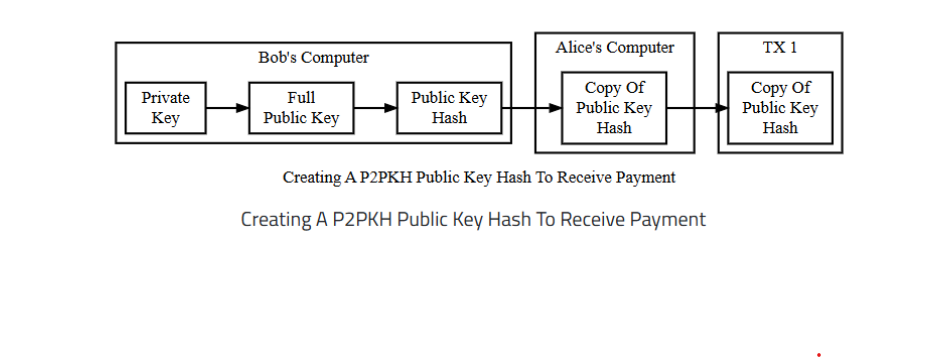
Different blockchain architectures handle exposure risks in varied ways. On Bitcoin, certain address types conceal the full public key behind a cryptographic hash until the coins are actually spent. If underlying hash functions remain secure, this design provides an additional layer of defense. Conversely, modern Taproot addresses expose public keys directly on the blockchain.
Bourdon noted that common SegWit addresses keep public keys hidden until a transaction is broadcast, and reputable hardware wallets routinely generate fresh receiving addresses to limit the risks of address reuse. However, he cautioned against rash behavior, warning that panicked migrations often lead to user error and present prime opportunities for malicious actors and scammers looking to exploit fear. Furthermore, whenever a Bitcoin transaction is broadcast, the public key is temporarily exposed in the mempool during the validation window.
Not All Crypto Assets Are Created Equal
Different blockchain ecosystems are approaching potential cryptographic threats through distinct developmental roadmaps. NEAR Protocol, an AI-focused blockchain network, allows users to integrate quantum-safe FIPS-204 keys into existing mainnet accounts through a single transaction without requiring a full asset migration, while compatible wallets like Meteor support quantum-safe signing mechanisms. This approach relies on lattice-based cryptography, though figures like Ethereum co-founder Vitalik Buterin have previously expressed caution regarding the long-term security of lattice-based schemes.
Ethereum developers are pursuing a broader post-quantum roadmap that incorporates hash-based signatures and zero-knowledge proof aggregation to secure transaction signatures, consensus layers, and network data. The community has also mapped out emergency response strategies on paper, including a potential emergency hard fork. In a post published in March 2024, Buterin outlined a conceptual hard fork designed to roll back blocks following an outbreak of mass theft, temporarily disable conventional wallet transactions, and allow rightful users to reclaim funds by providing zero-knowledge proofs tied to their recovery seed phrases.
Max Shannon, senior research associate at Bitwise Europe, noted that such emergency protocols remain theoretical proposals without fixed deployment timelines. While no working exploits have been demonstrated in practice, Shannon suggests that users should gradually transition toward quantum-safe signature schemes over the long term.
Architectures utilizing account abstraction, such as Starknet, offer additional flexibility by enabling users to switch signature schemes without forcing a complete migration of funds to a new address. Ben-Sasson explained that because of account abstraction, the core technology does not need to be entirely rewritten to accommodate new cryptographic standards. Nevertheless, underlying infrastructure components, including network state trees and settlement layers, would still require significant updates.
On Solana, public keys are exposed by default, meaning that simple address rotation offers little protection unless users migrate funds to specialized post-quantum vaults. However, Jacob Creech, vice president of technology at the Solana Foundation, argued that network users would not necessarily need to enter a state of panic if traditional signature schemes failed. A network upgrade could theoretically enable users to prove ownership of their secret seed phrases using hash-based proofs and migrate accounts to secure signature schemes, though such an upgrade has not yet been deployed.
Evaluating the Actual Risk
As the crypto industry weighs the validity of these warnings, analysts urge measured prudence rather than reactionary alarm. Bitwise’s Max Shannon emphasized that while the theoretical risk is worth acknowledging, the firm is not modifying its operational strategy based on these scenarios alone.
Herbert reiterated that while discussing extended public keys and fresh addresses makes for an interesting technical thought experiment, it does not constitute a viable, practical defense plan for individual holders. Due to the presence of legacy devices, complex multisignature setups, and dormant Bitcoin wallets untouched for years, standard software updates would not automatically safeguard every asset in existence.
Bourdon reminded market participants to examine the context surrounding such warnings, noting that discussions regarding unproven threats often coincide with technological pitches for alternative cryptographic standards. While this does not invalidate the theoretical concerns raised by researchers, the absence of empirical evidence demonstrating imminent vulnerabilities suggests that rushing to move funds carries more immediate risk than the threat itself.
Should the foundational cryptography securing digital wallets and blockchains ever truly fail, migrating coins will likely represent only the first and easiest challenge in a much wider systemic response.