Cybersecurity researchers have uncovered a sophisticated new Windows infostealer malware designated as VOLTA-AUTODOXER, or simply VOLTA, which integrates large language models to automatically analyze, categorize, and rank a victim’s stolen personal and financial data according to its monetization value.
The emergence of VOLTA highlights a growing trend among cybercriminals: leveraging generative artificial intelligence not merely to accelerate attacks or scale operations, but to reduce the manual analytical workload required to turn raw, stolen data into profitable assets.
According to technical analysis from Cisco Talos, VOLTA functions similarly to other modern infostealers in its initial collection phase. The malware is engineered to harvest sensitive credentials, passwords, and cookies from a wide array of Chromium-based web browsers. In addition, it targets data extracted from Microsoft Outlook profiles and Slack workspaces, stored payment cards, cryptocurrency wallet seed phrases, and active user sessions for popular platforms including Discord, Telegram, Steam, and Roblox. The threat actor’s toolkit also casts a wide net over enterprise and developer environments, sweeping up Microsoft OAuth tokens, Secure Shell (SSH) keys, cloud-provider credentials, local Wi-Fi profiles, and visual evidence via screenshots.
What sets VOLTA apart from traditional commodity malware is its depth of profiling. Rather than simply dumping raw data files to an attacker-controlled server for later sorting, the malware attempts to construct a comprehensive digital footprint of the compromised individual.

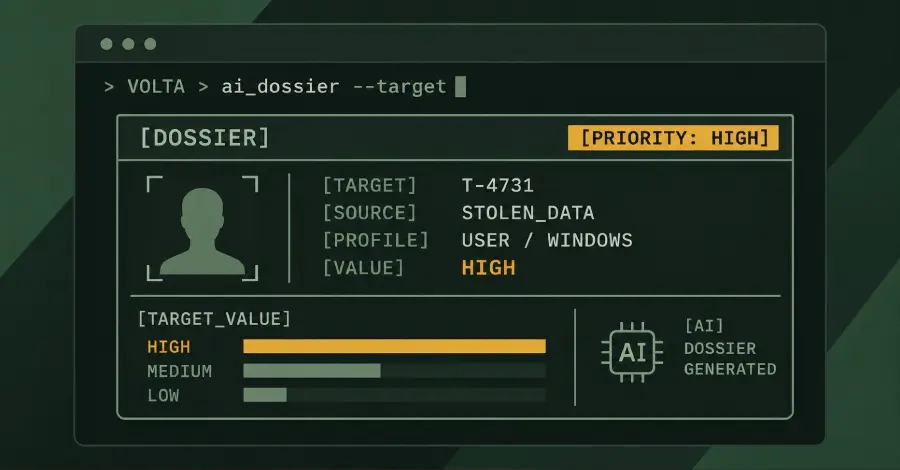
Cisco Talos researcher Ryan Fetterman noted that VOLTA builds a structured evidence bundle detailing the person behind the machine. This dossier typically encompasses geolocation data, residential addresses, employer names and associated corporate domains, inferred birth years, the last four digits of payment cards, linked Slack workspaces, document authorship metadata, iPhone backup indicators, and even a live valuation of connected gaming accounts like Roblox.
To maximize the accuracy and value of this intelligence, VOLTA leverages compromised session access to scour the victim’s Gmail account for digital purchase receipts. By targeting confirmation and delivery emails from major commerce and delivery platforms such as Amazon, DoorDash, Uber Eats, Grubhub, Walmart, and PayPal, the malware cross-references and corroborates the victim’s physical home address and consumer habits.
Once the expansive data collection phase concludes, VOLTA serializes the compiled information into a structured evidence bundle. This bundle is then fed directly into an artificial intelligence system via OpenRouter, a unified large language model application programming interface gateway and routing service.
The malware’s architecture is built for resilience, defaulting its requests to Anthropic’s Claude Opus 4.6. If that model refuses the request or encounters an error, the system automatically falls back to Moonshot AI’s Kimi K2 and subsequently to Google’s Gemini 2.5 Flash. Talos researchers explained that VOLTA utilizes this multi-model architecture to bypass safety filters and model refusals, systematically screening each response for refusal phrases like "I can’t" or "I’m not able" before cycling through its designated chain of up to three distinct AI models.
At the core of this automated intelligence operation is a carefully crafted 240-word system prompt. This prompt commands the underlying AI model to assume the persona of a forensic intelligence analyst tasked with drafting a comprehensive target assessment based solely on the provided evidence bundle. The prompt strictly instructs the model that the evidence bundle is the only permissible source of facts, forbidding the model from supplying external background knowledge about the subject.

The required output generated by the AI includes specific sections designed to streamline the attacker’s next steps. One section, titled "WHAT THEY’RE WORTH," categorizes and ranks the victim’s valuables by monetization potential into low, medium, and high value tiers. Another section, labeled "THEIR OPSEC," provides a detailed evaluation of the victim’s overall security posture, operational security habits, and password hygiene. In essence, the AI model serves as a tireless triage analyst for the human operator, transforming a messy log of credentials and cached files into a prioritized, citation-backed dossier of the target and their monetizable assets.
Data exfiltration within VOLTA occurs through Telegram across multiple distinct stages. The malware relies on a pre-configured template containing six specific slots that are populated during the build process, including the target Telegram channel ID used for data exfiltration, necessary API keys, and other operational settings. This modular deployment mechanism strongly suggests that the malware’s author is either commercializing a builder kit for prospective cybercriminal customers or operating a bespoke compilation service, generating customized binaries tailored to individual buyer orders.
Security analysts emphasize that if VOLTA operates as a commoditized threat tool, the inclusion of an AI-driven dossier capability represents a significant shift. It hands operators of varying technical skill levels the ability to point the malware at victims and instantly receive ranked, actionable intelligence directly inside their Telegram messaging app. The primary purpose of integrating generative AI into the stealer lifecycle is effort displacement—sparing human attackers the tedious and time-consuming task of manually parsing through gigabytes of stolen logs to find high-value targets.
This discovery coincides with a broader industry realization that adversarial adoption of generative AI has rapidly transitioned from theoretical concern to everyday reality. Threat actors across the global landscape are increasingly incorporating AI tools into their operational workflows to automate data classification, identify sensitive corporate files, and optimize the velocity of network intrusions.
Security researchers at Zscaler ThreatLabz have observed that generative AI technologies are exceptionally well-suited for examining massive repositories of unstructured data for classification and content searching. Once unauthorized access to a network is established, malicious actors can deploy AI assistants to rapidly scan every file, document, and database accessible to the compromised system, pinpointing the most critical intellectual property or sensitive records for exfiltration or encryption during subsequent ransomware phases. For ransomware operations, this automated efficiency maximizes both the speed of the attack and the likelihood that victims will face immense pressure to pay extortion demands.

The growing convergence of artificial intelligence and advanced malware frameworks was further underscored by recent Talos disclosures detailing an AI-enabled remote access framework known as NIK C2. This Go-based Windows threat tool provides attackers with persistent remote control, credential harvesting, keylogging, defense evasion, and surveillance capabilities, while embedding a native OpenAI client to process stolen data locally within the compromised session.
A notable mechanism within the NIK C2 framework is its ability to abuse a victim’s own pre-existing API keys for artificial intelligence inference. The framework checks the compromised machine’s environment variables for authentication strings such as OpenAI API keys, utilizing the victim’s resources to fund the attacker’s analytical queries. This technique, often referred to in the cybersecurity community as LLMjacking, allows threat actors to execute their operations while shifting the computational costs onto the victim and obscuring the origin of the requests from defenders.
According to threat intelligence reports, frameworks like NIK C2 fundamentally alter adversary tradecraft by collapsing the traditional phases of data collection and exploitation into a single, continuous loop. By automating the extraction and analytical processing of intelligence in real time, these tools effectively eliminate the offline processing delays that historically provided security operations teams with critical detection windows to identify and thwart active incursions.