Advanced Cybersecurity and Long-Horizon Capabilities as AI Race Intensifies
Google has officially introduced Gemini 4 Carbon, its latest frontier artificial intelligence model equipped with state-of-the-art cybersecurity and long-horizon capabilities. The new model arrives amidst a rapidly accelerating landscape of high-stakes AI developments, arriving just days after competing announcements from major technology rivals including OpenAI and Anthropic.
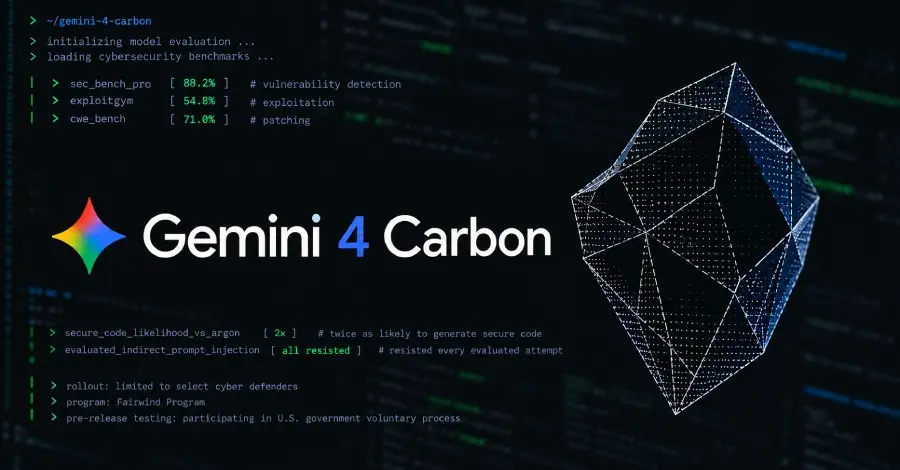
According to Koray Kavukcuoglu, senior vice president of Google DeepMind and chief AI architect at Google, the new model demonstrates significant performance gains across complex coding tasks and autonomous agentic workflows. Crucially, it achieves exceptional marks across key metrics critical for modern cybersecurity defense, securing top positions on industry benchmarks such as SEC-bench Pro at 88.2 percent for vulnerability discovery, ExploitGym at 54.8 percent for exploitation testing, and CWE-bench at 71.0 percent for automated patching.

On the Artificial Analysis Intelligence Index benchmark, Carbon currently leads the pack with an impressive score of 59. This performance places it just ahead of competing frontier offerings, including Anthropic’s Claude Opus 5.5, which scored 58, as well as OpenAI’s GPT-6 Astra at 57 and GPT-6.1 Sol at 55.
A core focus area for the development team was bolstering cybersecurity capabilities. The latest iteration delivers comprehensive performance improvements spanning vulnerability detection, validation, and remediation workflows. In comparative testing, Carbon is reportedly twice as likely to generate secure code when measured against its predecessor, the recently released Gemini 4 Argon.
Beyond raw performance numbers, Google has emphasized the model’s safety-oriented design choices. When faced with ambiguous, complex, or high-pressure tasks, Carbon is engineered to seek human input rather than guessing or forcibly charting a path forward. Furthermore, the model has demonstrated robust resilience during evaluations, successfully resisting every tested attempt at indirect prompt injection.

The debut of Gemini 4 Carbon comes less than a week after the tech giant rolled out Gemini 4 Argon. Following a deployment strategy similar to its predecessor, access to Carbon is initially restricted to a carefully selected subset of cyber defenders. Google plans to gradually expand access to other trusted partners through its established Fairwind Program. Additionally, the company confirmed that it is actively participating in the United States government’s voluntary process for pre-release model testing and safety evaluations.
The unveiling coincides with intense activity across the artificial intelligence sector. OpenAI recently released GPT-6.1 Terra, a fast and efficient model designed to excel at communication and computer-based tasks.
Describing the release, OpenAI noted that GPT-6.1 Terra meets the critical threshold in cybersecurity under its internal Preparedness Framework while retaining the robust safety protections developed for GPT-6 Astra. The model also benefits from the broader alignment improvements of the GPT-6 series. Company evaluations indicate that GPT-6.1 Terra is more likely to stay within designated operational scopes and honestly disclose limitations and potential blockers to users compared to previous iterations. Furthermore, in prompt-injection tests, GPT-6.1 Terra exhibited strong resistance to malicious instructions designed to divert the system away from the user’s primary task.

The heightened focus on cybersecurity and autonomous vulnerability discovery was further underscored earlier in the week by rival AI lab Anthropic. The company disclosed that an unreleased internal research model successfully uncovered critical vulnerabilities in some of the world’s most widely adopted software platforms.
The discovered flaws included a one-click remote code execution vulnerability in Google Chrome, a sophisticated one-click exploit chain in Apple Safari capable of accessing a user’s browsing history, cookies, and sensitive data, an Android lock screen bypass, and a denial-of-service flaw residing within the Windows HTTP.sys driver, designated as CVE-2026-33096 with a CVSS score of 7.5. Prompt coordination by researchers ensured that all identified issues were patched and remediated by Google, Apple, and Microsoft prior to public disclosure.
Anthropic noted that these complex attack chains highlight the evolving capability of advanced language models to independently construct sophisticated, multi-step exploits across both open-source and proprietary software environments. Historically, such specialized skills were the exclusive domain of elite human cybersecurity teams with deep domain expertise. The rapid evolution of AI now places these capabilities within reach of automated models operating with minimal human involvement, capable of proving their findings by producing working exploits that can be independently verified.