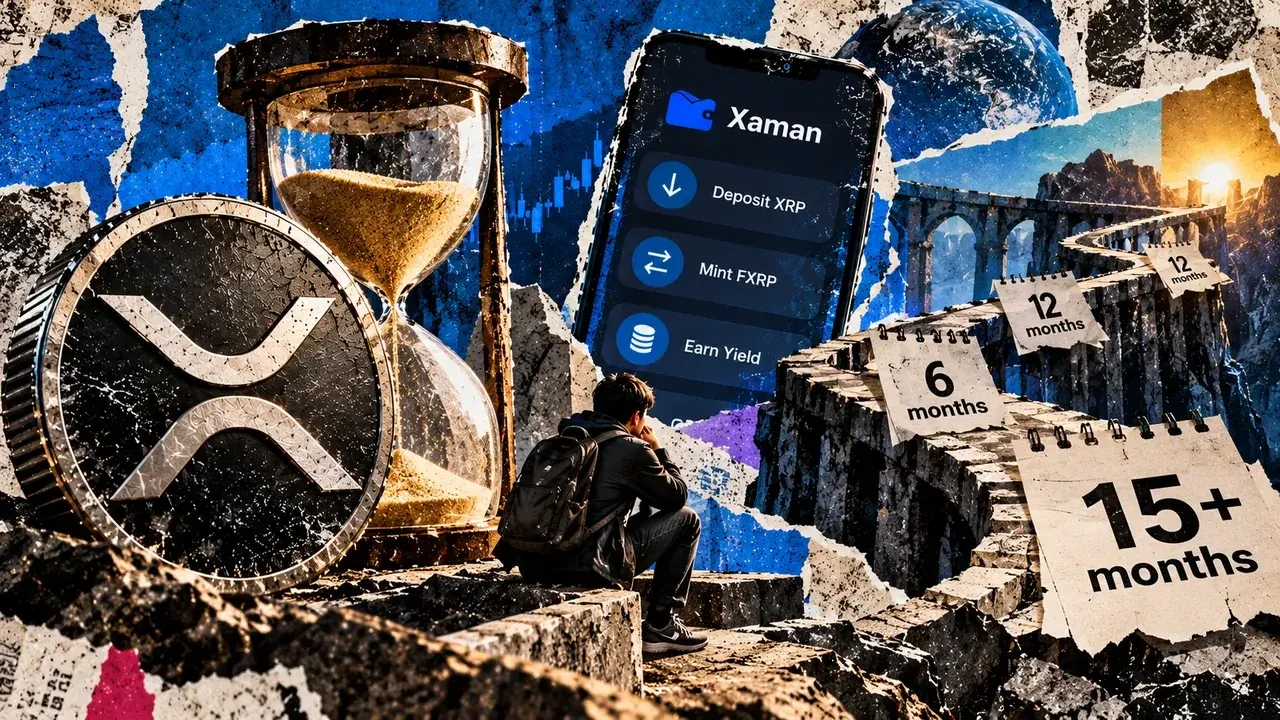
Navigating the growing world of decentralized finance on the XRP Ledger brings distinct economic trade-offs, particularly for smaller retail participants. A detailed look at Xaman’s Flare yield route illustrates that an initial deposit of 100 XRP would return approximately 99.38 XRP after a full year, assuming the wallet’s published fee structure and a constant 2.25% net annual return. While the path provides a streamlined user experience, the interplay of fixed setup costs, network entry deductions, and redemption fees means that smaller capital allocations face a significantly steeper path to profitability than larger positions.
According to Xaman’s hypothetical scenarios for its wallet integration, the break-even point for a 100 XRP deposit sits at roughly 15.4 months. This calculation factors in a net annual return of 2.25% after vault fees, alongside separate entry and redemption costs. For substantially larger allocations, such as a 10,000 XRP deposit, the estimated break-even period drops sharply to approximately 4.5 months. The disparity highlights a structural reality of digital asset management: fixed setup charges consume a significantly larger percentage of a small deposit compared to massive holdings, compounding the impact of percentage-based fees assessed during entry and redemption.
These figures, detailed in Xaman’s public documentation, represent simulated scenarios rather than guaranteed returns for customers. Current terms in the broader ecosystem also fluctuate. Specific data from the earnXRP vault reveals a lower management charge than the example assumes, while its trailing yield display sits below the net rate used in the wallet’s hypothetical model. A ledger study published by XRPL.to brings these operational costs into sharp focus, raising a fundamental question for asset holders: how much native XRP returns after an entire investment cycle, and how long must assets remain deployed just to recover the cumulative charges?
How Xaman’s Fees Affect Small XRP Deposits
The documented Xaman routing mechanism works by sending native XRP to a Flare-secured account on the XRP Ledger, minting FXRP on the Flare network, and subsequently depositing it into the earnXRP vault. Flare operates as a separate blockchain, where FXRP acts as a digital representation of the supplied XRP. The asset holder receives earnXRP as a receipt representing their fractional share of the vault. The underlying strategy is curated by Clearstar, utilizing infrastructure provided by Upshift.
In a mid-summer update released by Flare, the network highlighted a simplified pathway requiring only a single XRP Ledger signature, effectively removing the need for separate wallet management and gas-token steps. However, while this technological convenience improves user experience, it does not erase the economic costs associated with crossing networks and participating in an actively managed yield strategy.
Xaman’s published fee schedule lists a 0.5% deposit service charge alongside a 0.11% FXRP minting charge, which is calculated after the initial Xaman deduction. Furthermore, deploying a Flare Smart Account requires a one-time 2 XRP setup charge. Converting FXRP back into native XRP at the end of the cycle carries a separate 0.2% redemption fee.
For small-scale participants, the fixed charge is felt immediately. A 2 XRP setup cost represents 2% of a total 100 XRP deposit, whereas it constitutes a negligible 0.02% of a 10,000 XRP deposit. Additional service and minting charges trim the balance further before the remaining capital even begins generating returns. Although Xaman exempts yield withdrawals from its own service charge, this policy does not waive Flare’s redemption fees.
Xaman’s illustrative model starts with a 3.5% gross annual yield, arriving at a 2.25% net return after accounting for estimated vault costs. Using these assumptions, the approximate break-even timelines scale heavily with deposit size: 15.4 months for 100 XRP, 6.5 months for 500 XRP, 5.4 months for 1,000 XRP, 4.6 months for 5,000 XRP, and 4.5 months for 10,000 XRP. This fee order—taking a management charge followed by a performance fee on the remainder—serves as an illustrative convention rather than a rigid rule.
What the XRP Yield Example Returns After Fees
Evaluating what the assumed 2.25% effective net APY means across standard holding periods reveals clear divergence based on initial capital. Under a model subtracting entry deductions, accounting for the first-use setup charge, and applying the 0.2% redemption fee to the ending balance, a 100 XRP deposit yields approximately 98.28 XRP after six months and 99.38 XRP after twelve months. By comparison, a 1,000 XRP deposit grows to about 1,001 XRP at six months and 1,012.19 XRP at one year, while a 10,000 XRP deposit returns roughly 10,028.13 XRP and 10,140.32 XRP over the same respective periods.
These outcomes are calculated scenarios that assume successful redemption and a constant rate of return. They deliberately exclude additional network costs, instant-exit premiums, potential tax liabilities, slippage, reward-conversion delays, and unexpected market losses. Under this convention, a 100 XRP deposit starts with roughly 97.39 XRP actively invested after initial deductions. An immediate redemption would return about 97.2 XRP before accounting for other incidental costs. Consequently, positive vault returns must first fill this initial shortfall before the round trip can successfully add net native XRP to the holder’s balance.
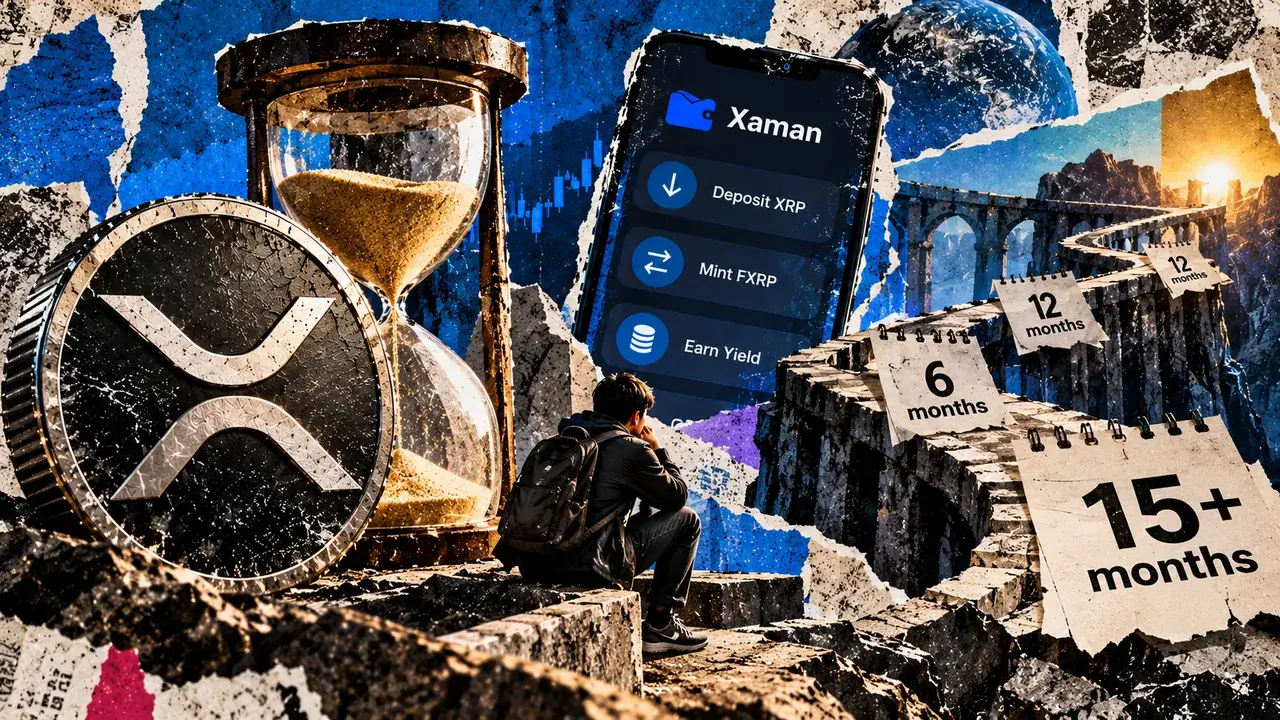
The setup charge applies exclusively to a user’s first deployment. If a holder has already established the required Smart Account, removing that specific fee eliminates the primary disadvantage faced by smaller allocations. Even under those favorable conditions, the analytical model still requires roughly 4.4 months at a constant 2.25% effective net APY simply to recover the remaining percentage-based fees.
The Current Rate Differs From the Illustration
Real-world market conditions and vault parameters frequently diverge from hypothetical models. Fee records for Clearstar’s earnXRP vault list a 0.75% management fee and a 10% performance fee, whereas Xaman’s theoretical example assumes a 1% management charge. Furthermore, public vault pages have displayed trailing 30-day annualized total yields that sit below the net rate used in the wallet’s promotional calculations.
A portion of the advertised yield often stems from vested rewards known as rFLR, which are discounted in the displayed annual percentage yield due to their respective vesting schedules. Consequently, a headline total cannot be automatically interpreted as an immediate increase in spendable XRP, nor can it serve as a guaranteed net return after factoring in wallet entry and exit costs.
Platform explanations emphasize that share-price returns already reflect fees charged internally within the vault. Deducting management and performance charges a second time from that component would result in double-counting, though external wallet setup, minting, and redemption costs remain entirely separate out-of-pocket expenses.
To demonstrate sensitivity to changing yields, if redeemable XRP were to grow at a constant 1.18% effective net annual rate, the initial-use model would require approximately 29.1 months to restore a 100 XRP balance and roughly 8.5 months for a 10,000 XRP allocation. These figures remain conditional calculations rather than forward-looking projections.
How the Study Counts Xaman Fees
Broader ledger analyses have sought to quantify the volume of transactions interacting with these routes. Network data reports tens of thousands of payments charged at the standard 0.5% rate within categories combining large plain transfers and yield deposits. Analysts note that such counts do not inherently verify the exact number of unique users or completed vault round trips.
Publishers of ledger insights maintain commercial interests in broader wallet economics, often disclosing separate swap charges through their own platforms. Meanwhile, Xaman’s service-fee policy independently confirms the general 0.5% yield-deposit charge, distinguishing provider fees from standard XRP Ledger transaction costs, which permanently destroy the native XRP consumed for network fees.
The Final Test Comes After Withdrawal
Completing an investment cycle introduces additional timing variables regarding asset withdrawal. While standard vault documentation outlines multi-day withdrawal periods without standard exit fees, optional instant-exit routes carry additional fees contingent on available liquidity. These differing withdrawal descriptions underscore that exact timelines for converting FXRP back into native XRP can vary.
Disclosures across the ecosystem consistently remind participants that smart-contract mechanics, cross-chain execution, counterparty exposure, and liquidity risks remain present even when users retain full control of their private keys. A delayed exit or unexpected protocol friction can easily outweigh a small modeled yield surplus.
Asset denomination represents another critical layer of exposure. With XRP trading near $1.36 during recent market snapshots, holders participating in yield strategies remain fully exposed to underlying fiat price volatility regardless of whether their token balance increases. The definitive test for any decentralized finance strategy remains the amount of native XRP successfully received after a completed withdrawal, weighed against the total capital initially committed. Lower entry costs or stronger net returns naturally shorten the recovery period, but for small initial deposits, the structural hurdles of time and fees remain prominent fixtures of the experience.