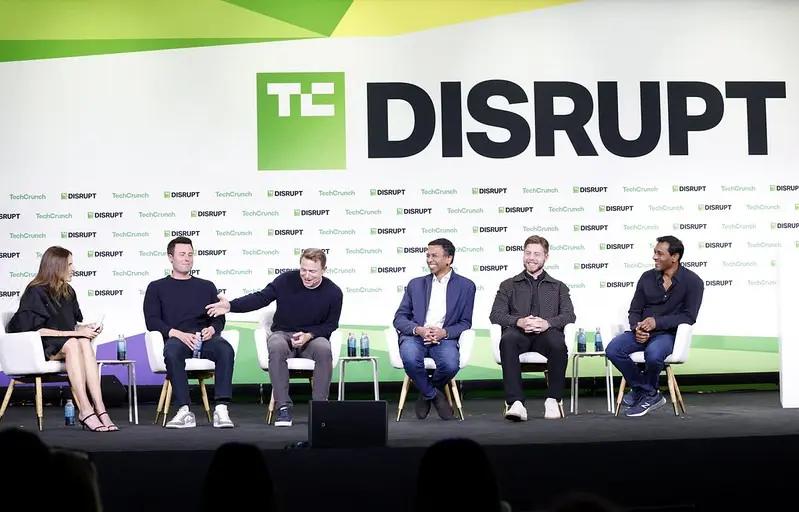
The players at storied venture capital firm Benchmark may occasionally change, but its fiercely guarded ethos remains remarkably resilient. When a conversation took place with four of the firm’s partners three years ago, three of those individuals have since moved on. Capital commitments have also experienced a rare shift: this summer, Benchmark announced a staggering $2 billion deployed across two separate funds, marking only the second time in its 31-year history that the firm has veered away from maintaining a far smaller, tightly restricted vehicle.
Yet, during an appearance at TechCrunch Disrupt, Benchmark’s current roster of five general partners convincingly portrayed a close-knit, deliberate team that refuses to simply put the pedal to the metal, even as many of their industry rivals do precisely that. While the broader tech world speeds up, the firm continues to invest at the measured pace it has always maintained: just two or three new bets per year per partner. The world may be drowning in information, but their Monday partner meetings still run without an agenda. And while macroeconomic indicators point to potential turbulence ahead, the partners remain unbothered, viewing many warning signs as little more than the products of social-media-fueled hysteria.
The five general partners—Peter Fenton, Ev Randall, Jack Altman, Chethan Puttagunta, and Eric Vishria—gathered on stage to discuss the realities of modern venture capital, their evolving fund sizes, market volatility, and why a lack of corporate structure remains their greatest competitive advantage.
Evolving the Core Without Losing the Craft
Benchmark has adapted in notable ways, headlined by a larger core fund and a brand-new growth fund designed to capture late-stage opportunities. Addressing how the firm adapts without diluting its identity, Peter Fenton emphasized that the foundational craft of the core fund remains untouched. Working closely with founders at the earliest stages is typically a 10-to-15-year commitment executed shoulder-to-shoulder, and that level of dedication simply does not scale.
At the same time, Fenton acknowledged economic realities, noting that the core fund was held at $500 million for two decades before finally inflating to match the broader economy—a delay he described as a tactical error on the firm’s part. As for the newly introduced $1.25 billion growth fund, Fenton framed it as a natural expansion of their mandate. Previously, the firm’s strict early-stage focus created a blind spot, forcing them to pass on exceptional opportunities that could have returned anywhere from 10 to 1,000 times their investment.
When asked how the firm plans to deploy that massive growth vehicle, Fenton highlighted the beauty of a diverse partnership. Leaning into the principles of a celebrated J.P. Morgan paper detailing the agony and ecstasy of a concentrated portfolio, Fenton noted that if the fund succeeds, a mere one or two investments will ultimately generate 90% of its returns, pointing to a target of roughly four to six, or perhaps seven to eight, total bets.
Small Partnerships and the Power of Shared Instincts
For Ev Randall, who previously spent time at Founders Fund, Bond, and Kleiner Perkins, Benchmark’s appeal lies in its intimate structure. Randall observed that every venture firm is ultimately a reflection of its people and how they collaborate. While some firms operate with hierarchical, 50-to-60-person investment teams divided by bureaucratic product groups, small partnerships foster a higher level of throughput and conversational fidelity. Decisions are made without navigating a Byzantine corporate structure, likening the experience to a sports team stepping onto the field together. Randall emphasized that finding colleagues whom one not only likes but deeply admires and learns from is exceedingly rare in the industry.
Jack Altman, who joined the firm in February after famously raising a $275 million fund for his own firm in just one week, echoed those sentiments. Having hosted a podcast with the Benchmark partners earlier in the year, Altman was drawn to their unwavering commitment to small funds, concentrated portfolios, and a genuine, primary focus on helping founders build companies. In an industry frequently obsessed with status and raw capital, Altman found a team that genuinely cares. While he enjoyed being an independent investor, navigating a volatile market alone felt daunting compared to learning alongside a driven, deeply focused group of peers.
The Agenda-Free Monday Ritual and Deal Dynamics
One of the firm’s most famous traditions is its weekly Monday partner meeting, which famously operates without an agenda. Eric Vishria described the practice as an ongoing, naturally evolving conversation. In a period of rapid technological transformation, the partners meet to decipher what has suddenly become possible that was impossible six months prior, discussing the companies they are meeting, the signals pulling their attention, and insights gleaned from boardrooms. Trying to overly systematize that process would be counterproductive; the fluidity only works because the partnership remains small and genuinely enjoys spending time together. Puttagunta added that the absence of an agenda deliberately preserves space to be reactive, ensuring all five partners remain entirely at the disposal of founders who need immediate help landing executives or forging strategic partnerships.
When questioned about their egalitarian structure and whether a single partner can unilaterally veto a deal, Puttagunta admitted they have no formal rules around the matter. Altman noted that because the firm targets a low volume of deals, a heavy CRM system or formal voting process is entirely unnecessary. Fenton added that Benchmark consciously avoids the arrogant "winner or loser" bravado common on television startup shows, maintaining a sense of awe toward entrepreneurial possibilities. If a founder proves polarizing and a single partner harbors reservations, the firm steps back, recognizing that a conflicted partnership serves no one.
Pace, Competition, and Navigating the AI Era
Despite companies growing faster than ever, Puttagunta insisted that Benchmark’s investment pace remains entirely consistent. The firm accepts that it will never back every successful startup, focusing instead on identifying exceptional entrepreneurs and amplifying their core strengths, regardless of capital requirements or corporate structures.
Addressing the thorny issue of venture capital firms backing competing companies—a tension heightened as startups rapidly expand into one another’s territories—Vishria acknowledged that modern tech companies pivot and evolve at breakneck speeds, occasionally breeding natural conflicts. While Benchmark prioritizes strict confidentiality and exclusivity where it matters most, the sheer ambition of founders in the artificial intelligence era, where the cost of coding new products has effectively dropped to zero, means overlap is increasingly inevitable. Navigating those collisions requires mutual respect and careful relationship management.
Reflecting on his early investments since joining the firm, Altman noted that his onboarding was uniquely defined by having no formal onboarding at all. Guided by his partners, who assured him that power laws dictate success over many investments rather than a single pressured transaction, Altman has expanded from software into chips, robotics, and infrastructure, relying heavily on the collective wisdom of the room to close deals.
Bold Bets, Public Markets, and Macroeconomic Volatility
Benchmark’s willingness to embrace unconventional bets was underscored by Vishria’s discussion of Cerebras, an AI chip company the firm backed in its early 2016 round. Recalling the investment, Vishria noted that it was their first hardware bet in a decade. Fenton admitted that initially, the company’s unorthodox thesis went against everything he had learned in traditional venture capital, only for him to completely reverse his perspective by Monday morning. That willingness to embrace polarizing, heretical ideas remains central to their investment philosophy.
When discussing Cerebras’ recent public market volatility—where the stock climbed significantly after pricing at $185 before pulling back—Vishria pointed out that dramatic peak-to-trough swings of 500% are remarkably common among high-growth tech companies. Navigating public markets, he noted, demands a stomach of titanium. Regarding the ongoing debate over direct listings championed by former colleague Bill Gurley, Vishria explained that while direct listings have their merits, capital-intensive AI companies requiring billions in funding make traditional IPOs a necessity.
Addressing broader macroeconomic fears and the recent high-profile bankruptcy filing of interactive chatbot platform Character.AI, Randall argued that attempting to predict macro trends with precision is a fool’s errand. Randall noted that Character.AI was effectively the remnant of a team whose core talent was acqui-hired by Google years prior, and reading its Chapter 11 filing as an indicator of an AI chill is largely a product of hyperactive social media echo chambers. While capital expenditures tied to foundational AI players remain massive, the underlying demand for compute and gross-margin-positive revenue among their portfolio companies remains robust. The real unhealthiness, Randall suggested, stems from market volatility driven by unverified clicks and rumors rather than fundamental business weaknesses.
Finally, addressing the geographic center of gravity in the AI landscape, Fenton and Altman agreed that while extraordinary companies can emerge from anywhere, San Francisco continues to offer an unmatched density of talent, capital, and customers. As Randall aptly summarized, iron sharpens iron, making the Bay Area the definitive epicenter for ambitious founders looking to build the defining companies of the current technological era.