Bitcoin’s ongoing recovery above the $85,000 threshold is currently facing a rigorous demand test, driven by a sharp recalibration of macroeconomic expectations following a steep decline in market bets favoring another Federal Reserve interest rate hike. Recent macro-analytical studies examining market behavior in the wake of the latest nonfarm payrolls report indicate that the most intense wave of forced buying occurred immediately before the employment data was published on Friday. Conversely, the premier digital asset experienced a notable retreat once the official figures were finally released to the public, leaving traders and institutional participants to evaluate whether organic buying pressure can genuinely sustain the current price trajectory.
Trading at approximately $85,276 during Sunday’s early sessions, Bitcoin registered a modest 24-hour gain of about 0.83%. However, despite this positive momentum, the weekend price action remained visibly constrained beneath the $86,000 resistance zone—a local peak that the cryptocurrency had successfully touched just prior to the dissemination of the crucial labor market data. For long-term holders, institutional allocators, and short-term speculators alike, this lingering gap between pre-report peaks and current levels introduces a practical, pressing question: exactly who will step up to sustain the recovery now that the initial adrenaline-fueled short squeeze has fully played out? While robust US spot Bitcoin Exchange-Traded Fund (ETF) inflows recorded earlier in the week provided an encouraging buying signal, incomplete figures for Friday’s sessions left the broader industry’s immediate response to the payrolls report partially unresolved as the market prepared for the resumption of traditional trading hours in the United States.
The Squeeze Came Before Payrolls
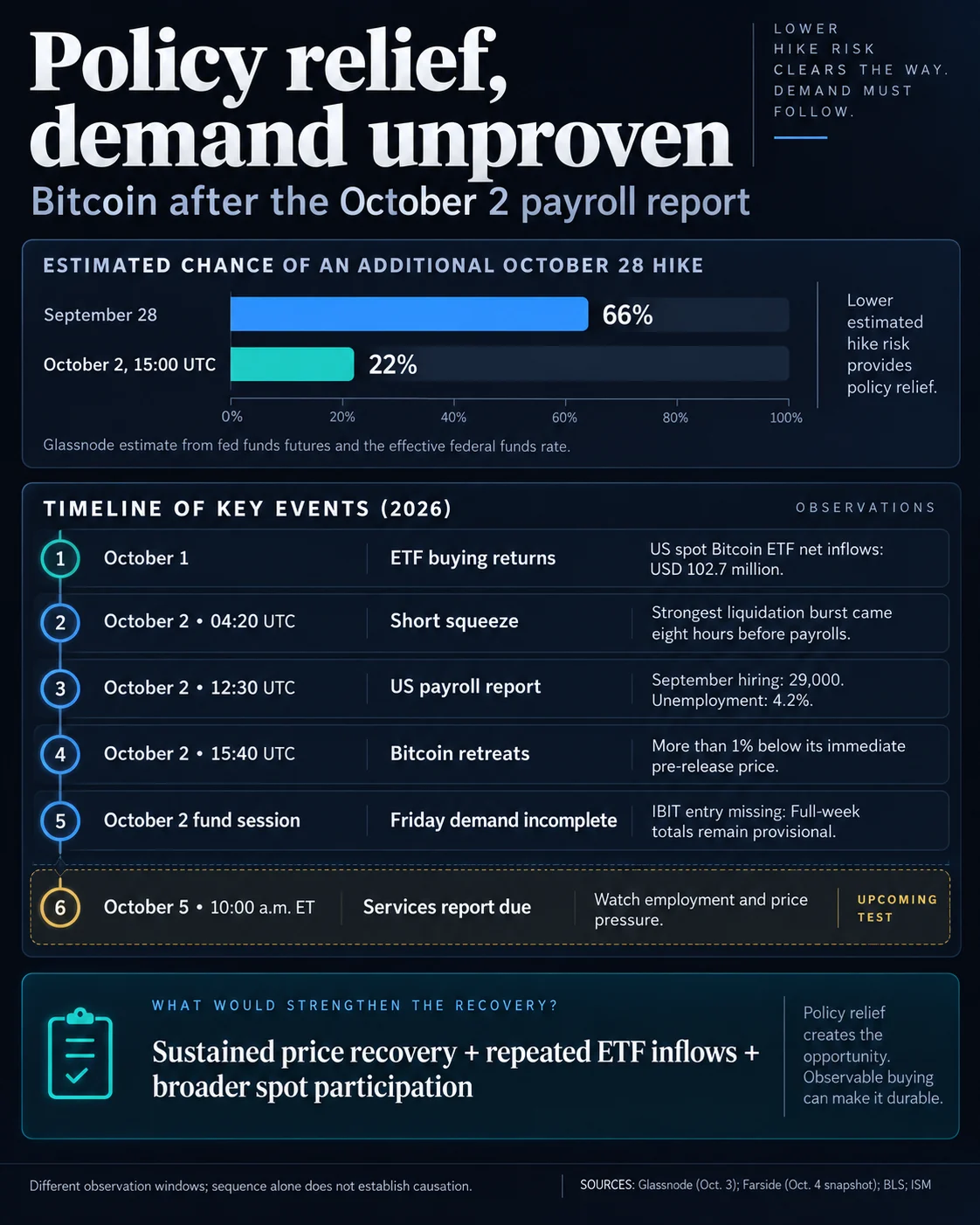
A comprehensive post-payroll study published by blockchain analytics firm Glassnode on Oct. 3 sheds considerable light on the shifting macroeconomic landscape, estimating that the implied market probability of an additional quarter-point interest rate hike at the upcoming Oct. 28 Federal Open Market Committee meeting plummeted dramatically from 66% on Sept. 28 down to just 22% by 15:00 UTC on Oct. 2. This probability estimation is derived from sophisticated calculations utilizing fed funds futures contracts alongside the effective federal funds rate, reflecting a sudden and profound dovish shift in market sentiment.
The exact timing of the market’s strongest forced buying spree offers a revealing look into the mechanics of the pre-payroll advance. According to Glassnode’s granular data breakdown, the market witnessed approximately $50 million worth of short liquidations compressed into a lightning-fast ten-minute window at 04:20 UTC on Oct. 2—roughly eight hours before the official government jobs report hit the wire. Momentum quickly reversed shortly thereafter; by 15:40 UTC that same day, Bitcoin was trading more than 1% below its immediate pre-release level, illustrating the fleeting nature of moves driven strictly by liquidations rather than steady, organic demand.
In the derivatives market, short sellers can frequently act as a potent source of unexpected buying pressure when rising asset prices force them to cover and close out their underwater positions. Yet, once those vulnerable short positions are completely flushed out of the system, maintaining elevated price levels requires a totally different class of buyers to step forward and absorb the ongoing sell offers floating on exchange order books. Friday’s sequential price action strongly supports a cautious approach when attempting to extrapolate an overnight short-covering advance into a lasting commitment from broader investor capital.
Further compounding this dynamic, aggregate open interest—representing the total notional value of outstanding derivatives futures positions across major exchanges—surged by a substantial $2.1 billion during the 24-hour window leading up to the payrolls release. Glassnode figures indicate that total positioning also expanded by about 2.5% when evaluated purely in terms of coin volume. However, this expansive trend reversed abruptly when open interest plummeted by $1.5 billion after continuing to climb for roughly an hour following the employment data publication.
While tracking changes in US dollar values helps measure total outstanding financial exposure, it is also inevitably influenced by underlying asset price volatility; the actual investment capital permanently lost or gained during such swings represents a fundamentally distinct metric. The Glassnode study’s detailed sequence directly links expanding futures positions to the initial price advance and their subsequent rapid contraction to the ensuing market retreat, while the underlying fundamental catalyst for the ultimate reversal remains open to interpretation.
The traditional fund market supplies an entirely separate, yet equally crucial, piece of the puzzle. US spot Bitcoin ETFs successfully recorded net inflows totaling $102 million on Oct. 1, according to comprehensive tracking data compiled by Farside Investors. This robustly positive session arrived directly on the heels of mid-week redemptions, demonstrating quite clearly that institutional fund buying had already begun to make a comeback well before the payrolls report was officially published.
This pre-report institutional accumulation grants the broader market recovery substantially more underlying substance than an explanation relying solely on a temporary futures short-covering squeeze. Nevertheless, Thursday’s recorded inflows only describe a single session occurring right before the employment report, leaving Friday’s ultimate reaction to be measured and evaluated separately. Repeated, consecutive days of net inflows would extend the encouraging evidence observed on Thursday across multiple sessions, definitively showing whether institutional investors continue to commit fresh capital long after the initial macroeconomic data has been digested. Conversely, a return to renewed fund redemptions would quickly place that single positive day back into the troubling context of a fragile recovery struggling desperately for sustained institutional backing.

Market participation must also be evaluated far beyond mere fund subscriptions and ETF creations. In an earlier market study published on Sept. 30, Glassnode estimated the combined daily trading volume across centralized spot exchanges and US spot Bitcoin ETFs at approximately $6.4 billion. This figure rested uncomfortably near the absolute bottom of the historical range observed since the spot ETFs were initially approved and launched. This pre-payroll assessment provides a dated yet valuable baseline for judging whether actual market activity broadens significantly in the days ahead.
Trading volume fundamentally measures transaction activity, including high-frequency and repeated trades by market makers. A meaningful rise in aggregate volume would signal a much broader expansion of market participation, whereas net fund flows provide an entirely separate measurement of primary market subscriptions and redemptions by traditional investors. When read side-by-side with underlying price action, these distinct observations help analysts successfully distinguish between a genuine, widespread expansion of market participation and a fragile price advance dominated primarily by the mechanical closing of leveraged futures positions.
Monday Tests the Path From Policy Relief to Buying
The most recent policy action executed by the Federal Reserve remains a rate increase, finalized during their Sept. 16 announcement, which successfully raised the central bank’s target federal funds rate range by a quarter percentage point to 3.75%-4%. The sudden drop in October rate hike expectations leaves that previous policy increase firmly in place; any potential future rate cut would obviously require an entirely separate, deliberate policy decision by central bank officials.
The September employment report itself, published by the Bureau of Labor Statistics on Oct. 2, recorded 29,000 net payroll gains alongside an unemployment rate holding steady at 4.2%. In its official commentary, the Bureau described both key metrics as little changed over the month. Significantly slower hiring trends can provide monetary policymakers with ample reason for patience, making the latest employment report highly relevant to the Fed’s next scheduled decision, even while September’s rate increase remains the prevailing policy baseline.
At the same time, longer-term interest rates present an entirely separate hurdle for risk-on assets. Glassnode’s Friday intraday study highlighted a notable divergence in the fixed-income market, where short-term yields drifted downward while longer-term yields continued to climb, with the benchmark ten-year US Treasury yield hovering stubbornly near the 5.2% threshold. This yield curve divergence matters profoundly because a reduced market prospect of near-term Fed rate hikes can easily coexist with elevated longer-term borrowing costs throughout the broader economy.
For Bitcoin, the ultimate net benefit depends heavily on how investors choose to react to these complex crosscurrents. A more favorable outlook for the upcoming monetary policy meeting could theoretically encourage market participants to take on additional risk exposure. Whether that sentiment successfully translates into sustained, organic buying must be carefully observed directly in the marketplace, alongside the tightening financing conditions that investors continue to navigate daily.
Adding another layer to the macroeconomic puzzle, the Institute for Supply Management is scheduled to release its closely watched September services report on Monday, Oct. 5, at 10:00 a.m. ET. The previous survey for August famously combined a headline services PMI of 55.4 with a sub-index for employment languishing at 47.8 and a hot prices index sitting at 72.6—a striking economic combination of expanding overall activity, contracting sector employment, and pervasive input-cost pressures.
This unusual combination makes the intricate details of the upcoming services report just as relevant as its headline figure. A combination of softer employment growth accompanied by easing price pressures could strongly reinforce the prevailing argument for ongoing policy patience from the Federal Reserve. On the other hand, persistent price pressures or stronger-than-expected economic activity could significantly complicate that narrative. Consequently, the upcoming services release provides a fresh, critical check on the evolving interest rate outlook that initially emerged from the payrolls data.
The subsequent US ETF trading sessions will ultimately demonstrate whether institutional fund investors maintain their buying appetite as the broader financial market fully absorbs these macroeconomic signals. The precise timing of these flows remains crucial: fund flows reported after the release can effectively extend the empirical evidence far beyond the single Thursday inflow already recorded, while a fully completed Friday data row will clarify the market’s immediate tactical response.
Bitcoin stood firmly above the $85,000 mark during Sunday’s market snapshot, though it remained noticeably below its pre-payroll $86,000 area. Successfully sustaining a robust recovery back toward that local resistance level, backed by a consistent streak of repeated fund inflows and much stronger spot market participation, would significantly alleviate lingering market concerns regarding underlying demand. Conversely, another stark price rejection in the absence of these supportive technical and fundamental signals would only validate those fears. Evaluating these combined market observations will ultimately provide holders with much firmer evidence of true follow-through than a simple drop in estimated interest rate hike probabilities ever could.