
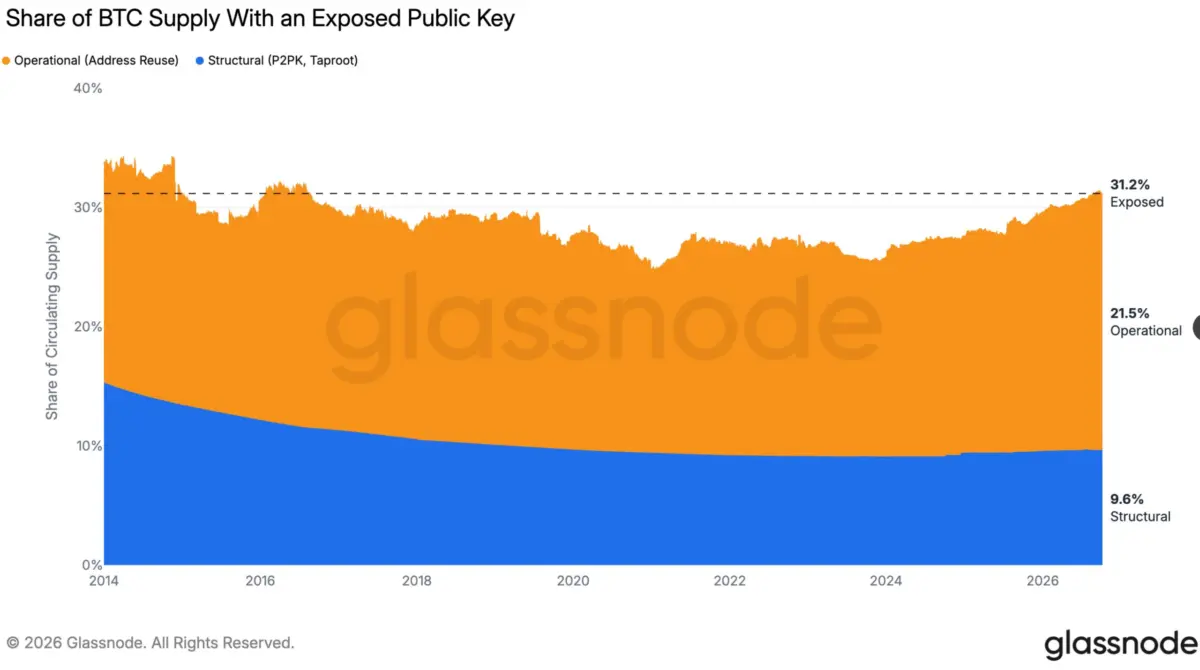
More than 6 million Bitcoin now sit behind public keys that are already visible on-chain, highlighting a growing vulnerability scale across the cryptocurrency market. This exposure raises significant concerns about the safety of digital asset holdings should rapid advancements in artificial intelligence or quantum computing ultimately undermine foundational wallet cryptography.
According to recent data shared by Rafael Schultze-Kraft, co-founder of the blockchain analytics firm Glassnode, the amount of circulating supply with exposed public keys has steadily climbed. These coins currently represent 31.2% of the total circulating Bitcoin supply. This figure sits roughly 5% to 6% above the cyclical low point reached by the market back in 2023, signaling a measurable reversal in privacy and cryptographic hygiene practices among network participants.
The latest metrics reveal that the exposed supply has expanded notably over a relatively short period. Schultze-Kraft noted that the quantum-exposed supply has increased by 222,000 BTC—valued at approximately $18.2 billion based on current market prices—since Glassnode published its comprehensive May report on the subject. During that same timeframe, the total supply of Bitcoin grew by a modest 64,000 BTC, meaning the growth in exposed coins significantly outpaced the issuance of new currency.
Cryptocurrency exchanges have played a substantial role in this shifting landscape. Data shows that centralized trading platforms accounted for 123,000 BTC of the recent increase. Consequently, exchanges now collectively hold 1.79 million Bitcoin behind visible public keys.
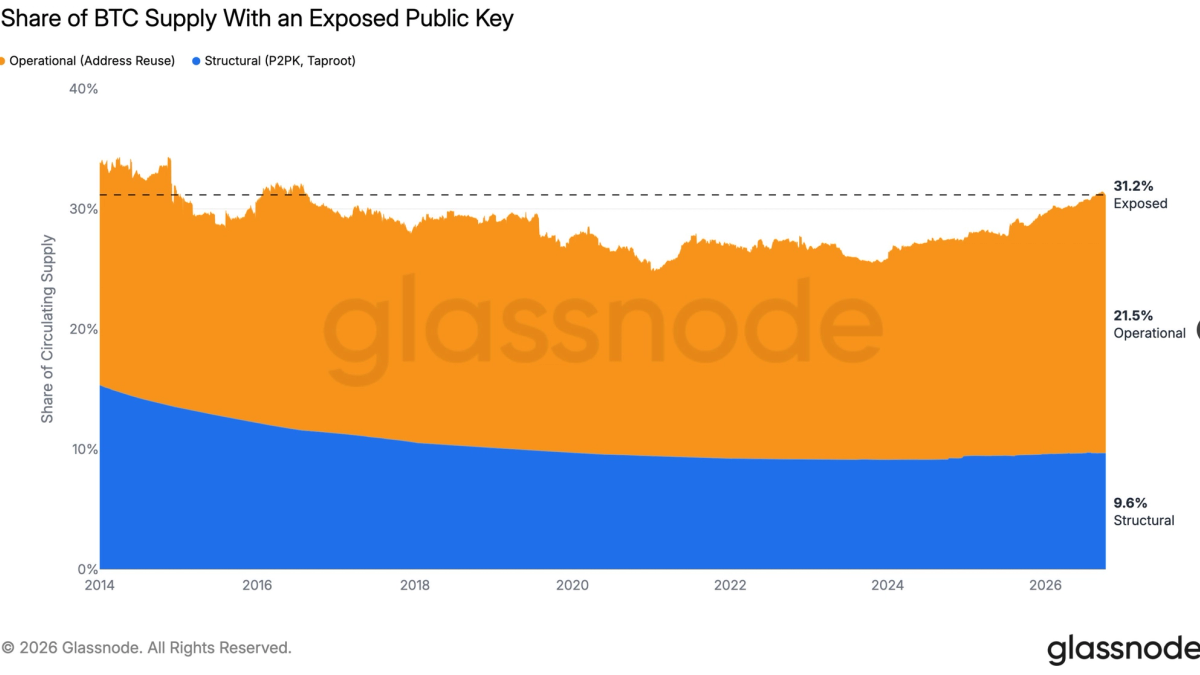
However, the degree of exposure varies drastically from one institution to another, reflecting divergent operational and wallet-management policies across the financial sector. For instance, Coinbase maintains a relatively conservative posture with an exposed share standing at just 10%. In sharp contrast, Binance exhibits an exposed share of 83% across its tracked holdings.
Beyond traditional exchanges, institutional custodians and financial platforms show similarly wide discrepancies in how they handle wallet architecture. Fidelity holds approximately 375,000 Bitcoin, with a remarkably low exposure rate of just 2%. On the other end of the spectrum, Grayscale’s share of exposed holdings sits at 49%, while fintech and retail trading platforms show near-total vulnerability under Glassnode’s methodology, with Revolut registering 99% exposure and Robinhood recording 100%. Meanwhile, sovereign holdings belonging to the governments of the United States, the United Kingdom, and El Salvador display zero exposure under the same analytical framework.
Public keys typically become visible on the blockchain through address reuse—where a user repeatedly receives funds to the same address—or they can appear directly by default within specific Bitcoin output types. These include early pay-to-public-key (P2PK) outputs utilized in the network’s infancy, as well as modern implementations like Taproot. In a theoretical threat model, a sufficiently advanced quantum computer, or alternatively a breakthrough in mathematical cryptanalysis, could potentially leverage these visible public keys to mathematically derive the corresponding private keys, granting unauthorized access to the underlying funds.
This data update arrives against the backdrop of escalating industry discussions regarding long-term cryptographic security. Recently, prominent Ethereum researcher Justin Drake issued a stark warning to the digital asset community, urging stakeholders to prepare for what he termed "bunker mode." Drake cautioned that rather than waiting decades for physical quantum computers to materialize, worst-case scenarios could involve artificial intelligence rapidly uncovering mathematical shortcuts to crack wallet cryptography. According to Drake’s assessments, such AI-driven breakthroughs could theoretically accelerate threat timelines down to months rather than years, intensifying the urgency for developers and major holders to fortify network defenses long before quantum hardware becomes a commercial reality.