
Running an independent blockchain has long carried a distinct and powerful promise: absolute control. For years, the prevailing wisdom in the Web3 industry was that launching a standalone Layer 1 architecture allowed projects to become masters of their own destiny. By building an independent network, developers could set their own customized rules of consensus, maintain proprietary validator sets, and construct bespoke infrastructure tailored precisely to their user base, all without relying on the security or performance of any other external network.
However, in the world of decentralized technology, with great power comes great responsibility—and, increasingly, a formidable and unsustainable financial expense. Operating a standalone blockchain requires maintaining a massive array of core functions, including execution, consensus, data availability, and settlement. Furthermore, these independent networks must continually fund the heavy token incentives required to bootstrap and secure their systems through proof-of-stake validator rewards.
For a blockchain to survive independently, it needs a thriving, self-sustaining ecosystem composed of enough active users, dedicated developers, and consistent economic activity to support the heavy infrastructure securing it. Yet, for a growing number of smaller and mid-tier networks, keeping an entire standalone ecosystem afloat no longer makes basic economic sense. Funding has shifted, liquidity has concentrated, and the sheer cost of maintaining isolated security has become a glaring vulnerability.
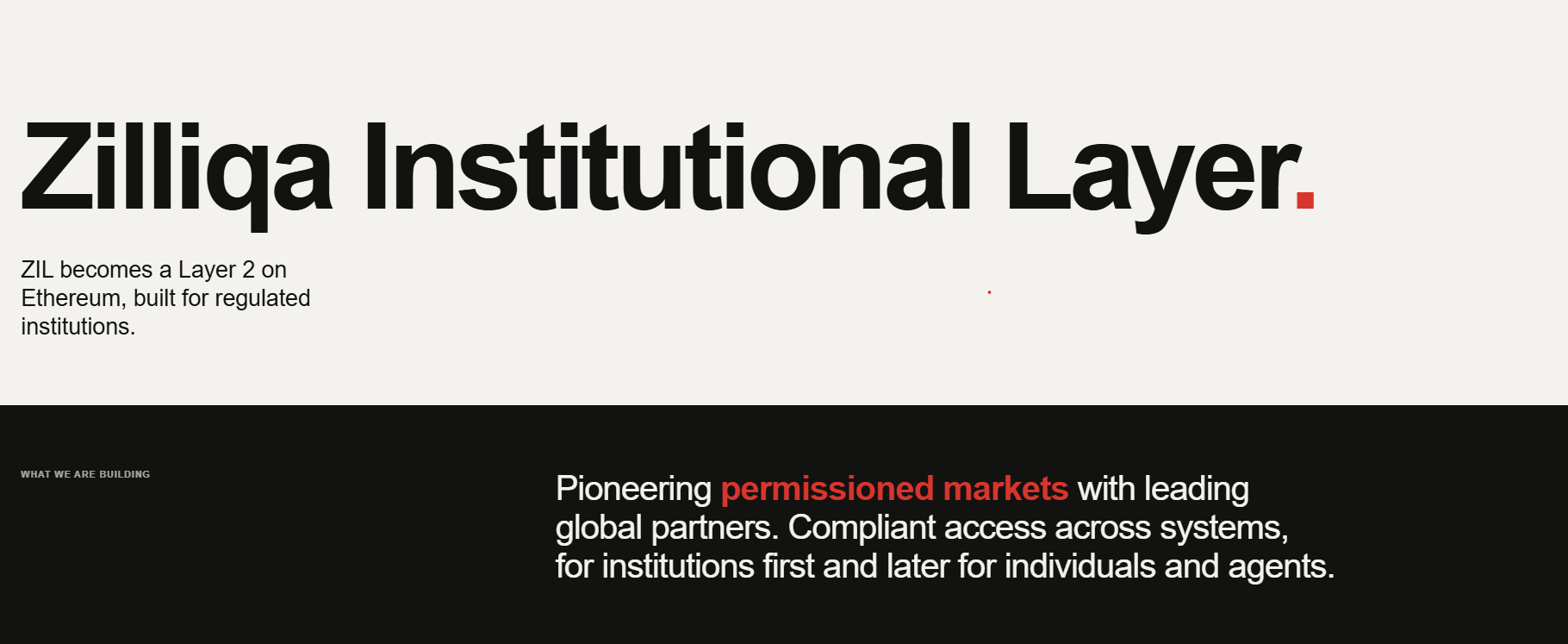
Zilliqa has emerged as the latest high-profile project to confront this sobering market reality. Last week, the project officially announced plans to move away from its foundational Layer 1 architecture and transition into an Ethereum-based Layer 2 network. In a frank and revealing public statement, the team pulled back the curtain on the challenges that forced their hand after nearly a decade of independent operation.
"We know it’s not great. For nine years we built and ran our own Layer 1. It hasn’t worked," the project stated in its announcement. Explaining the painful pivot further, the post noted that organic usage never reached the critical mass that a standalone chain desperately requires to survive. Furthermore, funding and liquidity for standalone Layer 1 blockchains have largely dried up across the broader market. Pointing to recent high-profile security incidents across the industry, the team emphasized that recent hacks have laid bare just how much capital, effort, and vigilance it truly takes to secure a blockchain entirely on your own.
The Mounting Cost of Going It Alone
Zilliqa is far from an isolated case. The blockchain ecosystem Gnosis, which has historically maintained close alignment with the Ethereum network, is similarly working to transition Gnosis Chain into a fully integrated Ethereum-based network through its ambitious Ethereum Economic Zone initiative. As part of this evolution, its RollupX test network is designed to demonstrate how participating chains can seamlessly share Ethereum settlement and synchronous composability as native rollups.
At the same time, the gaming-focused Ronin blockchain officially completed its own strategic migration back to Ethereum as a Layer 2 network. With interest and venture capital funding for alternative Layer 1 chains drying up simultaneously, industry observers are increasingly asking whether we are entering an era of mass ecosystem consolidation centered around Ethereum.
According to industry analysts, the shift is driven fundamentally by cold, hard economics. Max Shannon, a senior research analyst at Bitwise, explains that the viability of a blockchain ultimately comes down to its core profitability and operational overhead.
"It comes down to a chain’s profitability," Shannon notes, pointing out that Layer 2 networks operate under a vastly different financial model. Because L2s inherit their base security from Ethereum, they only need to maintain their own execution environments and do not necessarily require a native token to secure consensus, making them a much more attractive financial and operational proposition for developers.
Shannon points out that while the top ten largest projects in the crypto industry have achieved financial sustainability, the picture changes dramatically beneath the surface. Major corporate-backed networks, such as the Layer 2 networks launched by Coinbase and Robinhood, have generated staggering financial returns, pulling in $48 million and $52 million in fees respectively over a recent 365-day period, while maintaining operating profit margins well above 90%. The next eight largest chains each managed to generate more than $1 million annually.
However, once you look past the top ten networks, the financial reality becomes stark. From the eleventh spot onward, annual fee revenue across individual chains collectively amounts to less than $1 million. Consequently, a network may possess ambitious, cutting-edge technology and a deeply dedicated community of supporters, but those intangible assets do not automatically pay the underlying operational bills.
Ethereum itself has frequently faced public criticism from detractors who argue that the network gives away too much of its fee revenue to scaling rollups and Layer 2s. Yet, paradoxically, that exact dynamic is precisely what makes building projects within the Ethereum ecosystem so financially attractive. By outsourcing heavy security and data settlement to the base layer, smaller networks can avoid the crushing capital expenditures required to run independent validators.
At the same time, experts caution that simply rebranding or redeploying as an Ethereum Layer 2 does not automatically guarantee instant profitability. Shannon points to networks like Optimism, Katana, and Linea as examples where ongoing operational expenses continue to outweigh fee revenue, while projects like Blast have already been forced to shut down entirely amid changing market conditions.
Ethereum as a Liquidity "Black Hole"
For Gnosis, the path toward consolidation involves a meticulous, multi-year roadmap, with the project targeting the spring of 2027 to complete its comprehensive transition. This migration will see Gnosis officially give up its independent validator-based consensus mechanism in favor of relying entirely on Ethereum for economic settlement.
Reflecting on the evolution of the technology, Gnosis co-founder Martin Köppelmann recalled giving a talk two years prior about the concept of "native rollups" that would genuinely extend Ethereum rather than functioning as isolated, siloed chains. Commenting on the current rollout of the Ethereum Economic Zone, Köppelmann noted that the architecture "even goes beyond what I had imagined back then."
The EEZ initiative is specifically designed to enable separate Ethereum-based networks to interact with one another synchronously. This means that a smart contract operating on one network will be able to call another network and directly utilize its response within the exact same transaction block, entirely bypassing the traditional, sluggish bridge-and-wait process that has plagued cross-chain communication for years.
This prospect has generated substantial excitement and bullish sentiment among prominent members of the Ethereum community. Crypto commentator and investor materkel described the developing EEZ framework as a potential "black hole for liquidity," arguing that it could allow participating networks to tap directly into Ethereum’s massive total value locked while further cementing its dominant position as the industry’s ultimate liquidity hub. As network effects and deep interoperability improve, the gravitational pull drawing more independent chains into Ethereum’s orbit appears increasingly difficult to resist.
Beyond Cost Savings and Ecosystem Integration
Beyond basic operating cost economics and financial survival, moving closer to Ethereum offers projects another massive advantage: immediate access to a deeply established ecosystem of existing applications, smart contracts, and developers, rather than being forced to build critical network effects completely from scratch.
Alex Gluchowski, co-founder and chief executive of Matter Labs—the core development company behind the Ethereum Layer 2 network ZKsync—notes that he fully expects more independent Layer 1 teams to maintain their own customized execution chains while strategically leaning on Ethereum for shared settlement.
"Running an independent L1 means maintaining its security as well as building something people want to use," Gluchowski explains. "Sharing Ethereum’s security gives a team more room to focus on its users. I see very few user needs that require an independent L1 rather than an Ethereum-based chain."
Crucially, Gluchowski emphasizes that technological sovereignty and deep Ethereum integration do not have to be mutually exclusive concepts. Individual application chains can easily retain total control over their internal rules, governance, and daily operations while simultaneously leveraging Ethereum as a neutral, highly secure layer for shared settlement. Furthermore, for applications handling sensitive financial or enterprise information, maintaining a private, specialized environment under their own direct control remains essential. Gluchowski points out that sharing base-layer settlement does not inherently require exposing confidential transaction data to the public.

Nevertheless, significant technical hurdles remain across the scaling landscape. The most pressing obstacle facing the ecosystem today is that the vast majority of existing Layer 2 networks are effectively isolated from one another as well as from Ethereum itself. While users can certainly move funds between different rollups, the process is far from seamless, and overall interoperability remains notably poor.
"Fragmentation is already happening," Gluchowski says, highlighting the inherent technical difficulties of connecting disparate networks when transactions involve strict privacy requirements. As more commercial applications seek to combine confidential, enterprise-grade activity with seamless access to public blockchain liquidity, solving interoperability between private execution environments will only grow in importance.
Does Every Chain Need Ethereum?
Despite the clear wave of migrations toward Ethereum, market analysts urge caution against oversimplifying the current industry landscape as a monolithic march toward total consolidation.
While major fintech firms and traditional financial institutions are indeed launching proprietary Layer 2 networks on Ethereum—exemplified by corporate deployments from companies like Coinbase and Robinhood—other prominent projects continue to chart a distinct course by building independent Layer 1 architectures designed for highly specific, high-performance use cases. Examples of this counter-trend include Circle’s Arc, Stripe’s Tempo, and Hyperliquid’s purpose-built perpetual futures blockchain.
As the debate between standalone sovereignty and shared security continues to evolve across the Web3 space, industry participants are finding that there is still no single, universal conclusion to the Layer 1 versus Layer 2 debate.