
Ethereum creator Vitalik Buterin has stated that the network should actively promote Ether (ETH) as a store of value (SOV), moving away from the narrative that the asset derives its primary worth from burning transaction fees.
In a recent thread addressing the token’s long-term economic model, Buterin argued that the idea of "ETH as a fee-burning token never was as strong as it seemed." He warned that optimizing exclusively for fee-driven deflation would negatively impact Ethereum’s core principles, specifically its decentralization and capture resistance.
Instead, Buterin suggested that Ethereum’s intrinsic value should stem from the stability provided by its focus on what he described as "CROPS"—referring to censorship and capture resistance, open source, privacy, and security. He believes these foundational characteristics will become increasingly vital in an "era of AI disruption."
The Evolution of the "Ultrasound Money" Narrative
The debate over Ethereum’s monetary design gained significant traction following the 2021 EIP-1559 upgrade, which introduced a mechanism to burn a portion of transaction fees. During periods of high network congestion and sky-high revenue, the upgrade temporarily flipped Ethereum into a deflationary asset. This dynamic prompted prominent supporters, including the Bankless podcasters, to dub Ethereum "ultrasound money."

However, structural scaling choices and network upgrades have caused transaction fees and overall protocol revenue to decline steadily. Data from January to October indicates that median transaction fees dropped from 35 cents to 3.5 cents, even as the number of daily transactions increased by more than 50%. This ongoing compression in fee revenue has made the fee-burning narrative increasingly unsustainable over the long term.
Reactions to Buterin’s comments were swift across the broader cryptocurrency ecosystem. Bitcoin advocates, who view BTC’s store-of-value status as foundational, criticized the pivot. Held Media founder Dan Held derided the remarks, characterizing them as an attempt by the Ethereum community to adopt Bitcoin’s SoV narrative after previous economic theses lost momentum. Held argued that a protocol with a frequently changing monetary policy cannot realistically be classified as sound money.
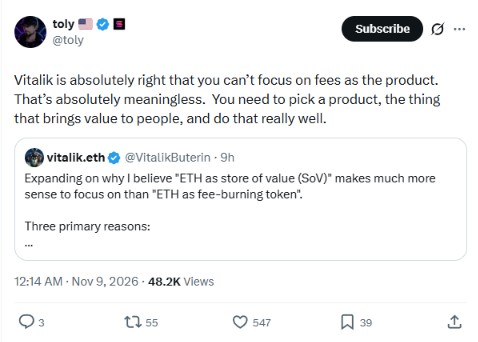
Conversely, proponents of the network welcomed a clear narrative direction from the protocol’s co-founder. MetaLeX attorney Gabriel Shapiro described the comments as a welcome return to fundamentals, asserting that ETH could potentially serve as a stronger store of value than competing privacy or legacy assets. Solana co-founder Anatoly Yakovenko also weighed in, agreeing that networks cannot sustainably focus on transaction fees as their primary product, while offering a subtle critique of Ethereum’s architectural approach.
Political Shifts and Regulatory Outlook in Washington
While developers debate economic models, the political landscape in Washington is undergoing a transformation following the recent midterms. Despite the crypto industry injecting approximately $176 million across 100 congressional races—including a $64 million effort that ultimately failed to unseat Senator Sherrod Brown—the long-term influence of political action committees on the election outcome remains a subject of intense debate.
Democrats have secured control of both the Senate and the House of Representatives. However, data compiled by Stand With Crypto suggests that majorities of lawmakers in both chambers are broadly supportive of digital assets, counting 50 pro-crypto senators against 33 opponents, alongside 241 supportive members of the House versus 106 who are actively hostile.
Despite broader industry support, key legislative committees will be led by vocal critics of the sector. Sherrod Brown is expected to join the Senate Agriculture Committee, while Elizabeth Warren is tipped to chair the Senate Banking Committee. Industry analysts suggest that this leadership dynamic will likely translate into heightened regulatory scrutiny during the upcoming legislative session.
Discussions are already underway among Democratic lawmakers to potentially expand proposals originally introduced by Representative Maxine Waters into a comprehensive market structure bill. While the CLARITY Act remains a possibility for revival, experts note it would likely require stringent ethics provisions addressing concerns surrounding political figures and digital assets. Fidelity Digital founder Hadley Stern highlighted these governance concerns, pointing to the optics of political figures launching memecoins and stablecoins as a significant hurdle for mainstream adoption and regulatory clarity.
Binance Suffers $6.34 Billion Breach Stemming From Sophisticated Social Engineering
On the operational security front, cryptocurrency exchange Binance revealed the mechanics behind a massive $6.34 billion security breach, attributing the exploit to a coordinated, months-long campaign orchestrated by North Korean hackers.

According to an official post by Binance co-CEO Richard Teng, the breach began in June when an employee inadvertently downloaded a compromised Homebrew installation while attempting to install an AI coding tool. Although the exchange detected the initial anomaly, attackers had already gathered intelligence regarding personnel working on Binance’s internal wallet infrastructure.
The attackers leveraged this intelligence in September by posing as recruiters to target another software engineer, tricking them into downloading a malicious file disguised as a routine coding assignment. By Oct. 20, the threat actors used the compromised workstation and an integrated internal AI tool to infiltrate the systems of two additional engineers, ultimately deploying malware that granted them access to the exchange’s internal wallet-signing service and facilitating the multi-billion-dollar theft.
THORChain Restarts Operations Despite Federal Warnings
Despite the massive scale of the Binance hack, decentralized infrastructure continued to operate under intense pressure. Cross-chain liquidity protocol THORChain resumed trading services for major networks, including Bitcoin, Ethereum, Dogecoin, and Litecoin, ignoring an explicit warning from the Federal Bureau of Investigation (FBI) not to process funds linked to the Binance breach.
The resumption of services sparked a 15% rally in THORChain’s native RUNE token over a 24-hour period. Analytics firm Chainalysis reported that the decentralized exchange had processed more than $46 million in funds associated with the hack within its initial 72 hours of activity, generating substantial fee revenue before trading was temporarily paused due to an unrelated Ethereum block reorganization.

Addressing the regulatory warning, THORChain co-founder JPThor argued that the protocol’s ability to operate independently of federal directives demonstrated its true decentralization, noting that no centralized entity could or would intervene to halt transactions.
Accelerating Quantum Resistance and Broader Market Trends
In developer news, Ethereum Foundation researcher Justin Drake announced an accelerated timeline for the network’s security roadmap during Devcon 8 in Mumbai. Drake targeted December 2028 for the completion of Ethereum’s post-quantum and post-AI transition, moving the deadline forward by a full year compared to the September roadmap, which had set December 2029 as the target. The updated schedule requires core developers to deliver three major network upgrades over the next 24 months, even as current upgrade timelines face delays due to smart contract security reviews.
Market-wide, digital asset prices faced downward pressure over the week. Bitcoin traded lower at around $74,302, while Ethereum fell to $2,117, bringing the total cryptocurrency market capitalization down to approximately $2.49 trillion. Among the top 100 digital assets, altcoins experienced mixed performance, with projects like Pieverse and Injective registering weekly gains, while tokens such as Official Worldcoin and Ethena saw notable declines.