
The month of October has proven to be a punishing period for United States spot Ether exchange-traded funds (ETFs), with the investment products shedding more than $1 billion in capital withdrawals and marking their most severe monthly downturn of 2026. This sudden and substantial capital flight has not only erased previous gains accumulated over late summer but has also underscored a broader divergence in institutional sentiment toward the two leading cryptocurrencies. While Bitcoin investment vehicles have experienced erratic momentum following a brief surge early in the week, Ether-based products have faced persistent, heavy selling pressure as broader market values retreat.

According to market data compiled by SoSoValue, net outflows from US spot Ether ETFs reached a staggering $1.08 billion since the opening trading sessions of October. The downward spiral intensified following a modest influx of $26 million on Tuesday, which did little to counterbalance the heavy redemptions recorded throughout the rest of the month. This sharp reversal has entirely wiped out the positive momentum generated in September, during which spot Ether ETFs managed to attract $832 million in net inflows. Consequently, the cumulative year-to-date net inflows for these specific financial instruments have been severely compressed, dwindling down to approximately $485 million.
The current trajectory highlights a grim milestone for the asset class. October has already officially secured its place as the worst-performing month in terms of net outflows since November 2025. What makes this contraction particularly notable is that it has materialized with nearly a week and a half of trading remaining in the month, leaving open the possibility that these figures could expand further before the final bell sounds.
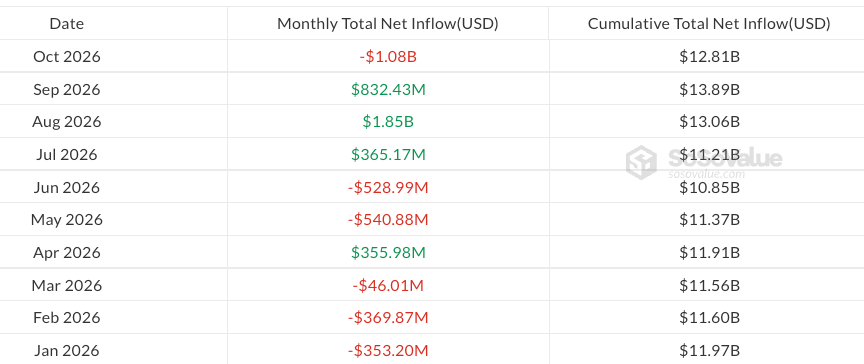
The bleeding in institutional investment vehicles has unfolded in tandem with a noticeable downward correction in the underlying asset’s market price. Ether has suffered a substantial 9.7% price slide over the course of October, descending from around $2,700 at the start of the month to hover near $2,438 at the time of publication. When looking at a broader macroeconomic and market timeframe, ETH has struggled to maintain upward momentum throughout the entirety of 2026, registering a negative price return of nearly 18% year-to-date according to metrics provided by CoinGecko.
In stark contrast to the persistent capital drainage affecting Ether-based products, United States spot Bitcoin ETFs have displayed a different pattern of behavior, characterized by volatile bursts of institutional interest followed by stabilization. On Tuesday, these premier Bitcoin investment funds recorded $23 million in net inflows. While this figure represents positive territory, it also highlights a significant deceleration when compared to the massive $527 million influx that flooded into the funds just a day prior on Monday.

Despite the occasional high-volume influx days, the wider picture for spot Bitcoin ETFs in October remains subdued. The funds have recorded roughly $67 million in net outflows since the beginning of the month. Even with these recent monthly redemptions, the resilience shown earlier in the year keeps the year-to-date net inflows for US spot Bitcoin ETFs at a much healthier cushion of roughly $809 million, according to SoSoValue tracking metrics.
Meanwhile, the world’s largest cryptocurrency by market capitalization has experienced relative price stability compared to its smaller altcoin counterpart, though it has still not been immune to downward pressure. Bitcoin was changing hands at $82,954 at the time of publication, marking a relatively modest decline of 2.2% since October 1. On a year-to-date basis, Bitcoin’s price performance reflects a mild contraction of 5.3%, demonstrating a higher degree of relative price resilience during the ongoing autumn market cool-down compared to the steeper double-digit losses faced by Ethereum over the same multi-month horizon.