
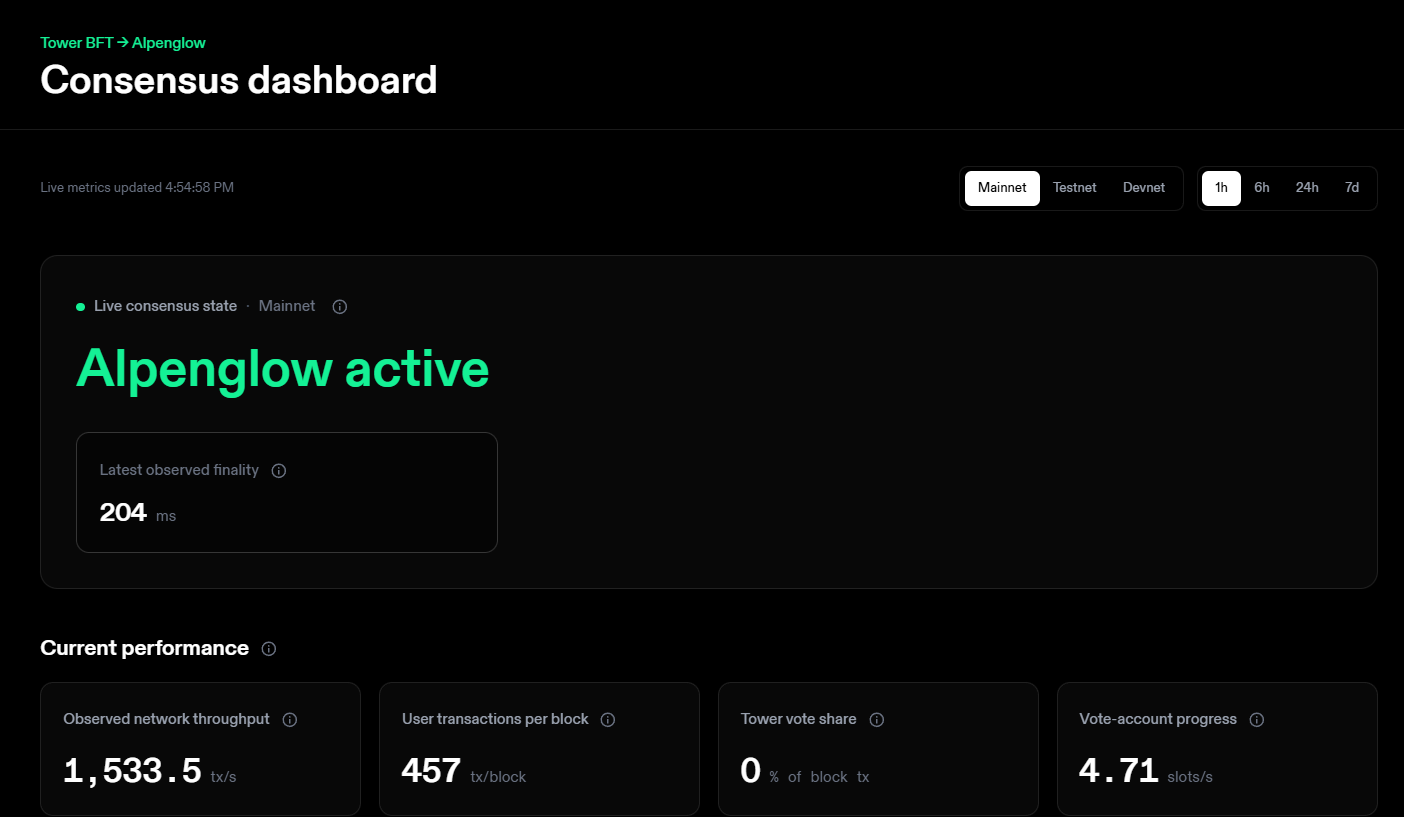
Solana’s first major consensus upgrade, Alpenglow, officially went live on the network’s mainnet at approximately 1:54 pm UTC on Wednesday, marking a historic technical milestone for the high-performance blockchain. The deployment of Alpenglow is detailed extensively on the Solana Foundation’s official Alpenglow activation dashboard, signaling the dawn of a new architectural era for the network.
Designed to fundamentally transform how transactions are processed and confirmed, Alpenglow seeks to reduce transaction finality by an astounding 99%. According to projections outlined in the Solana Foundation’s July announcement, the upgrade aims to compress transaction finality from roughly 12.8 seconds down to a blistering 150 milliseconds. This near-instantaneous settlement capability represents a massive leap forward for the network’s underlying infrastructure, positioning it to compete directly with traditional Web2 payment rails and financial messaging networks.
The rollout of Alpenglow is structured in deliberate phases to ensure network stability while systematically overhauling core mechanics. The upgrade’s first phase introduces Votor, which replaces the existing voting and finalization mechanism with direct validator voting and a sophisticated certificate-based system. This specific component is engineered to cut transaction finality to the targeted 150-millisecond threshold. A subsequent phase of the upgrade roadmap will introduce Rotor, a brand-new block data-distribution protocol intended to eventually replace Turbine, further optimizing data propagation across the global validator set.

Alpenglow marks Solana’s very first major consensus upgrade since its genesis block, effectively replacing its long-standing consensus model, TowerBFT. By targeting a 150-millisecond finality, the upgrade aims to deliver near-immediate transaction confirmation for everyday users and institutional participants alike. In practical terms, this dramatic reduction in latency could unlock a wide range of improvements, including significantly faster peer-to-peer payments, more reliable and efficient trade settlements, and highly responsive decentralized applications that feel indistinguishable from centralized web services.
At the time of press, metrics displayed on the Solana Alpenglow dashboard indicated that the mainnet was operating with a transaction finality of roughly 6.6 seconds and maintaining a robust throughput of 4,721 transactions per second as the network began adjusting to the new infrastructural parameters. Cointelegraph has formally reached out to the Solana Foundation for further comment regarding Alpenglow’s finality measurements observed in previous testnet environments, as well as its anticipated performance benchmarks in demanding real-world production applications.
Alpenglow Marks ‘Biggest Change’ for Solana’s Core Protocol: Anza
The magnitude of the Alpenglow upgrade has drawn widespread attention from core developers and researchers across the ecosystem. In a comprehensive blog post published back in May, researchers from Solana Labs offshoot Anza described Alpenglow as introducing the “biggest change to Solana’s core protocol” since the network’s inception.
The Anza research team—comprising Quentin Kniep, Kobi Sliwinski, and Roger Wattenhofer—emphasized that achieving a 150-millisecond latency profile allows “Solana to compete with Web2 infrastructure in terms of responsiveness, potentially making blockchain technology viable for entirely new categories of applications.” Their analysis underscored how eliminating latency bottlenecks could finally bridge the gap between decentralized protocols and traditional enterprise-grade software performance.
This architectural evolution builds upon a series of aggressive performance optimizations pursued by the Solana community throughout the year. In August, Solana successfully reduced its blockchain slot time for the first time since genesis. That move formed a crucial part of the Solana Foundation’s broader roadmap to halve slot times down to 200 milliseconds, with developers arguing that the reduction would inherently improve latency and accelerate confirmations network-wide. The fourth and final stage of that methodical slot reduction plan was successfully completed in October, paving the way for the ultimate activation of Alpenglow.
Looking ahead beyond the deployment of Alpenglow, Solana validators and core contributors are already preparing for subsequent protocol enhancements. Chief among these is Agave 4.5, an upcoming upgrade that proposes increasing the number of accounts supported by a single versioned transaction from the current limit of 64 up to 96. According to documentation from the Solana Foundation, this expansion could yield significantly better swap routes and superior execution prices for decentralized finance traders. The Agave 4.5 upgrade is currently deep in development and slated for a mainnet rollout in December.
Meanwhile, broader economic shifts and protocol adjustments continue to shape the ecosystem. In the financial markets, the native Solana token, SOL, saw its price appreciate by nearly 3% over the 24-hour window leading up to the Alpenglow activation. This modest upward movement helped reverse a portion of the broader 42% price decline recorded over the preceding year, according to data from CoinMarketCap, as market participants weighed the long-term fundamental implications of the network’s accelerated technical roadmap against prevailing macro conditions.