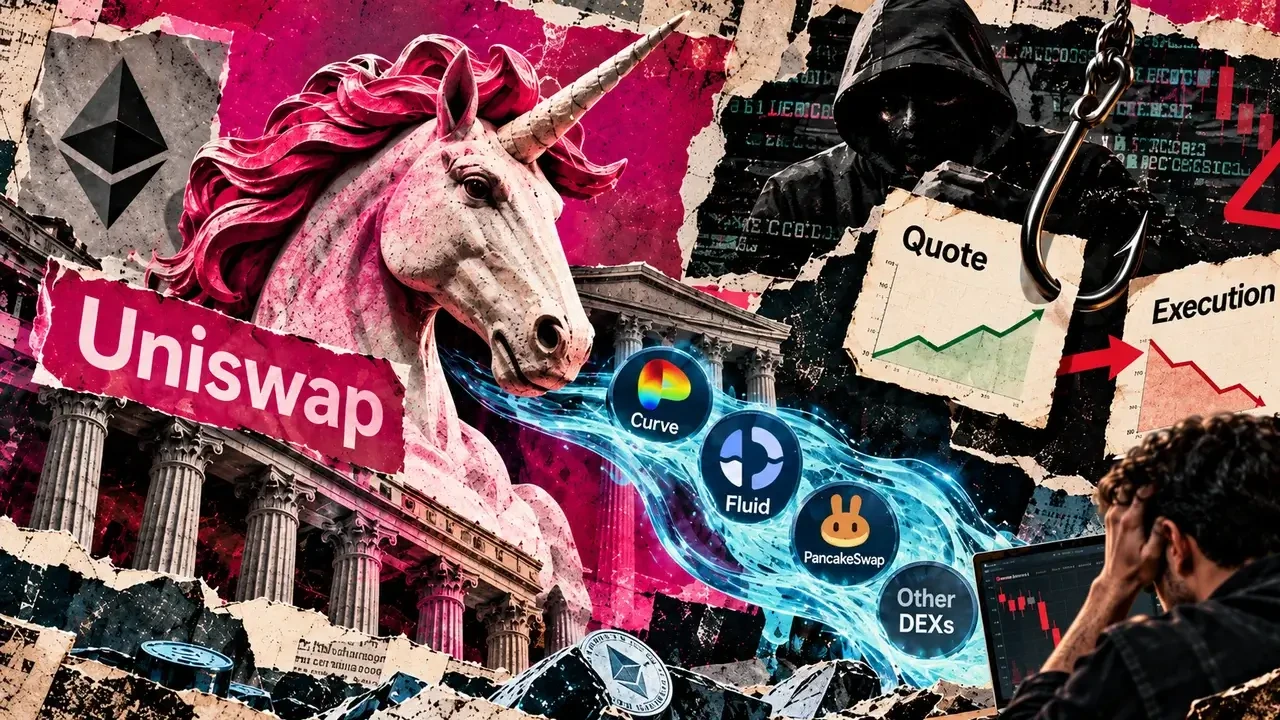
Uniswap Labs officially launched its new aggregator hooks on Ethereum, Base, and Robinhood Chain, enabling its web application and API to seamlessly route swaps through external liquidity sources such as Curve, Fluid, PancakeSwap, and several other prominent decentralized finance venues. Developed entirely by Uniswap Labs, these new adapters are designed to capture a broader swathe of decentralized exchange activity and aggregate market liquidity efficiently under the Uniswap umbrella. However, the rollout arrives against a backdrop of intense industry debate concerning the security of hooks, the reliability of swap quotes, and how aggregators should handle arbitrary liquidity pools.
The debate was catalyzed in September when rival trading aggregator 0x published a comprehensive research study examining third-party hooks within the decentralized finance ecosystem. According to the 0x study, which analyzed over 84,000 hooks across six distinct blockchain networks, a significant percentage of pools exhibited predatory behavior. Specifically, the research reported that certain malicious Uniswap v4 hooks would quote one price during the initial request phase and subsequently settle at a substantially different price upon execution. In some extreme instances highlighted by the findings, trades delivered as much as 50% less value than originally quoted to the user.
The 0x research, conducted across multiple chains, categorized 84,163 hooks as of mid-September and classified only 19.4% as safe. Meanwhile, the report labeled 54.2% as malicious and another 26.4% as likely malicious. The mechanism behind these predatory pools typically involves displaying an artificially favorable price during the quote request phase, winning the transaction route, and then executing under entirely different parameters. For instance, the 0x data pointed to a single hook on the Base network that recorded 6,516 fills alongside $143,037 in accumulated fees, while a BNB Chain hook logged 4,879 fills and generated $18,592 in fees.
While the 50% shortfall represents the largest reported outcome in the study, the figures and classifications remain those of 0x, an entity that directly competes with Uniswap’s router as a market aggregator and relies heavily on Uniswap liquidity for approximately 70% of its transactions.
Uniswap’s Pushback
The findings quickly drew sharp pushback from key figures within the Uniswap ecosystem. Uniswap founder Hayden Adams rejected the criticism shortly after the study was published, characterizing the issues identified by 0x as a "skill issue" rather than a foundational protocol flaw. Adams argued that users and routing algorithms simply should not route trades to bad or unverified hooks. He offered assistance to development teams struggling to screen out malicious actors and vigorously defended v4 hooks as a vital engine for ongoing decentralized finance innovation. Furthermore, he used the opportunity to promote Uniswap’s own native API as a reliable method for accessing broad liquidity at competitive prices while circumventing unsafe third-party hooks.
Dan Robinson of Paradigm echoed these sentiments in even sharper terms, suggesting on social media that the 0x research post should have been titled to reflect routing mistakes made by 0x itself. Robinson pointed directly to Uniswap’s internal hook-approval process, asserting that independent routers have a responsibility to vet arbitrary hooks thoroughly before treating them as legitimate liquidity sources. Although Paradigm maintains a close association with the broader Uniswap ecosystem, Robinson clarified that his commentary was offered in an independent capacity rather than on behalf of Uniswap Labs.
The unified stance from Uniswap and Paradigm centers on the premise that aggregators must take responsibility for vetting the specific hooks they choose to route transactions through, and that Uniswap’s own native router already incorporates such safeguards.
Despite these assurances, 0x engineers have continued to question the efficacy of those protections. Duncan Townsend, an engineer at 0x, alleged that his team had already utilized Uniswap’s designated allowlist yet still encountered at least one malicious hook residing on it. Furthermore, the 0x study documented sophisticated hooks capable of detecting specific quoting environments and dynamically altering their behavior to return unfavorable execution prices once a trade is confirmed. Philip Liao, director of engineering at 0x, also highlighted a specific transaction on the Robinhood Chain allegedly routed through the official Uniswap interface, where a malicious hook managed to siphon off 4.8% of a single routing leg, translating to a 1.2% loss on the overall trade.
What Uniswap Has Documented
In response to growing community focus on routing safety, Uniswap updated its official routing guidance to clarify how eligible hooks are processed. The documentation specifies that the Uniswap router automatically considers most eligible pools but enforces a strict manual allowlisting requirement for hooks utilizing specific sensitive permissions, such as beforeSwap, afterSwap, delta-return, or dynamic-fee capabilities, as well as those featuring designated address prefixes.
Uniswap’s updated guidance emphasizes that this approval mechanism is strictly a routing decision, leaving independent security audits and execution guarantees outside its operational scope. To address security concerns regarding underlying codebases, an audit conducted by OpenZeppelin evaluated specific router and periphery changes, documenting optional per-hop slippage checks. The review addressed a low-severity finding involving allowances granted to arbitrary addresses within cross-chain bridging code, which has since been resolved.
These per-hop checks are designed to supplement the router’s existing minimum-output and maximum-input thresholds, though transactions can technically bypass them if an empty maxHopSlippage array is passed. The scope of the OpenZeppelin review, however, remained limited to specific pull requests rather than serving as an exhaustive audit of every potential route facilitated by the newly introduced adapters.
What the Expansion Adds
With the latest rollout, Uniswap asserts that seven external liquidity sources are live at launch, collectively covering more than 90% of total decentralized exchange activity across Ethereum, Base, and Robinhood Chain. Under this new architecture, quotes refresh dynamically with every new block, trades settle atomically within a single transaction, and users retain their existing token approvals. External liquidity is presented to the user interface as standard Uniswap v4 pools via custom adapters developed in-house by Uniswap Labs, with routing fees contributing directly to native UNI token burns.
These proprietary adapters represent a distinct technical surface area compared to the third-party hooks scrutinized in the earlier 0x research. Similar concerns regarding quote discrepancies have also been raised in past independent investigations. In July, a study by Enso into an Ethereum Curve USDC/USDT pool uncovered over 129,000 successful swaps that delivered less output than initially quoted. That investigation estimated approximately $225,000 in gross quote overstatements and roughly $34,593 in direct attacker extraction before the pool’s behavior abruptly ceased and it went dormant.
Given that Curve is now integrated as an external liquidity source for Uniswap, questions remain regarding whether the specific pool identified by Enso is capable of being routed through the new adapters. A central unknown for traders is whether Uniswap actively screens the underlying pools accessed behind its adapters or simply relies on vetting the adapters themselves.
Where It Goes From Here
As the new aggregator hooks go live, market participants will be closely watching how the platform handles execution quality and security. If Uniswap publishes transparent execution-quality data, demonstrates that per-hop minimum-output checks are actively enforced by default across all new integrations, and provides independent audit reports corresponding precisely to the deployed code, the defensive arguments put forward by the protocol’s supporters will carry substantial empirical weight.
Conversely, if deceptive pools manage to reach everyday users through the newly deployed adapters or allowlisted hooks, the ongoing dispute between Uniswap and rival aggregators will transition from theoretical arguments to reproducible financial losses. With seven new liquidity sources now expanding the system’s operational surface area, traders relying on aggregated routing will depend heavily on robust screening mechanisms to ensure that quoted expectations consistently match on-chain execution realities.