
The United Kingdom’s Financial Conduct Authority (FCA) has published its long-awaited crypto regulatory framework, marking a definitive milestone in the completion of its comprehensive roadmap designed to bring digital assets firmly under the regulator’s institutional purview.
The announcement, detailed in a press release shared with Cointelegraph, introduces sweeping changes to the digital asset landscape in the UK. Significant new elements include mandatory licensing requirements for crypto asset firms, rigorous capital stress-testing protocols, enhanced market manipulation and insider trading rules, and streamlined capital requirement standards tailored specifically for stablecoin issuers.
According to the FCA’s timeline, the licensing window for existing and prospective crypto companies will formally open in September and run through Feb. 28, 2027. The broader regulatory regime will then go live nationwide on Oct. 25, 2027.
David Geale, executive director of payments and digital finance at the FCA, emphasized that the new framework ensures cryptocurrency companies operating within the UK will be held to standards comparable to those of traditional financial service providers.
"We’ve created a framework that doesn’t force firms to choose between regulatory certainty and room to innovate — this regime means they can have both in a stable, competitive home to build and grow," Geale wrote.
Under the updated rules, a wide array of cryptocurrency entities—including trading platforms, digital asset custodians, stablecoin issuers, staking service providers, and other market intermediaries—must obtain formal FCA authorization to legally operate in the United Kingdom.

The unveiling of the framework arrives nearly a month after the regulator concluded its public consultation window regarding guidelines for the country’s future crypto regime on June 3. This policy progression marks a profound shift in the UK market, transitioning the sector away from a fragmented, enforcement-heavy approach toward a fully realized financial services paradigm.
Edwin Mata, a corporate lawyer and the CEO of tokenization platform Brickken, noted that the draft represents a significant step in moving the UK crypto market from an enforcement-led environment into a comprehensive financial services regime. Mata highlighted that the changes vividly illustrate the FCA’s broader institutional efforts to make crypto firms operate akin to traditional regulated financial institutions.
While industry participants have largely welcomed the clarity provided by the regulatory roadmap, major players have also voiced nuanced concerns. Katie Harries, Coinbase’s head of policy in Europe, praised the final rules for helping preserve access to global liquidity and commended the innovative nature of the licensing structure. However, she pointed out two pressing issues that continue to trouble major digital asset firms.
"While the FCA has made welcome changes to its prudential framework, it is an open question as to whether these changes have gone far enough to ensure the cost of doing business in the UK is not materially higher vis-a-vis other jurisdictions," Harries told Cointelegraph. She further noted that the UK’s future approach to decentralized finance regulation remains her second major concern, warning that earlier proposals risked acting as a de facto ban on centralized platforms providing retail and institutional access to decentralized finance applications.
AML-Authorized Crypto Firms Need New Licenses in the UK
A critical operational challenge for companies currently active in the British market is that crypto firms with existing authorization under current money laundering regulations will not have their current licenses automatically converted. Instead, these entities will be required to go through the comprehensive process of obtaining entirely new authorizations under the updated framework.
Recognizing the logistical hurdles this poses, the FCA noted that certain companies already operating in the UK may continue specified activities for a limited transitional period while they actively seek proper authorization under the framework’s transitional savings provisions. To assist firms through this complex regulatory transition, the regulator announced that pre-application support meetings will become available to companies starting next month.
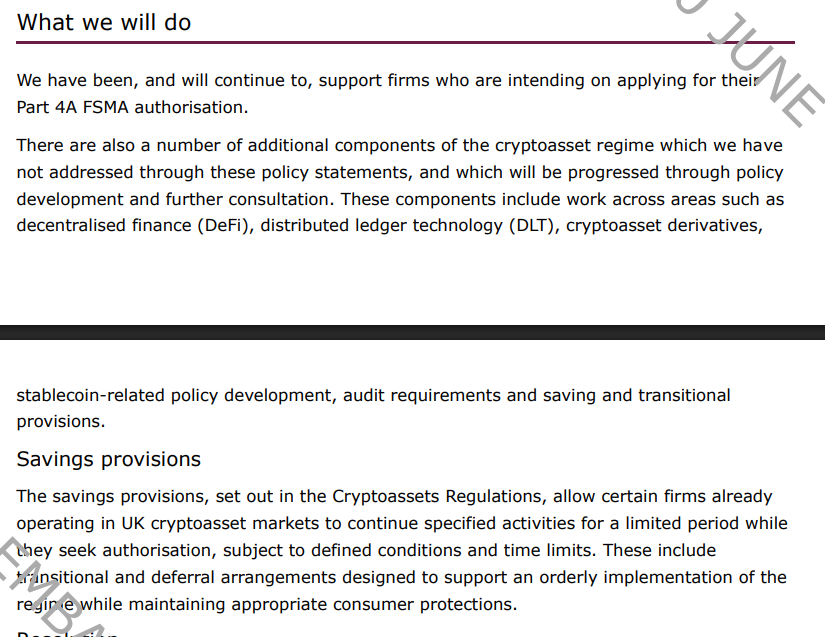
The FCA plans to elaborate on its overarching policy statements during an upcoming industry webinar scheduled for July 17. Furthermore, the regulator will publish an additional policy statement in September designed to clarify precisely how the regulatory perimeter applies to specific cryptoasset activities.
FCA Simplifies Stablecoin Capital Standards, Promises Tailored DeFi Guidance
In refining its policy positions, the FCA has maintained the core structure of its stablecoin framework while introducing several minor, practical adjustments. These updates include simplifying the backing asset composition requirements by removing the previous mandate for estimated redemption forecasts. Additionally, the revised guidelines introduce clearer requirements for statutory trusts over reserves and remove provisions relating to unallocated backing fund accounts.
Under the finalized guidelines, stablecoin issuers will be required to offer specific, robust withdrawal rights to their users. The rules also permit a 5-percent excess to be held within the backing asset pool and allow for limited intragroup custody arrangements, provided that strict operational safeguards are maintained.
The FCA noted that these provisions establish a baseline regime for stablecoin issuance. The regulator added that it intends to consult closely with the Bank of England later this year to determine how the central bank’s rules will apply to stablecoin issuers that are formally recognized as systemic by HM Treasury.
Looking ahead to the remainder of the year, the regulator confirmed it will host a separate consultation dedicated to decentralized finance guidance, alongside operational resilience guidelines for firms utilizing distributed ledger technology. The agency also plans to consult on vital updates to its Financial Crime Guide that are relevant to crypto asset businesses.
Matthew Long, director of payments and digital assets at the FCA, underscored the regulator’s measured and deliberate approach to emerging sectors. "We’re going to continue to work on DeFi," Long said, explaining that the agency is pursuing a case-by-case approach because true decentralized finance—characterized by scenarios where there is no identifiable person undertaking the activity—will naturally fall outside the operational scope of the regulation.