
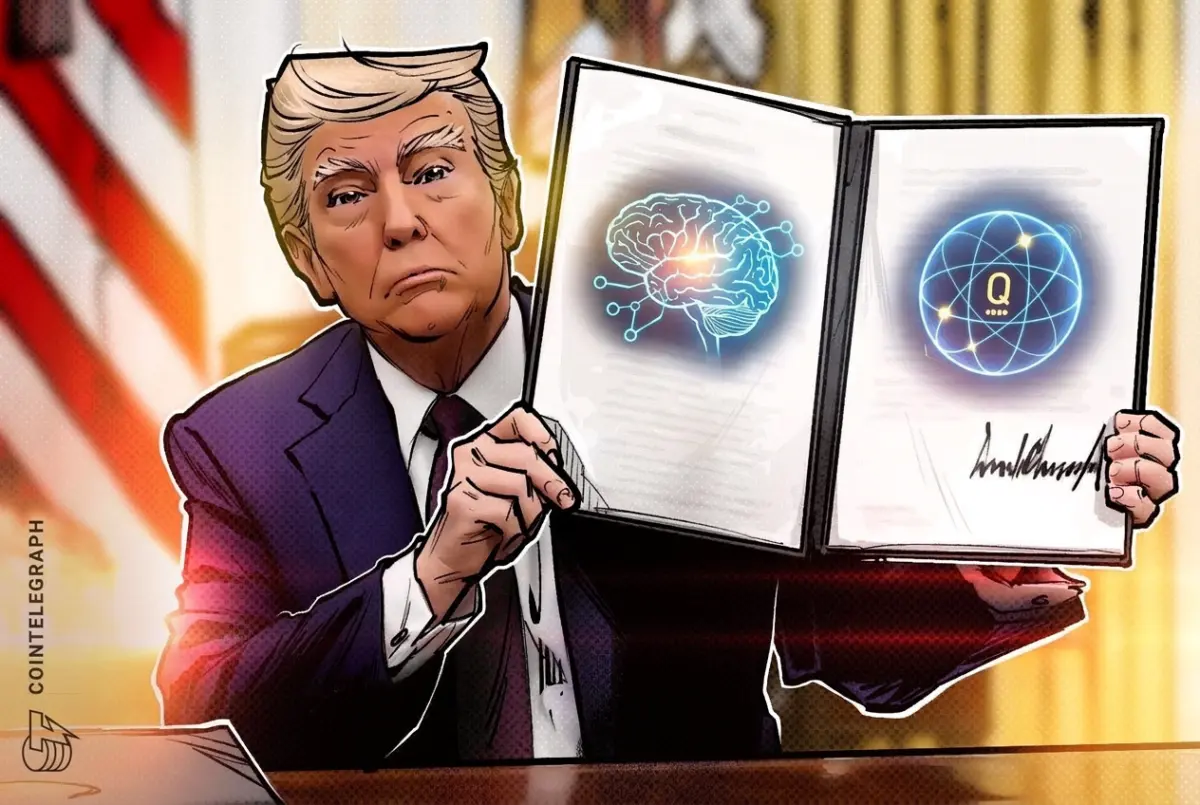
The Trump administration has officially announced a sweeping package of over $6 billion in science initiatives, headlined by a $215 million quantum computing competition and an unprecedented $2.4 billion in industry commitments aimed at bolstering artificial intelligence tools and computational resources across federal agencies.
This major push into advanced technologies represents one of the most ambitious federal strategies of the century aimed at securing the United States’ leadership in critical scientific domains. The overarching initiative is designed to accelerate research and development in sectors that are rapidly reshaping the global technological landscape, ensuring that public-sector research institutions have access to cutting-edge tools traditionally locked behind private corporate research facilities.
As part of this broader strategy, the Department of Energy formally identified eight key scientific applications to guide its newly structured Quantum Genesis Q Competition on Thursday. This high-stakes competition offers up to $215 million in planned federal funding specifically earmarked for companies and developers working toward the creation of fault-tolerant quantum computers.
First publicly introduced in September, the funding framework relies heavily on milestone-based awards and targeted incentive prizes. These financial mechanisms are structured to reward companies that successfully demonstrate increasingly powerful, stable, and scalable quantum systems. The specific research priorities outlined by the Department of Energy span several highly technical disciplines, including chemistry, materials science, subatomic physics, and applied mathematics. By targeting these foundational fields, the administration hopes to unlock breakthroughs that could ripple across manufacturing, medicine, national security, and energy production.
However, the rapid acceleration toward fault-tolerant quantum computing also brings complex challenges, particularly regarding global cybersecurity frameworks. Advances in quantum systems could eventually have profound implications for blockchain-based assets and digital currencies that rely heavily on traditional public-key cryptography for security.
These concerns were recently underscored on September 23, when three prominent European Union financial watchdogs issued a joint warning. The regulators cautioned that the continued development and eventual maturation of more powerful quantum computers could severely undermine the cryptographic systems currently used to secure blockchains and a wide array of global financial transactions.
For many prominent cryptocurrency assets, a sufficiently powerful quantum computer could theoretically possess the processing capability to derive private keys directly from exposed public keys. If achieved, this capability would give malicious actors the theoretical ability to intercept and steal funds from digital wallets. Nevertheless, cybersecurity experts frequently emphasize an important caveat: no quantum computer capable of carrying out such sophisticated cryptographic attacks currently exists, and bridging the gap between theoretical physics and functional quantum hacking remains a formidable engineering hurdle.
In tandem with the quantum computing push, the White House announced a massive influx of private-sector backing for artificial intelligence research within the federal government. Eleven major technology companies have collectively pledged an astounding $2.4 billion in advanced AI tools and compute credits designed to directly support cutting-edge research and operational modernization at 15 different federal agencies.
The scale of these industry commitments highlights the growing collaboration between the federal government and private technology giants. Leading the charge is semiconductor giant Nvidia, which has committed $1 billion in AI-related resources. Rival chipmaker AMD followed closely with a $500 million pledge, while artificial intelligence pioneer OpenAI contributed $200 million. Rounding out the major private-sector commitments are Anthropic and Google, both of which have pledged $150 million each in tools and compute credits.
These substantial resource injections are intended to empower federal agencies to tackle complex data analysis, streamline regulatory reviews, enhance scientific modeling, and modernize aging technological infrastructure without placing an undue direct financial burden on taxpayers.
As these federal programs begin to take shape, the convergence of quantum computing acceleration and massive artificial intelligence resource sharing marks a pivotal moment for national science policy, setting the stage for a highly competitive and technologically transformative era.