As organizations race to integrate artificial intelligence into daily workflows, a silent transformation is taking place across corporate networks. Right now, there is a strong statistical probability that an AI agent is running on an unmonitored laptop somewhere within your enterprise infrastructure. These autonomous or semi-autonomous programs often store sensitive API keys, database passwords, and high-privilege credentials. They maintain deep access to internal enterprise systems, and they execute tasks constantly without human supervision, review, or administrative oversight.
Nobody reviewed the access rights granted to these tools. In many cases, nobody even formally owns them.
If a human employee possessed that level of unrestricted network reach with such minimal oversight, corporate security teams would immediately classify it as a critical insider risk. Yet, organizations routinely label these identical capabilities as productivity tools. While the broader cybersecurity conversation largely focuses on how external threat actors manipulate artificial intelligence for sophisticated cyberattacks, the more immediate and insidious threat may already be operating quietly from within the organization.
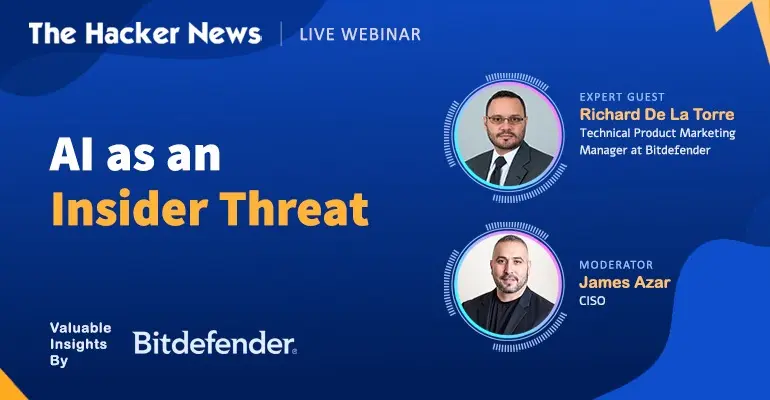
To address this emerging paradigm, security experts are drawing attention to the unseen expansion of autonomous software. Addressing this vulnerability requires shifting the perspective from viewing AI strictly as an external threat vector to confronting it as a foundational internal security challenge. A specialized webinar titled "AI as an Insider Threat: From Shadow AI to Governed AI," featuring expert guest Richard De La Torre, Technical Product Marketing Manager at Bitdefender, is bringing this issue to the forefront, offering a practical security playbook designed to help organizations bring unseen artificial intelligence under administrative control.
Where AI is Hiding on Your Endpoints
The proliferation of artificial intelligence within modern enterprises extends far beyond specialized software developers or data science teams. Today, AI agents, advanced coding assistants, Model Context Protocol (MCP) servers, and specialized browser extensions are quietly embedding themselves across diverse departments and business units.
Crucially, the vast majority of these tools never cross the traditional network gateway in a manner that legacy security monitoring tools are designed to recognize. Traditional perimeter defenses, firewalls, and standard endpoint detection systems often fail to flag the subtle installation of local browser extensions or command-line AI assistants operating under user-level permissions.
This creates a stark and dangerous irony within modern enterprise security architectures. The artificial intelligence applications that possess the deepest access to internal systems, source code repositories, and corporate credentials are frequently the exact tools that the central security operations team cannot see. Without visibility, security teams operate in the dark, unable to enforce data loss prevention policies or audit how sensitive corporate information is being processed and stored by local algorithms.
The Visibility Gap, By the Numbers
The scale of this enterprise blind spot is supported by recent industry data. According to Bitdefender’s 2026 Cybersecurity Assessment report, a mere 51.8 percent of organizations report having full visibility into the various artificial intelligence tools utilized by their staff. That leaves nearly half of all surveyed enterprises operating without a complete picture of the AI workloads active on their endpoints.
This widespread lack of visibility carries a measurable financial and operational cost. Research conducted by IBM reveals that approximately 20 percent of organizations that suffered a data breach or security compromise traced the root cause back to shadow AI—unauthorized and unvetted artificial intelligence applications deployed outside the purview of IT departments.
These statistics highlight an urgent operational dilemma for cybersecurity leaders: what can resource-constrained organizations realistically do about software they cannot even see? Practical answers to this question form the core of ongoing industry research, emphasizing that lean security teams require actionable frameworks to discover and manage the AI workloads proliferating across their corporate footprint.
From Shadow AI to Governed AI
Recent investigative research conducted by Bitdefender Labs sheds light on the actual software and scripts running on enterprise endpoints based on real-world machine telemetry. Among the more alarming findings is the discovery of malicious agent skills caught active in the wild, demonstrating that cybercriminals are actively weaponizing the ecosystems surrounding AI developer tools and extensions to compromise corporate endpoints.
When confronted with the widespread adoption of unauthorized technology, the knee-jerk reaction for many corporate IT departments is to implement absolute blocks. However, attempting to outright block all artificial intelligence tools almost invariably fails. Employees facing rigid restrictions frequently resort to workarounds, utilizing personal devices, web-based interfaces, or unapproved shadow channels to maintain access to tools they view as essential to their daily productivity.
The viable alternative to prohibition is governed adoption. Rather than attempting to stifle innovation through impossible bans, security leaders must establish frameworks that provide visibility, risk assessment, and policy enforcement while allowing employees to leverage safe, approved AI capabilities. Industry discussions and technical briefings are increasingly focusing on what this governed approach looks like in practice, moving organizations away from risky shadow deployments and toward secure, transparent utilization.
The artificial intelligence applications already operating on corporate endpoints will not wait for formal enterprise policies or lengthy security reviews to be finalized. Addressing this challenge requires immediate awareness and structured intervention. Security professionals and IT leaders seeking to understand the full scope of the problem and discover actionable remediation strategies can explore these concepts further through expert-led sessions examining how to transform shadow AI into a securely governed enterprise asset.