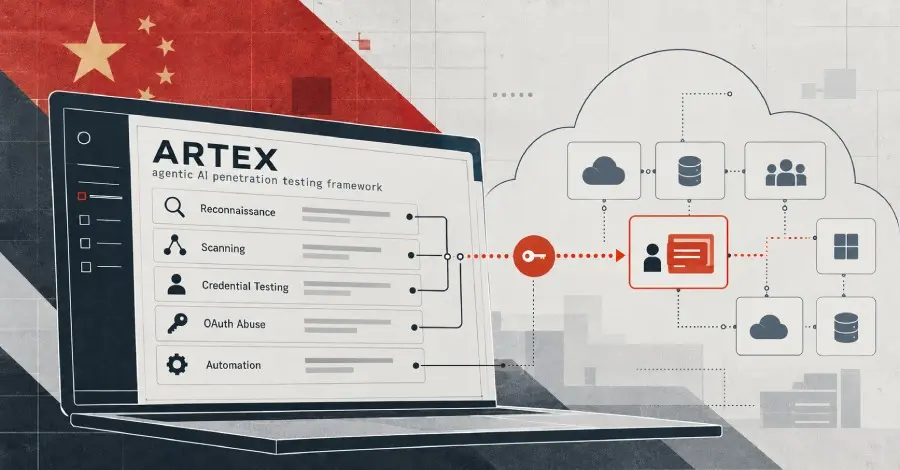
Microsoft has officially disclosed that a China state-aligned cyberespionage group identified as Storm-0940 orchestrated the recent supply chain compromise affecting the ConnectWise Cloud Backup application. According to telemetry and analysis released by the technology giant, the threat actor leveraged an advanced, agentic artificial intelligence penetration testing framework to execute automated reconnaissance, password-spraying operations, and OAuth application abuses at an unprecedented scale and velocity.
The campaign, which has been unfolding at "machine speed" since September 2026, has targeted hundreds of organizations globally across a remarkably diverse range of industry sectors. Among the impacted verticals are aerospace and defense, automotive, chemicals, energy, financial services, government, legal, manufacturing, media, military, semiconductors, software, technology, think tanks, and non-profit organizations. Security analysts note that the integration of automated artificial intelligence agents into offensive cyber operations fundamentally alters the threat landscape, allowing sophisticated state-sponsored adversaries to compress the timeline from initial network probing to deep system compromise down to a matter of hours.
The weaponization of the ARTEX framework represents a significant technological leap in how advanced persistent threat groups operate. ARTEX, a Go-based agentic AI penetration testing framework, originally gained notoriety within the cybersecurity community when it was used to target financial institutions in South Korea. Following those early incidents, developers and security maintainers pushed to make the framework closed-source in an effort to curb its malicious abuse. However, state-aligned actors like Storm-0940 have continued to leverage existing iterations or proprietary adaptations of the tool to automate complex, multi-step cyberattacks without requiring human intervention for every tactical decision.
Microsoft’s security advisory emphasized that Storm-0940’s utilization of ARTEX dramatically accelerated the speed at which compromised application credentials could be abused. By leveraging applications that had already been granted pre-existing access tokens, the threat actor was able to authenticate directly into target environments. This operational methodology allowed the adversary to bypass interactive user sign-in requirements, thereby reducing friction and evading traditional behavioral tripwires designed to flag anomalous manual logins. Once inside the cloud environments, the AI-accelerated follow-on activities immediately kicked in, executing rapid network reconnaissance, modifying application credentials, and attempting privilege escalations to secure persistent, long-term access.

Storm-0940 is far from a newcomer to the global threat landscape. The adversary was initially documented by Microsoft in November 2024, when researchers revealed that the group had been aggressively deploying a resilient botnet known as Quad7, also referred to as CovertNetwork-1658, to execute highly evasive password-spraying attacks against internet-facing applications. Intelligence assessments indicate that this specific threat cluster has been actively conducting espionage operations since at least 2021. Over the years, the group has refined its tactics, transitioning from basic botnet-driven credential harvesting to exploiting edge infrastructure and ultimately integrating autonomous artificial intelligence agents to orchestrate complex supply chain intrusions.
The standard operational cycle for Storm-0940 typically begins with the exploitation of vulnerable internet-facing applications to establish initial footholds. Once inside, the adversary pivots using compromised accounts to traverse targeted corporate and governmental networks. To ensure long-term persistence, the group has frequently been observed adding rogue credentials to existing OAuth applications within compromised cloud infrastructures, effectively securing a stealthy backdoor into Microsoft 365 resources and related enterprise productivity suites.
The integration of ARTEX into these workflows has yielded alarming efficiency for the hacking collective. Microsoft reports that a significant portion of these AI-driven intrusions successfully resulted in the adversary gaining highly privileged access to an organization’s core cloud infrastructure. In several recorded instances, the entire operational kill chain—spanning from the initial targeting phase to the acquisition of full administrative privileges—was compressed into a window of less than three hours.
The ConnectWise Cloud Backup incident serves as a textbook example of this automated aggression. During the early stages of the attack, Storm-0940 deployed ARTEX to launch massive, high-frequency authentication floods. The AI agents attempted to sign in to more than 2,250 separate enterprise tenants at a staggering rate of approximately 2,900 sign-in attempts per minute. Microsoft researchers noted that this extreme operational velocity leaves defenders with an exceptionally narrow window of opportunity to detect, isolate, and respond to the intrusion before administrative barriers are breached.
Between October 10 and October 14, 2026, telemetry data traced the Storm-0940 infrastructure back to a specific IP address, 144.172.64[.]99, from which an automated cross-tenant password-spray campaign was launched. This targeted wave focused on 327 specific accounts spread across eight distinct organizations, all aiming to compromise Microsoft 365 and Exchange Online environments. Over this four-day window, Microsoft’s monitoring systems captured more than 151,000 failed logon events originating from the malicious infrastructure.

The assault reached its apex on October 11, when the automated systems hammered target networks with 2,900 failures per minute, accumulating over 111,000 failed attempts within a single 24-hour period. During this peak activity, at least 48 individual user accounts absorbed more than 1,000 failed login attempts each. Despite the overwhelming volume of traffic, Microsoft confirmed that no successful authentications, token issuances, Graph API calls, or unauthorized directory modifications were detected during this initial brute-force phase.
The dynamic of the attack shifted dramatically on October 15, 2026. On this date, the autonomous AI agents successfully acquired the identities and access credentials of multiple ConnectWise cloud applications. Rather than relying solely on brute-force password spraying, the ARTEX framework began utilizing these legitimate, stolen application credentials to authenticate directly into downstream customer environments. By leveraging the pre-established trust that these administrative applications already held within corporate tenants, the threat actor effectively bypassed standard perimeter defenses.
Following this successful authentication phase, the AI agents operating on behalf of Storm-0940 transitioned to deeper internal operations. Operating through the same IP ranges, the autonomous agents executed Microsoft Graph queries and directory-level operations. Their objectives included comprehensive internal reconnaissance, application credential modifications designed to establish secondary persistence mechanisms, and unauthorized adjustments to user identities, security groups, and privileged administrative roles.
Microsoft warned that the application credential modifications performed by Storm-0940’s automated agents in victim environments are particularly dangerous. These changes can successfully establish persistent backdoors through alternate identities, secondary credentials, and connected cloud services that remain fully active and functional even after the initial compromised application is remediated or revoked by administrators.
While Storm-0940 has become a prominent adopter of the ARTEX framework, Microsoft’s intelligence indicates that this tool is not exclusive to a single threat actor. Security researchers have observed multiple distinct hacking groups across various geographic regions weaponizing the same framework to optimize their own offensive security operations and streamline large-scale data exfiltration campaigns.

The broader implications of these developments underscore a fundamental paradigm shift in cyber warfare. Security analysts point out that threat actors are rapidly moving past traditional, manual hacking methods, choosing instead to embed agentic AI tools directly into their offensive workflows. Unlike human operators, AI agents are entirely unconstrained by biological limitations; they can operate continuously around the clock, executing complex maneuvers across weekends and holidays, and testing multiple breach paths simultaneously. This capability drastically reduces the time required to transition from target selection to objective completion, compounding the severity of sophisticated supply chain attacks.
In the wake of Microsoft’s disclosures, ConnectWise issued a formal statement emphasizing that the campaign reaches far beyond the footprint of any single software vendor. The company highlighted that modern state-sponsored adversaries are deliberately focusing their efforts on the software supply chain because a single compromised, trusted connection can instantly open the door to hundreds or thousands of downstream organizations.
ConnectWise noted that artificial intelligence has fundamentally altered the economics of cyber attacks, enabling threat actors to probe interconnected software supply chains at machine speed. Managed Service Providers occupy a particularly precarious position in this ecosystem, acting simultaneously as direct targets and as open pathways into every client organization they serve. Consequently, technology vendors and service providers alike are being urged to recalibrate their defensive strategies to account for the velocity and autonomy of AI-driven adversaries.
In response to the security breach, ConnectWise temporarily shut down affected services to contain the threat and initiate forensic investigations. The company has since been engaged in a phased restoration process designed to bring systems back online securely, an undertaking that leadership noted will require several days to complete thoroughly across all platforms.