
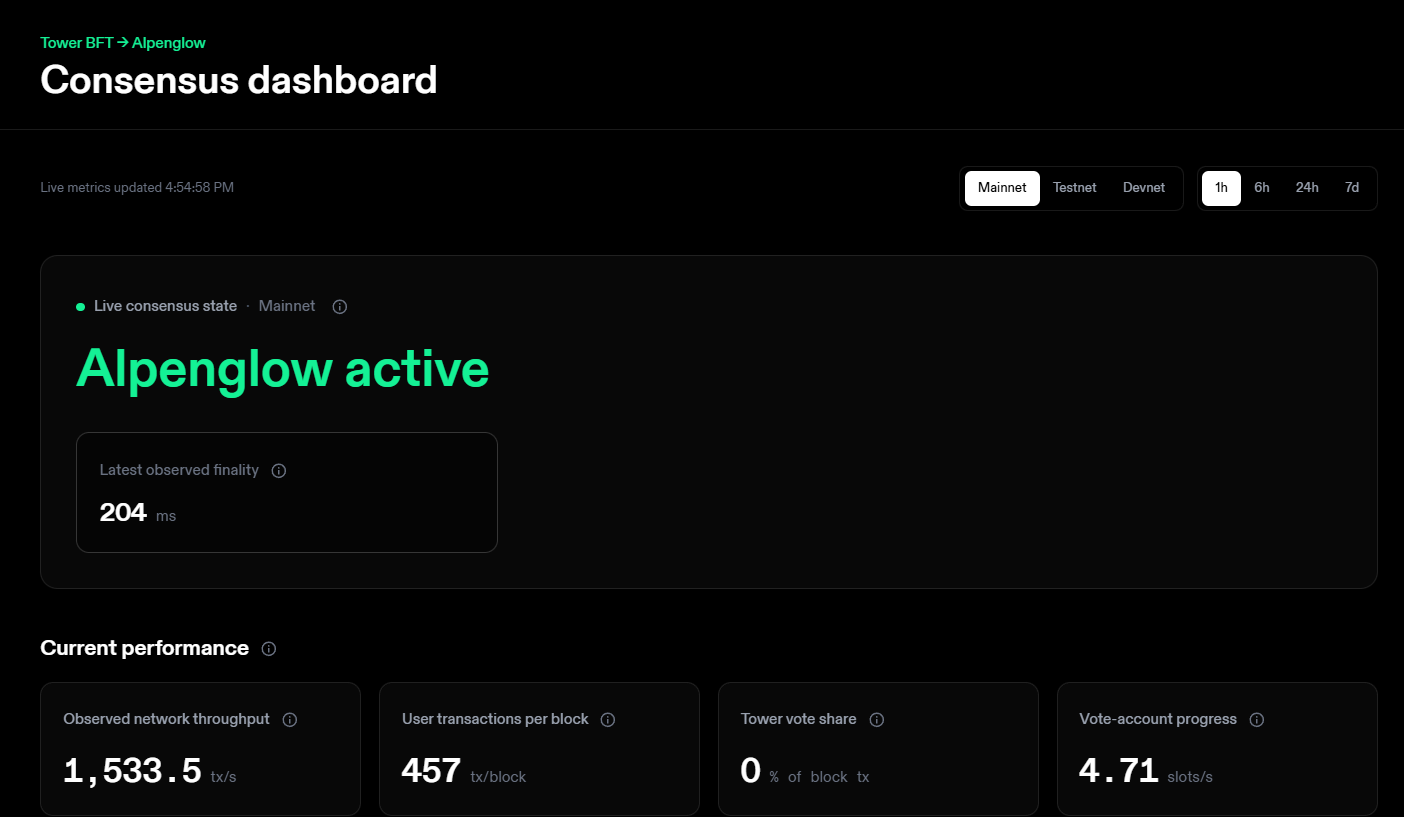
Solana has officially launched Alpenglow, marking the network’s first major consensus upgrade since its genesis block. According to the Solana Foundation’s Alpenglow activation dashboard, the upgrade went live on the mainnet on Wednesday at approximately 1:54 pm UTC.
The deployment of Alpenglow represents a monumental milestone for the high-performance layer-1 blockchain. The overarching objective of the upgrade is to slash transaction finality by an extraordinary 99%, dropping wait times from roughly 12.8 seconds down to a blistering 150 milliseconds. This ambitious target was first detailed by the Solana Foundation in an official announcement back in July, setting the stage for what developers and researchers hope will bridge the performance gap between decentralized blockchain infrastructure and traditional Web2 systems.
At the heart of this transformation is a multi-phase technical roadmap. The first phase of the upgrade, known as Votor, has now replaced Solana’s existing voting and finalization mechanism. Votor introduces a direct validator voting structure alongside a certificate-based system specifically engineered to achieve near-instantaneous transaction finality. By cutting finality down to roughly 150 milliseconds, the network aims to provide users with near-immediate confirmation. In practical terms, this dramatic speed enhancement could translate into fundamentally superior user experiences across the ecosystem, enabling faster digital payments, instantaneous trade settlements, and vastly more responsive decentralized applications.

Alpenglow fundamentally replaces Solana’s longstanding consensus model, TowerBFT. While the initial phase focuses on restructuring validator communication and finalization through Votor, a subsequent phase of the Alpenglow upgrade cycle will introduce Rotor. Rotor is designed as a new block data-distribution protocol intended to ultimately replace Turbine, further optimizing how data propagates across the globally distributed network of validators.
As the cryptographic and validation community digests the immediate aftermath of the mainnet launch, observers are closely monitoring network metrics. At press time, initial data retrieved from the Alpenglow dashboard indicated that the Solana mainnet was operating with a transaction finality of roughly 6.6 seconds and processing a throughput of 4,721 transactions per second. Cointelegraph has reached out to the Solana Foundation for further comment regarding Alpenglow’s finality measurements observed in preceding testnet environments, as well as projections for how these performance metrics will scale under heavy real-world application loads.
Alpenglow Marks ‘Biggest Change’ for Solana’s Core Protocol: Anza
The magnitude of the Alpenglow deployment has been widely acknowledged by core developers and research entities within the ecosystem. Back in May, researchers from Anza—an independent development shop spun out of Solana Labs—published a detailed blog post characterizing Alpenglow as introducing the "biggest change to Solana’s core protocol" since the network’s inception.
Authored by Anza researchers Quentin Kniep, Kobi Sliwinski, and Roger Wattenhofer, the May publication emphasized the paradigm-shifting nature of sub-second finality. The researchers wrote that achieving a 150-millisecond latency allows "Solana to compete with Web2 infrastructure in terms of responsiveness, potentially making blockchain technology viable for entirely new categories of applications" that previously required the centralized speed of traditional tech stacks.
This architectural evolution arrives on the heels of several other aggressive performance-tuning initiatives spearheaded by the Solana Foundation and core engineering teams. In August, Solana successfully reduced its slot time for the first time since genesis. That milestone was part of a broader, phased initiative by the Solana Foundation to systematically halve slot times down to 200 milliseconds, a move championed by developers as a vital step toward reducing latency and accelerating overall confirmation speeds across the network. The fourth and final stage of that slot-reduction plan was successfully completed in October.
Looking ahead, the roadmap for Solana validators remains packed with upcoming protocol improvements. Following the integration of Alpenglow, developer focus is expected to pivot toward Agave 4.5, an upcoming upgrade that proposes increasing the number of accounts supported by a single versioned transaction from 64 to 96. According to the Solana Foundation, this enhancement could facilitate better swap routes and more competitive execution prices for decentralized finance users. The Agave 4.5 upgrade is currently in active development, with a mainnet rollout planned for December.
Against this backdrop of rapid technical evolution, the market performance of Solana’s native token, SOL, has shown positive momentum. In the 24 hours leading up to the Alpenglow mainnet activation, the price of SOL rose by nearly 3%. This short-term uptick helped offset a portion of the broader 42% downward price correction the asset experienced over the preceding year, according to data from CoinMarketCap.