
A novel security infrastructure introduced by Phylax aims to transform how decentralized finance (DeFi) protocols handle malicious transactions, offering a proactive defense mechanism designed to stop harmful exploits before they settle on the blockchain. While the technology promises to bolster crypto defenses against sophisticated threats—including state-sponsored hackers and United States-sanctioned actors—it has simultaneously ignited a fierce debate within the blockchain community over centralization risks, censorship potential, and the concentration of power within Ethereum’s block-building market.
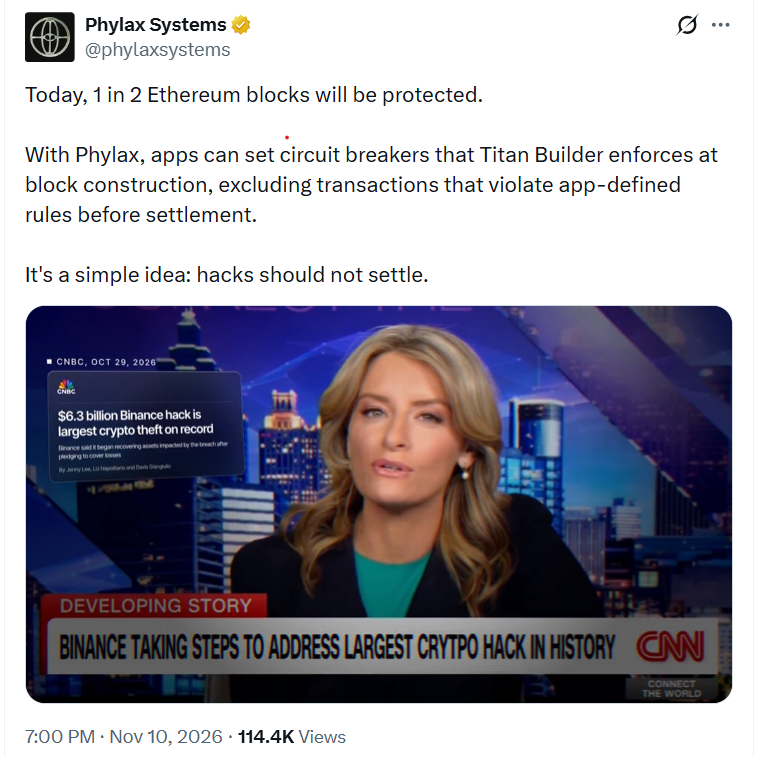
Announced on Nov. 10, the new system is built on an integration between Phylax and Titan Builder, a prominent block builder that accounts for approximately one out of every two Ethereum blocks. Through this collaboration, Ethereum applications are empowered to define specific rules that automatically exclude transactions likely to produce harmful outcomes during the block construction phase.
Unlike traditional security monitoring systems or emergency interventions deployed after an attack has already commenced, Titan checks incoming transactions against these pre-defined rules prior to including them in its blocks. The fundamental mission behind the system is straightforward: to stop users from losing money to hacks, exploits, and human errors in DeFi.
In an explanatory blog post, Phylax illustrated the utility of the system using a hypothetical scenario involving a vulnerable lending vault. Under normal circumstances, a bug could mistakenly release $1 million to a user whose collateral shares are only worth $1,000. With the Phylax system in operation, a built-in circuit breaker could cap the amount leaving the vault in a single transaction, effectively preventing the protocol from being completely drained.
Advocates argue that similar safeguards could have limited the devastating financial damage seen in recent major exploits, such as the $6.3 billion Binance hack or the $380 million Bitget exploit, where malicious actors successfully drained exchange wallets and leveraged decentralized protocols to launder and move massive amounts of cryptocurrency.
A Security Mechanism with a Potential Freeze Risk
Despite its potential to mitigate catastrophic losses, the system has drawn sharp criticism from legal and technical experts over unintended side effects. Digital assets lawyer Gabriel Shapiro warned that applications integrating the system could become effectively freezable if block builders suddenly stopped providing the required cryptographic attestations.

Shapiro explained that smart contracts can be configured to reject transactions unless they are included in blocks produced by builders that have successfully performed the mandatory security checks. If those builders were to halt or withhold their attestations, protected functions could continuously reject legitimate transactions until the builders resumed normal operations.
In response to these concerns, Phylax founder and chief executive Odysseas Lamtzidis noted that protocols can actively avoid this risk by designing their systems to allow transactions to go through even when the security checks are unavailable. The sane default provided and suggested to protocols is a fail-open behavior, according to Lamtzidis.
However, that safeguard remains optional rather than mandatory, leaving individual protocols to decide how much priority they wish to assign to security versus availability. Some protocols might naturally choose to prioritize safety over liveness, Lamtzidis acknowledged. He also pointed out that protocols retain the autonomy to decide whether their smart contracts are immutable or subject to future modifications through governance.
Shapiro has argued that fail-open protections should ideally be mandatory, and any subsequent changes to these safeguards should be subjected to strict time delays to prevent protocols from removing essential protections on short notice.
Ethereum’s Builder Concentration Problem
Beyond the immediate mechanics of the circuit breakers, the technology has brought broader structural concerns about Ethereum back into the spotlight. Specifically, critics question whether the system risks reinforcing Ethereum’s already heavily concentrated block-building market.
Fan Zhang, an Ethereum researcher, noted that Phylax’s technology is only becoming practical today because of that existing market concentration. The industry finally has a way to implement this effectively, Zhang observed, but added that it is a bittersweet reality driven entirely by how centralized Ethereum’s builder market has unfortunately become.
While acknowledging that Phylax’s approach brings appealing security benefits—particularly in an era where AI-driven bots can identify and exploit smart contract vulnerabilities faster than ever—Zhang warned that introducing complex code at such a critical juncture in transaction processing introduces novel failure modes. These risks include potential implementation errors as well as vulnerabilities related to builder signing-key theft, loss, or impersonation.
The community is actively concerned about centralized builders and is making concerted efforts to address them, Zhang added. Consequently, he worries that introducing localized security systems dependent on dominant builders might inadvertently undermine broader decentralization efforts.
Echoing these
sentiments, Ethereum researcher Sen Yang noted that if major protocols begin relying heavily on a small group of builders for security enforcement, it could grant those builders an unfair competitive advantage, further exacerbating market concentration. Yang pointed out that Ethereum’s proposed enshrined proposer-builder separation upgrade, slated for inclusion in the upcoming Glamsterdam upgrade, may reduce systemic reliance on third-party relays, but it does not directly resolve the underlying issue of builder market concentration. Nevertheless, Yang noted that transactions excluded by dominant builders could theoretically still be processed by non-censoring builders, resulting in temporary transaction delays rather than permanent exclusion.
Where Does Security Become Censorship?
A central point of contention in the ongoing debate is the blurry line separating robust protocol security from systemic censorship. Phylax maintains that its system does not introduce a novel centralized authority over Ethereum transactions because the applications themselves independently define the filtering rules. Lamtzidis emphasized that the technology is explicitly opt-in and functions no differently than a standard conditional require statement written directly into a smart contract’s code, asserting that true censorship requires arbitrary decision-making or external coercion.
Zhang drew a similar philosophical distinction between applications voluntarily choosing to filter transactions and external entities forcing censorship upon an unwilling network. Applications willingly signing up for filtering is generally acceptable because a user always retains the freedom to walk away from those specific applications, Zhang explained. Externally forced censorship is where the real problem lies, and that is where the definitive line must be drawn.
Stefanie Boss, co-author of recent academic research examining censorship resistance and compliance behavior within Ethereum’s consensus mechanism, suggested that rules targeting a transaction’s outcome are inherently less concerning than rules targeting the identity of the person making the transaction. In this case, the mechanism is result-driven, which is widely considered less risky, Boss noted.
Boss considers the overarching security objective to be entirely legitimate, arguing that the collective financial harm caused by large-scale hacks far outweighs the potential harm introduced by this type of targeted exclusion. At the same time, she cautioned that identical technical rules could theoretically be repurposed in the future to enforce government sanctions or politically motivated exclusions. It remains vital to ensure that proper governance and technical safeguards are maintained so these rules remain fair and strictly dedicated to security, she concluded.