
For a long time, the prevailing narrative surrounding onchain foreign exchange has operated on a top-down model. Under this traditional assumption, the future of blockchain-based currency exchange begins with legacy banking institutions tokenizing sovereign currencies, moving their extensive foreign exchange operations directly onto public or private distributed ledgers, and allowing institutional liquidity to naturally follow.
The ultimate end result of this top-down vision would be a blockchain-based foreign exchange ecosystem that eventually grows large enough to closely resemble its multi-trillion-dollar traditional counterpart. However, according to Michael Egorov, founder of decentralized finance protocols Curve Finance and Yield Basis, that is not necessarily how the market is going to evolve. In fact, a growing body of evidence suggests that onchain foreign exchange is developing in the exact opposite direction—rising organically from the bottom up.
This bottom-up evolution is already visible across various decentralized platforms where local and alternative stablecoins are actively utilized. Digital assets such as Brazilian Digital (BRZ) or Monerium’s euro-backed stablecoin (EURe) can be rapidly redeemed onchain and seamlessly moved back and forth between digital cryptocurrency wallets and conventional bank accounts. These specialized tokens generate remarkably healthy trading activity as decentralized finance participants routinely swap them within decentralized exchange liquidity pools.
Markets of this nature end up developing in real time around an immediate, highly practical user need: the necessity
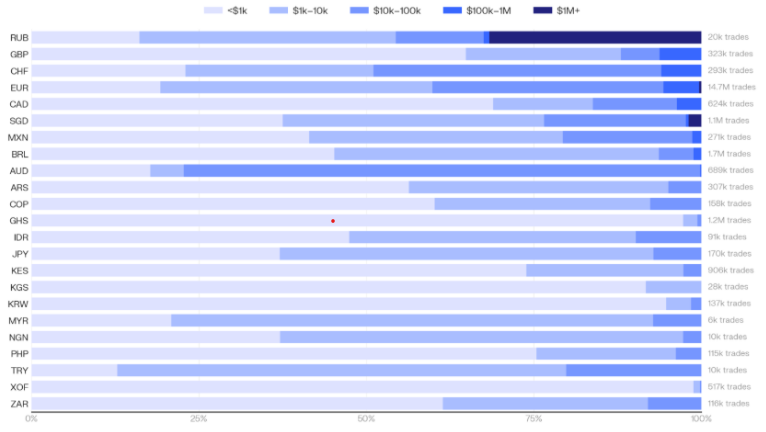
to move directly between digital currencies and traditional fiat money without friction. While this phenomenon remains an early-stage example of a broader financial shift, the underlying use cases and economic demands are entirely genuine. Recent data published by market maker Keyrock illustrates that the vast majority of onchain stablecoin trades tied to emerging market currencies typically fall within the $1,000 to $10,000 range.
Admittedly, these figures represent modest sums when compared directly against institutional-scale foreign exchange volumes. Yet, that reality is precisely the point. It demonstrates how the broader market is naturally building in the direction of onchain foreign exchange to meet authentic, everyday payment needs rather than merely serving massive macro traders or speculative hedge funds.
When examining these trends, Egorov emphasizes that "small" is fundamentally different from "useless." Individuals and modern businesses constantly need to move their capital efficiently between different national currencies, and they are clearly demonstrating that they are no longer content to patiently wait for major traditional finance institutions to transition their slow, legacy foreign exchange operations onto modern blockchain rails.

There exists a pervasive assumption within traditional financial circles regarding onchain foreign exchange: the belief that a market requires immense, deep liquidity before it can become genuinely useful to the broader public. In practical, everyday application, however, that traditional assumption simply does not hold true. If there is genuine economic demand from a participant who urgently needs to exchange United States dollars into euros, Swiss francs, or any other alternative currency, even a relatively modest liquidity pool can successfully process those transactions and serve a profoundly real economic purpose.
Onchain foreign exchange does not need to become massive before it achieves practical utility. Instead, it can grow robustly precisely because everyday people and businesses are actively utilizing it to solve real-world problems. As a matter of fact, this organic trajectory closely mirrors the historical evolution of standard dollar-pegged stablecoins. They initially began as a relatively niche, crypto-native use case utilized primarily within specialized trading circles, yet today they form an integral, widely recognized part of a much broader global financial infrastructure.
Recent data shared by blockchain analytics firm Chainalysis underscores this rapid expansion, revealing that cross-border stablecoin activity surged to over $220 billion by the middle of 2026. That impressive milestone represents an almost 80% growth rate over the course of a single year, providing concrete empirical proof that genuine economic demand and transactional activity are constantly on the rise across decentralized networks. There is no fundamental reason why onchain foreign exchange cannot follow a remarkably similar path of adoption.
From the perspective of everyday users, the practical reality is that consumers generally do not care how big an entire market is in the aggregate; they care whether a specific tool solves their immediate problem. Onchain foreign exchange will obviously not be in a position to directly compete with the entire multi-trillion-dollar global traditional foreign exchange market anytime soon, as that milestone remains years away from mainstream realization. But the far more compelling and immediate question is what specific financial problems onchain rails can solve for someone who already maintains capital within the decentralized ecosystem.
In the current financial landscape, a user can effortlessly exchange a dollar-pegged stablecoin into a euro-backed stablecoin—or another digital alternative—directly onchain and subsequently utilize those funds for commercial payments with remarkably little operational friction. In practice, executing financial transfers in this manner is frequently faster and significantly less expensive than relying on a classic international bank transfer through traditional wire services.
The exact same logical framework applies directly to modern fintech platforms and crypto-card issuers. These agile companies do not need to recreate the entire complex institutional foreign exchange market from scratch; what they desperately require is a mechanism to move their customers’ funds efficiently and cost-effectively between different sovereign currencies. When an individual attempts to make a purchase in a foreign currency using traditional payment cards, the currency conversion process invariably adds significant costs to the operation. This is because traditional transactions typically involve legacy payment processors like Visa or Mastercard, which routinely levy processing fees hovering around 1% of the transaction value.
Onchain currency exchanges represent a vastly superior alternative in these scenarios. If a user’s funds are already residing natively on blockchain infrastructure, swapping United States dollar stablecoins into euro stablecoins can be accomplished directly, bypassing any requirement to route the funds through a cascade of expensive extra intermediaries. This peer-to-peer approach is both substantially faster and noticeably less costly.
Legacy commercial banks will most likely remain vitally important entry and exit points for the foreseeable future, particularly where digital money must interface with physical, real-world banking systems. Issuing and redeeming local fiat currencies, managing physical bank accounts, and handling rigorous regulatory compliance requirements are operational domains where traditional banks will naturally take the lead. However, once capital has successfully transitioned onto the blockchain, many of the traditional in-between operational steps can be safely eliminated to achieve unprecedented financial efficiency.
From the vantage point of a standard user who simply wants to execute a cross-border financial transfer with minimal complications and low fees, this represents a profoundly positive structural improvement. How large or small the overarching global foreign exchange market happens to be matters very little to an end user who is saving both time and money on a routine transaction.
At the same time, recognizing strong underlying demand is only half of the equation. Real, organic demand is undeniably crucial for long-term survival, but it does not magically solve the persistent economic problem of liquidity provision. The primary challenge facing developers is not merely creating a euro-to-dollar or franc-to-dollar trading pool; the true test is ensuring those liquidity pools remain economically sustainable over extended periods of time.
This is precisely where automated market makers can make a transformative difference. Traditional institutional market-making firms may not always find it financially attractive to provide dedicated liquidity for smaller foreign exchange markets, as there may simply not be enough daily trading volume to justify the substantial operational and capital costs involved. Automated liquidity fundamentally changes that economic equation because software can operate continuously around the clock, providing uninterrupted market-making services without requiring a traditional financial firm to manually manage every individual trade.
Consider two prominent dollar-pegged stablecoins, such as USDC and Tether. From the perspective of a traditional, legacy financial exchange, executing a trade to move capital from one dollar stablecoin into another might appear to be a remarkably mundane and unexciting line of business. Because both digital assets are designed to maintain a stable value pegged closely to one dollar, there is very little volatile price movement to trade around for speculative profit.
However, if there remains a persistent, real-world need for market participants to smoothly switch between various stablecoins of this nature, an automated market maker can successfully establish a liquidity pool where users can execute that swap directly. Each individual trade generates a modest fee for the liquidity providers participating in the pool. When a sufficient aggregate number of people consistently require the exact same currency conversion, a viable market can thrive even if it does not look particularly flashy or exciting to a traditional institutional market maker.
This steady style of adoption cannot accurately be described as explosive, and that is entirely acceptable. There is nothing fundamentally wrong with slow, natural, organic growth within financial technology sectors. Sometimes, nascent markets simply require a dedicated, core group of participants who share a specific economic problem that existing legacy infrastructure fails to solve in an optimal manner. If those specialized users can collectively render the market economically viable, underlying liquidity can organically flourish and expand from there.
Michael Egorov is the renowned founder of Curve Finance and Yield Basis. In addition to his prominent entrepreneurial ventures in the decentralized finance sector, Egorov is a trained physicist and crypto maximalist. Having successfully transitioned from the rigorous world of academic scientific research into the fast-paced cryptocurrency industry, Egorov holds a prestigious bronze medal from the International Physics Olympiad and earned his doctoral degree specializing in ultracold atomic physics.