Not long before he passed away, my grandad said something that I thought was a little silly, a little old-fashioned, and entirely out of touch with the modern world. He declared that he simply didn’t trust the banks, and he certainly didn’t want them to know what he did with his own money. At the time, I scoffed at the notion, viewing it as the harmless paranoia of an old fella who had lived through a different era. But of course, as time has shown, it turns out I owe him a profound apology.
The realization came during a visit to his home while walking through the familiar rooms. He motioned toward an off-white wall sitting directly in front of an uncomfortably stiff sofa. This piece of singularly ugly furniture hadn’t budged an inch from that exact spot in more than a decade. The wall behind it featured a small, unassuming square door. When pushed inward, it revealed a hidden crawl space—a dusty time capsule containing packaging from the 1970s, partially gnawed board games, and various unimportant documents, all squirreled away as if they might one day be needed to stave off a harsh winter.
My grandad guided my flashlight beam toward a brown padded envelope tucked safely away near what I desperately hoped was not exposed asbestos. I retrieved the heavy envelope and handed it over to him. He seized the moment to deliver a short, heartfelt speech. He expressed genuine pride in my pursuit of a Master’s degree, acknowledging that it placed a heavy financial burden on my shoulders, and he made it clear that he wanted to help alleviate some of that pressure. Inside the envelope was a musty wad of cash, held securely together by a mostly decayed rubber band.
While his speech was deeply meaningful, what came immediately afterward was a piece of practical wisdom that took more than ten years to truly land in my mind. When I asked him why on earth he chose to hide cash inside the walls of his house, he explained calmly that the vast majority of his lifetime savings were actually hidden around the property—tucked away safely inside books, concealed deep within wardrobes, and slotted firmly under mattresses. In fact, with a characteristic touch of dark humor, he joked that when he finally died, I would need to tear the entire house apart brick by brick before it was ever put on the market.
Well, he did eventually pass away, and we did indeed examine every single crack, cavity, and hidden crevice of that house. And true to his word, we found most of his hidden savings. Some of the physical cash was so remarkably old that we genuinely worried the high street banks might refuse to exchange it for modern legal tender. At the same time, decades of relentless inflation had already quietly robbed those hidden piles of most of their underlying purchasing power anyway—serving as an early, harsh lesson in the two distinct scams of fiat currency, a topic I will gladly save for another article down the road.
My grandad grew up poor in wartime London, an experience that meant a fierce, unyielding caution regarding currency was woven directly into his DNA. In his formative years, money was fiercely scarce and hard-won. Yet, beneath his unconventional methods, his underlying philosophy was remarkably sound, and it has played continuously on my mind for years now.
The people of my grandparents’ generation were fiercely protective of their personal privacy, back in an era when privacy was still regarded as a fundamental, basic human right. I know, looking back from our current vantage point, how quaint that notion sounds.
To understand how drastically things have shifted, one only has to look back to 1950. A motorist named Harry Willcock was stopped by authorities in London, and a local police officer casually demanded to see his official identity card—an unfortunate, highly restrictive requirement that had been hurriedly introduced at the outbreak of World War II. Harry staunchly refused to brandish his papers and was subsequently arrested. During the subsequent legal battle, the lord chief justice presiding over the case made a striking observation: the wartime ID cards were clearly being utilized for governmental purposes far beyond their original, narrow scope. Consequently, the cards were scrapped.
Back in the 1950s, privacy remained the baseline expectation for most ordinary citizens. This cultural norm naturally fostered a deep suspicion of anything resembling surveillance, even though actual surveillance mechanisms were scarce at the time. Just seventy years ago, keeping tabs on citizens was rare, labor-intensive, and remarkably expensive, typically requiring an agent to physically follow a target down the street, quite possibly wearing a traditional trench coat.
Conversations, cash payments, and public transport journeys left behind no permanent digital record. Any official records that were created existed primarily on paper and, crucially, remained entirely siloed. You could not easily cross-reference disparate records across vast databases—a phenomenon that legal experts traditionally refer to as "practical obscurity."

Today, by contrast, our personal data is routinely farmed, bought, sold, and cross-referenced en masse as automated surveillance has firmly established itself as the new societal baseline. My grandad would have utterly loathed this modern way of living. He was, without ever realizing it, a true cypherpunk at heart. And those foundational values are eroding with increasing, alarming speed across the globe.
Privacy, self-sovereignty, decentralization: Before it’s too late
The intense privacy narrative that has recently bubbled to the surface of public discourse could be chalked up to numerous underlying causes, but it frequently feels like a desperate, inevitable last stand for civil liberties. Society has somehow grown so downtrodden and conditioned that basic tools designed to assist with digital privacy are routinely demonized by authorities and mainstream commentators alike.
For instance, when Ethereum co-founder Vitalik Buterin utilized a cryptocurrency mixer to donate funds anonymously to a noble cause, he faced immediate criticism laden with winks and nods, implying that he must be engaging in shady, illicit behavior simply for wanting financial discretion. Buterin simply replied with the iconic, perfectly measured statement: "Privacy is normal."
There is a persistent, damaging cultural narrative that a desire for privacy must inherently mean you have something illicit to hide. Yet, as Susie Violet Ward, CEO of Bitcoin Policy UK, once famously retorted in response to such accusations: "You have curtains in your house, don’t you?"
Eric Hughes eloquently addressed this distinction in "A Cypherpunk Manifesto," written back in 1993. He noted that privacy is entirely necessary for maintaining an open society in the electronic age. As Hughes explained, privacy is not the same thing as secrecy. A private matter is simply something that an individual does not want the entire world to know, whereas a secret matter is something one does not want a single person to know. Privacy, therefore, is the vital power to selectively reveal oneself to the world on one’s own terms.
Self-sovereignty has closely followed the same downward trajectory as privacy over the past few decades. Meaningful control over one’s own identity, personal data, and even physical property has been steadily stripped away, year after year, by both corporate giants and centralized states. Today, ordinary citizens must routinely offer up extensive identification—in a modern, digital equivalent of the authoritarian "papers, please" demand—to almost any centralized authority with which they wish to interact.
Regarding data, extensive and exhausting legal battles have carved out only a tiny sliver of control for everyday users through mechanisms like the "right to be forgotten," but even that statutory right still requires each individual person to manually request the erasure of their personal information from every single separate data holder. Likewise, when it comes to personal property, the hard-fought "right to repair" movement became strictly necessary only after manufacturers of everything from modern automobiles to personal smartphones aggressively raised the impenetrable walls of their proprietary walled gardens.
These critical issues are not the exclusive concern of the unscrupulous, and we certainly no longer need to whisper about them in hushed tones. Privacy is entirely normal, just as personal agency over the many intersecting threads of our daily lives is normal, alongside the fundamental right to a fair, pragmatically decentralized playing field.
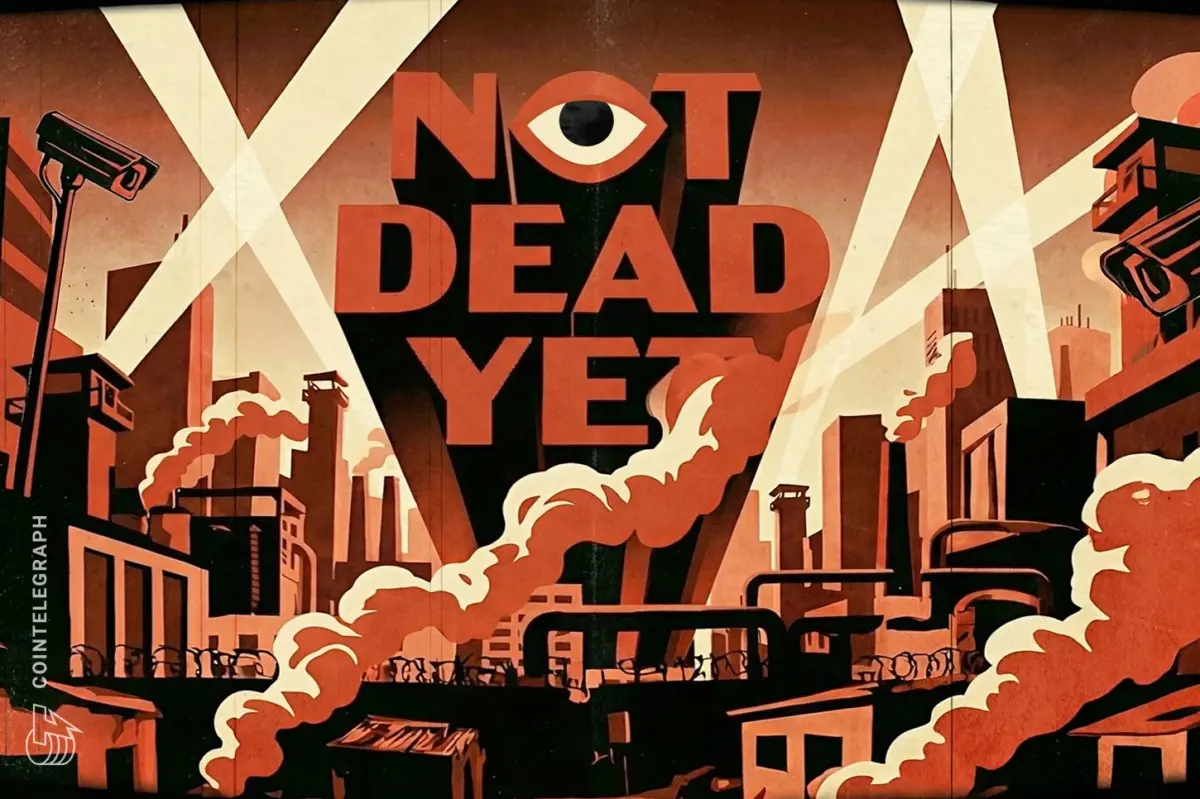
That precise reality is why Cointelegraph is launching a dedicated show centered entirely on crucial conversations concerning the ongoing erosion of these basic human rights. The program will feature discussions with bona fide experts, industry visionaries, and the builders actively engineering the tools required for a free and private digital future. It is a tailor-made show for the digital dissidents who still firmly believe in foundational civil liberties.
Because while traditional cypherpunk values may feel like they are slowly dying, they are not dead yet.
The weekly series will explore how these essential values can survive in an increasingly centralized, surveillance-oriented society, bringing together prominent figures from the worlds of cryptography, privacy, and decentralization to examine the road ahead.