New York Attorney General Letitia James has escalated the state’s legal battle against the collapsed cryptocurrency investment platform NovaTech, petitioning a state court to order the company, its founders, and associated entities to pay more than $1.3 billion. The legal move, filed on Oct. 22, builds directly upon a foundational liability ruling handed down in 2025 that established the defendants’ culpability in orchestrating a massive, multi-million-dollar financial fraud.
According to the official court filing, the state is seeking an astronomical $1,367,023,585, a figure that includes both principal disgorgement and accumulated interest. While the filing significantly advances the state’s aggressive pursuit of financial restitution on behalf of defrauded investors, officials emphasized that the filing of the demand does not establish that the total sum has been officially awarded, collected, or distributed to victims. The road to financial recovery for thousands of affected individuals remains complex and protracted.
The legal proceedings stem from a default order issued on Aug. 4, 2025, which formally found the defendants—including NovaTech and its founders, Cynthia and Eddy Petion—liable for widespread fraud. That ruling mandated investor damages and the disgorgement of ill-gotten gains, requiring the defendants to surrender money obtained through deceptive practices. However, the court deferred the final calculation of those exact monetary amounts to subsequent written submissions, culminating in the recent October filing by the attorney general’s office.
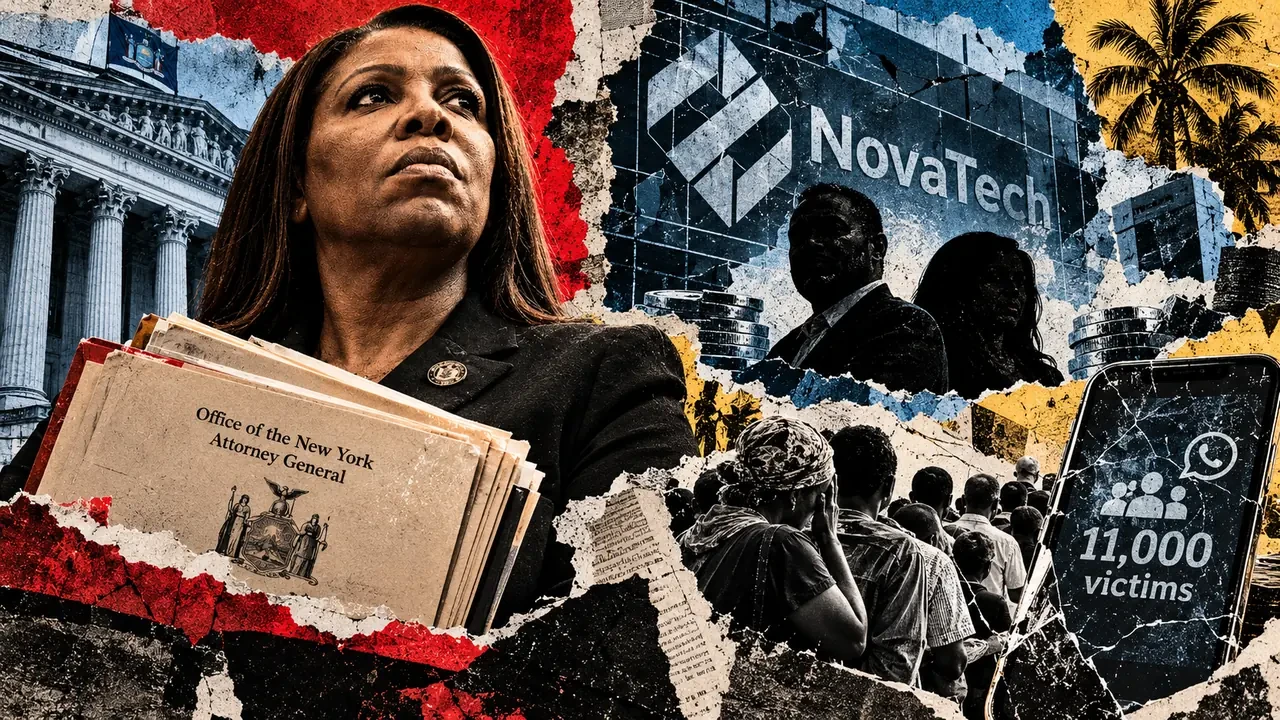
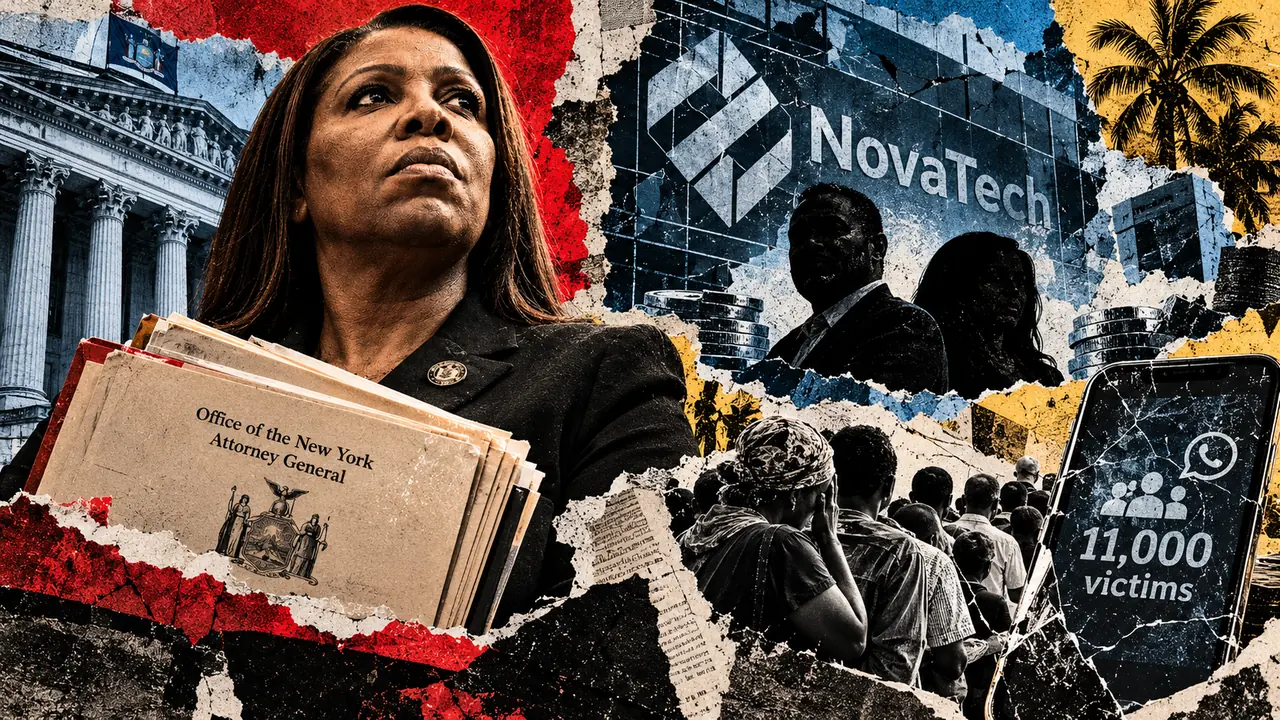
Investigations conducted by the New York Attorney General’s office revealed that more than 11,000 New Yorkers collectively lost tens of millions of dollars through NovaTech and a related enterprise known as the AWS Mining scheme. Prosecutors have detailed how the fraudulent operations deliberately preyed upon vulnerable immigrant and religious communities, focusing heavily on Haitian New Yorkers. The perpetrators utilized trusted environments such as prayer groups, alongside social media platforms and encrypted messaging applications like WhatsApp, to build false trust and lure unsuspecting participants into depositing their hard-earned savings.
State investigators uncovered the core mechanics of the operation, noting that payouts distributed to earlier investors and high-level promoters were funded directly by subsequent deposits made by newer victims, a classic hallmark of a Ponzi scheme. In its legal arguments, the state maintains that these historical withdrawals should not in any way reduce the total sum that NovaTech and its principals are legally obligated to surrender.
The state’s calculated disgorgement figure begins with approximately $1.161 billion in identified cryptocurrency deposits made by investors. From this baseline, prosecutors subtracted roughly $26 million that was actually routed to external trading platforms, resulting in a primary principal demand of $1,134,549,691. When combined with $232,473,894 in accrued interest, the total financial demand climbs to the staggering $1.37 billion mark.
Despite the scale of the legal action, tracking and returning funds to individual victims presents extraordinary logistical hurdles. The filing notes that the vast majority of deposit usernames cannot be reliably matched to real-world identities without a comprehensive, court-ordered accounting framework—an accounting that the defendants have persistently failed to provide. Furthermore, most cryptocurrency wallet withdrawals lack identifiable recipient names in the blockchain records, severely limiting what investigators can conclusively demonstrate regarding individual losses through standard transaction histories alone.
Settlement Obligations Stretch Over Years
In a parallel track addressing accountability among key participants, the Oct. 22 announcement also outlines nearly $6 million in separate promoter obligations designed to benefit victims. These commitments involve a roster of prominent promoters, including Frantz Ciceron, James Corbett, Ricardo Roy Sr., and Martin Zizi, who played active roles in propagating the schemes.

The timeline of these legal stipulations spans multiple stages and jurisdictions. According to court documentation, Ricardo Roy Sr.’s assurance dates back to June 2024. Subsequent agreements followed, with Martin Zizi entering a stipulation on Nov. 25, 2025, James Corbett formalizing his agreement on Oct. 20, 2026, and Frantz Ciceron securing his terms through a stipulation dated May 14 and filed on May 19, 2026.
Among these promoter settlements, Ciceron’s agreement stands out for its unique structure. It combines $1.35 million in additional monetary relief with the complete transfer to the state of New York of his personal and corporate rights to present and future receivership distributions tied to the separate EminiFX financial collapse. The state’s announcement places Ciceron’s total financial obligation under the settlement at $2 million.
The cash terms of Ciceron’s agreement require an initial payment of $850,000 to be delivered within 30 days of court execution. This is followed by a series of four annual installments of $125,000 each, due on December 31 of every year from 2026 through 2029. Notably, as part of the legal resolution, Ciceron and his corporate entity, Kings Multi Services Agency LLC, formally neither admitted nor denied the allegations outlined in the state’s complaint.
As state authorities continue to press forward with massive monetary demands and structured promoter settlements, neither the recent court announcements nor Ciceron’s multi-year payment schedule provide a finalized total for victim payouts or a definitive timeline for when individual investors can expect to receive distributed funds.