
A novel security infrastructure launched by Web3 security firm Phylax is designed to help decentralized finance (DeFi) protocols intercept and halt malicious transactions before they can settle on the blockchain. While the system offers a potentially powerful shield against advanced exploits, state-sponsored hackers, and United States-sanctioned actors, it has simultaneously ignited a fierce debate within the crypto community. Critics warn that the mechanism could inadvertently introduce smart contract freeze risks and deepen existing centralization trends within Ethereum’s block-building ecosystem.
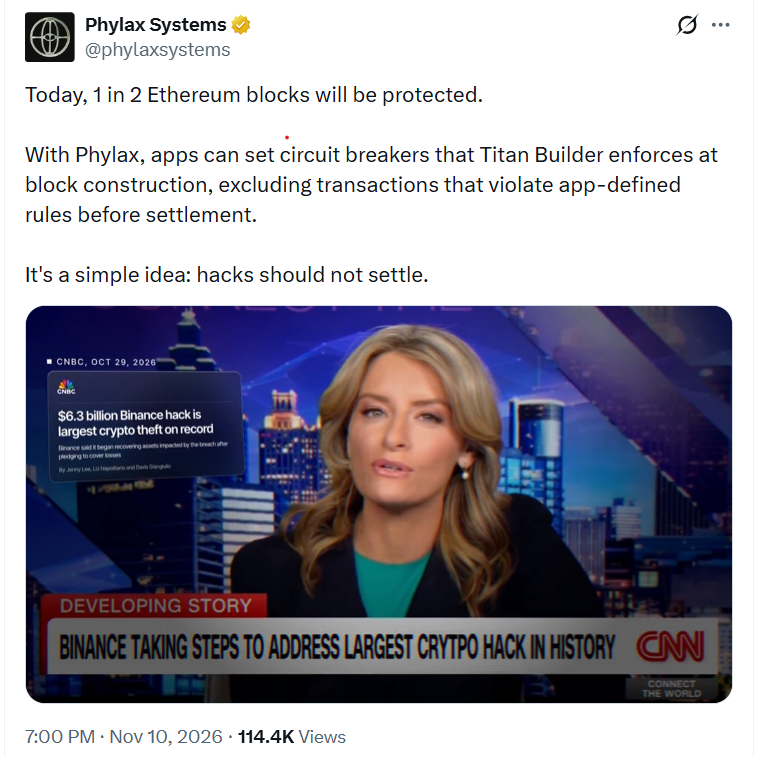
Announced on Nov. 10, the new system leverages a strategic integration with Titan Builder—a prominent block builder that Phylax states is responsible for producing one out of every two Ethereum blocks. Through this collaboration, Ethereum applications are empowered to define custom operational rules that flag and exclude transactions producing harmful outcomes directly at the block construction stage.
Instead of relying on reactive monitoring systems, delayed alerts, or emergency governance interventions after an exploit has already been initiated, the technology aims to intercept threats preemptively. "Our mission: stop users from losing money to hacks and errors in DeFi," the project’s official team announcement stated on social media.
A Security Mechanism With a Potential Freeze Risk
The practical application of this system is designed to safeguard protocols against catastrophic execution errors. In an explanatory blog post, Phylax outlined a hypothetical scenario involving a vulnerable lending vault that might mistakenly release $1 million to a user presenting shares worth only $1,000. Under the new architecture, an embedded circuit breaker could automatically cap the outflow of funds in a single transaction, effectively preventing the vault from being completely drained.
Proponents argue that similar safeguards could have limited the fallout from historical disasters, pointing to massive market incidents such as the $6.3 billion Binance hack and the $380 million Bitget exploit. In both of those high-profile cases, malicious actors successfully drained exchange wallets and attempted to launder large sums of capital through various decentralized protocols.
However, the introduction of automated, builder-enforced filtering has drawn immediate scrutiny from legal experts and developers alike. Digital assets lawyer Gabriel Shapiro warned in a public analysis that applications integrating the system could become effectively freezable if block builders stop providing the necessary cryptographic attestations.
Shapiro explained that smart contracts can theoretically be configured to automatically reject incoming transactions unless they are explicitly included in blocks processed by builders performing the mandated security checks. If those specific builders halt their attestations, protected protocol functions could continuously reject legitimate and illegitimate traffic alike until validation services resume.
Odysseas Lamtzidis, founder and chief executive of Phylax, countered that protocols can easily mitigate this operational risk by configuring their systems to default safely when security checks become unavailable. "The sane default we provide and suggest to protocols is a fail-open behavior," Lamtzidis explained.

Nonetheless, this safeguard remains entirely optional, leaving individual protocols to weigh the delicate balance between maximum security and continuous availability. Lamtzidis acknowledged that "some protocols might choose to prioritize safety over liveness," adding that projects also retain the autonomy to determine whether their smart contracts remain immutable or subject to future governance changes.
Shapiro maintains that fail-open protections ought to be mandatory by design, and any subsequent alterations to these security safeguards should be subjected to strict time delays to prevent protocols from hastily removing them under pressure.
Ethereum’s Builder Concentration Problem
Beyond immediate freeze risks, the deployment of Phylax’s technology has reignited longstanding anxieties regarding Ethereum’s heavily concentrated block-building market.
Fan Zhang, an Ethereum researcher, noted that while the tooling offers compelling benefits, its practical viability is entirely dependent on the existing market structure. "We finally have a way to implement this effectively, but sadly only because of how centralized Ethereum’s builder market has become," Zhang observed.
While praising the approach for its ability to counter AI-driven exploit bots that scan for smart contract vulnerabilities faster than ever, Zhang cautioned that layering additional code at such a critical juncture introduces novel failure modes. These risks include potential software implementation bugs as well as the theft, loss, or impersonation of builder signing keys.
"I think the community is very concerned about centralized builders and is making efforts to address them," Zhang added. "So I’m concerned that these efforts may undermine each other."
Echoing these apprehensions, Ethereum researcher Sen Yang warned that if major DeFi protocols begin relying heavily on a small cohort of specialized builders for security enforcement, it could grant those entities an unfair competitive advantage. This dynamic, Yang suggests, risks further exacerbating market concentration.
Yang noted that while Ethereum’s proposed enshrined proposer-builder separation (ePBS) upgrade—slated for inclusion in the upcoming Glamsterdam network upgrade—may reduce reliance on third-party relays, it does not directly solve the root issue of builder market concentration. Even so, Yang pointed out that transactions excluded by dominant builders could theoretically still be incorporated by non-censoring builders, resulting in temporary execution delays rather than permanent exclusion.
Where Does Security Become Censorship?
A central defense raised by Phylax is that its infrastructure does not establish a novel, centralized authority over Ethereum transactions, because the governing rules are defined entirely by the applications themselves. Lamtzidis emphasized that the technology is "explicitly opt-in," comparing the validation checks to conditional logic already common in blockchain development.
"It’s no different than a require() statement," Lamtzidis said, arguing that true censorship inherently implies arbitrary decision-making or external coercion.
Zhang drew a similar conceptual line between voluntary application-layer filtering and forced external censorship. "Applications willingly signing up for filtering is fine, as a user can walk away from such applications," he said. "It’s externally forced censorship that’s the problem. That’s where I’ll draw the line."
Stefanie Boss, co-author of recent academic research examining censorship resistance and compliance behavior within Ethereum’s consensus mechanism, noted that rules targeting specific transaction outcomes are generally viewed as less hazardous than rules targeting the identity of the transaction initiator. "In this case, it is also result-driven, which is often considered less risky," she explained.
Boss views the overarching security objective as legitimate, asserting that "the harm of those hacks is much higher than the harm of this type of exclusion." At the same time, she cautioned that the underlying mechanisms could theoretically be repurposed to enforce regulatory sanctions or politically motivated exclusions if proper governance boundaries are not maintained.
"It is important to ensure that there are proper safeguards in place to make sure that these rules will remain fair and designed for security," Boss concluded.