
On June 12, the Malta Financial Services Authority (MFSA) officially opened a public consultation on DeFi under the European Union’s landmark Markets in Crypto-Assets (MiCA) regulation. The newly released discussion paper invites industry stakeholders and the broader public to provide feedback through July 10. Within the paper, the regulator proposes a novel legal category for so-called "software-based organizations," which would encompass DAOs and other software-governed DeFi entities operating within the ecosystem.
Rather than treating DAOs as a standalone legal concept, the MFSA suggests recognizing them as a specific type of software-based organization. This approach aims to separate the legal framework governing the organization itself from the rules that govern the underlying protocol and software. By making this distinct separation, the Maltese regulator hopes to resolve ongoing legal ambiguities surrounding liability, governance, and institutional accountability in the decentralized workspace.
The discussion paper naturally builds upon Malta’s long-standing reputation as a pioneer in the digital asset industry. Back in 2018, the nation introduced one of the region’s very first comprehensive regulatory frameworks tailored specifically to the cryptocurrency sector, earning it the early moniker of "Blockchain Island." While the MFSA stresses that fully decentralized services generally fall outside the direct scope of MiCA, the regulator argues that many projects operating under the banner of DeFi actually retain centralized features. According to the authority, these hidden centralized elements complicate claims of true decentralization and raise pressing questions regarding regulatory accountability and consumer protection.

"MiCA excludes fully decentralised models from its regulatory scope, meaning that projects without intermediaries or central control may not need to comply with MiCA," the discussion paper notes, highlighting the regulatory grey area that currently exists between traditional financial rules and emerging blockchain architectures.
EU regulators increasingly turn attention to DeFi
Malta’s newly launched discussion paper arrives amid a broader, coordinated push across the European Union to clarify how decentralized finance and decentralized autonomous organizations should be treated under the overarching MiCA regime. As the digital asset landscape matures, European regulatory bodies are increasingly turning their analytical gaze toward the foundational pillars of the DeFi ecosystem.
Earlier in March, a European Central Bank working paper shed light on the structural realities of decentralization. The research found that governance and control across four major DeFi protocols remained highly concentrated among a small group of participants. This concentration of power suggested that many projects currently marketing themselves as decentralized might struggle to legally qualify as "fully decentralized," thereby potentially dragging them back into the scope of mandatory MiCA compliance.
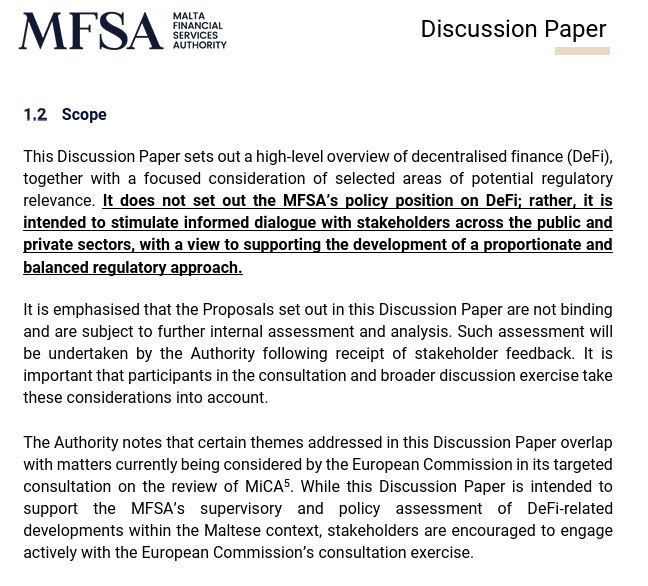
The policy debate intensified further in May, when the European Commission launched a targeted review of MiCA. This review sought crucial feedback from market participants on a variety of pressing issues, including the regulatory treatment of stablecoin interest payments, the precise handling of decentralized finance, and whether existing gaps in the legislative framework warrant additional, dedicated regulation.
However, a universal consensus on the necessity of a dedicated DeFi rulebook remains elusive among European policymakers and advisors. Speaking to Cointelegraph at the WAIB Summit Monaco earlier this month, European Commission adviser Peter Kerstens argued that policymakers should prioritize integrating tokenization into a broader, cohesive digital asset framework rather than immediately pursuing a second version of MiCA specifically focused on DeFi.
As the consultation period for Malta’s discussion paper progresses toward its July 10 deadline, the outcome is expected to contribute significantly to the ongoing European discourse. Whether through a bespoke national framework like the one proposed by the MFSA or through broader EU-wide legislative adjustments, the regulatory landscape for decentralized finance in Europe is approaching a critical juncture.