
A potential initial public offering (IPO) next year by cryptocurrency exchange Kraken may serve as a powerful catalyst to attract fresh capital from traditional finance (TradFi) investors, even as the broader digital asset market navigates a complex environment of high volatility, shifting macroeconomic indicators, and divided expert opinions regarding the trajectory of the ongoing bull cycle.
The conversation surrounding market direction comes at a delicate time for digital assets. Bitcoin recently achieved a historic milestone, recording an all-time high price above $126,000 on Oct. 6. However, the premier cryptocurrency has struggled to recover its upward momentum following a massive $19 billion liquidation event that rippled through the industry just days after its record-breaking surge. At the time of writing, the world’s largest cryptocurrency was trading at $87,015 per coin, reflecting a 6% decline over a two-week period, according to data from CoinGecko.
Despite the sharp correction and lingering short-term uncertainty, prominent voices in the investment community remain optimistic about the broader market cycle. Dan Tapiero, founder and CEO of 50T Funds, asserted that the current Bitcoin bull market is "still mid-stage." According to Tapiero, impending corporate milestones such as Kraken’s anticipated public offering, alongside an increasing number of mergers and acquisitions (M&As) within the sector, may provide the necessary structural tailwinds to bridge the gap between legacy financial institutions and the cryptocurrency ecosystem, thereby unlocking substantial new capital from TradFi allocators.

The speculation surrounding Kraken’s market debut follows significant corporate developments for the exchange. Kraken officially announced on Nov. 18 that it had successfully raised $800 million in a funding round, propelling its private valuation to an impressive $20 billion. Industry reports indicate that the prominent digital asset exchange confidentially filed for a United States initial public offering earlier in November, setting the stage for what could become one of the most closely watched public listings in the financial technology sector next year.
Crypto Industry Watchers Are Divided Over the Bull Cycle’s Continuation in 2026
While leaders like Tapiero view upcoming corporate developments as harbingers of continued expansion, not all market observers and institutional analysts are convinced that the broader bull cycle will maintain its upward trajectory through the coming years.
Contrasting sharply with Tapiero’s mid-cycle thesis, Jurrien Timmer, director of global macroeconomic research at Fidelity, has articulated a more cautious outlook. Timmer expects a challenging period ahead, predicting a year of downside price action for Bitcoin throughout 2026. This projection suggests that the market may experience a cooling-off period following years of aggressive expansion.

Timmer’s perspective points toward a cyclical pause reminiscent of historical market behavior. Elaborating on his analysis, Timmer noted that previous market contractions typically require extended consolidation phases. "Bitcoin winters have lasted about a year, so my sense is that 2026 could be a ‘year off’ (or ‘off year’) for Bitcoin. Support is at $65-75k," Timmer wrote in a post on X on Thursday.
Other market participants emphasize that the dynamics governing cryptocurrency valuations are evolving beyond simple historical patterns. Jimmy Xue, co-founder and chief operating officer of Axis—an onchain quantitative yield platform managing $100 million in live capital—suggests that while traditional four-year halving cycles provided the "initial rhythm" for early market adoption, current price movements are increasingly dictated by fundamental macroeconomic drivers. These core drivers include broader global liquidity trends and ongoing sovereign adoption of digital assets.
Addressing the cautious sentiment prevailing at the close of 2025, Xue noted that institutional hesitancy is entirely understandable given recent market swings. He described Fidelity’s call for a potential pullback as a "valid reminder that volatility is still on the table," while simultaneously cautioning against an overly narrow view of future market performance.
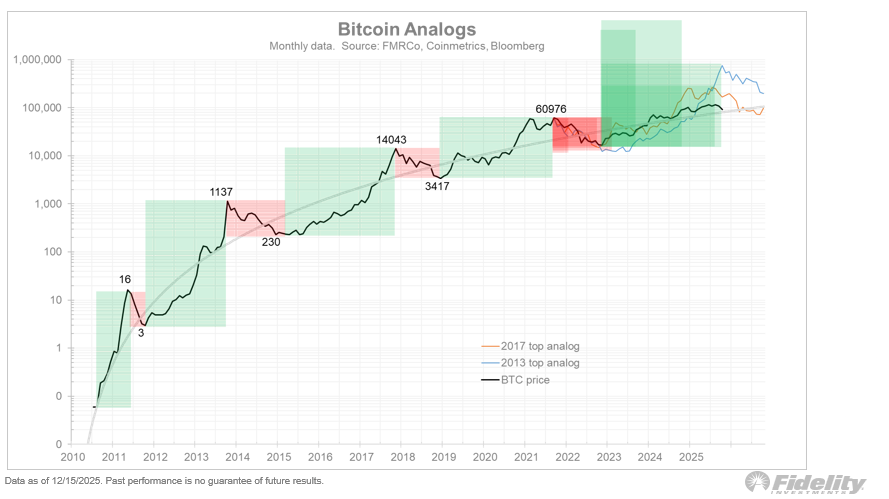
"However, framing 2026 purely as a year of downside might be missing the forest for the trees," Xue told Cointelegraph. He explained that if global macroeconomic conditions see a continuation of loose monetary policy and expanding global liquidity, established price support zones around the $75,000 level could ultimately materialize as higher lows within a much longer, multi-year secular super-cycle structure. From this perspective, the traditional four-year halving cycle is gradually transforming into a broader macroeconomic trend shaped by institutional and sovereign participation.
Short-term positioning data from sophisticated market participants indicates that caution remains prevalent among active traders. Market intelligence platforms tracking institutional and high-performing accounts reveal distinct defensive postures heading into the final stretches of the year.
According to data compiled by blockchain intelligence platform Nansen, the industry’s most successful traders—often tracked as "smart money" accounts based on historical returns and perpetual futures positioning on platforms like Hyperliquid—have increasingly tilted toward short-term downside exposure. Nansen’s metrics show that smart money accounts held net short positions across the majority of top-tier cryptocurrencies, with notable exceptions found primarily in select altcoins such as the Avalanche token and the native coin of memecoin launchpad Pump.fun.